Quilt vs Duvet Insert for Warmth: Which Sleeps Warmer?
August 13, 2026 · 13 min read
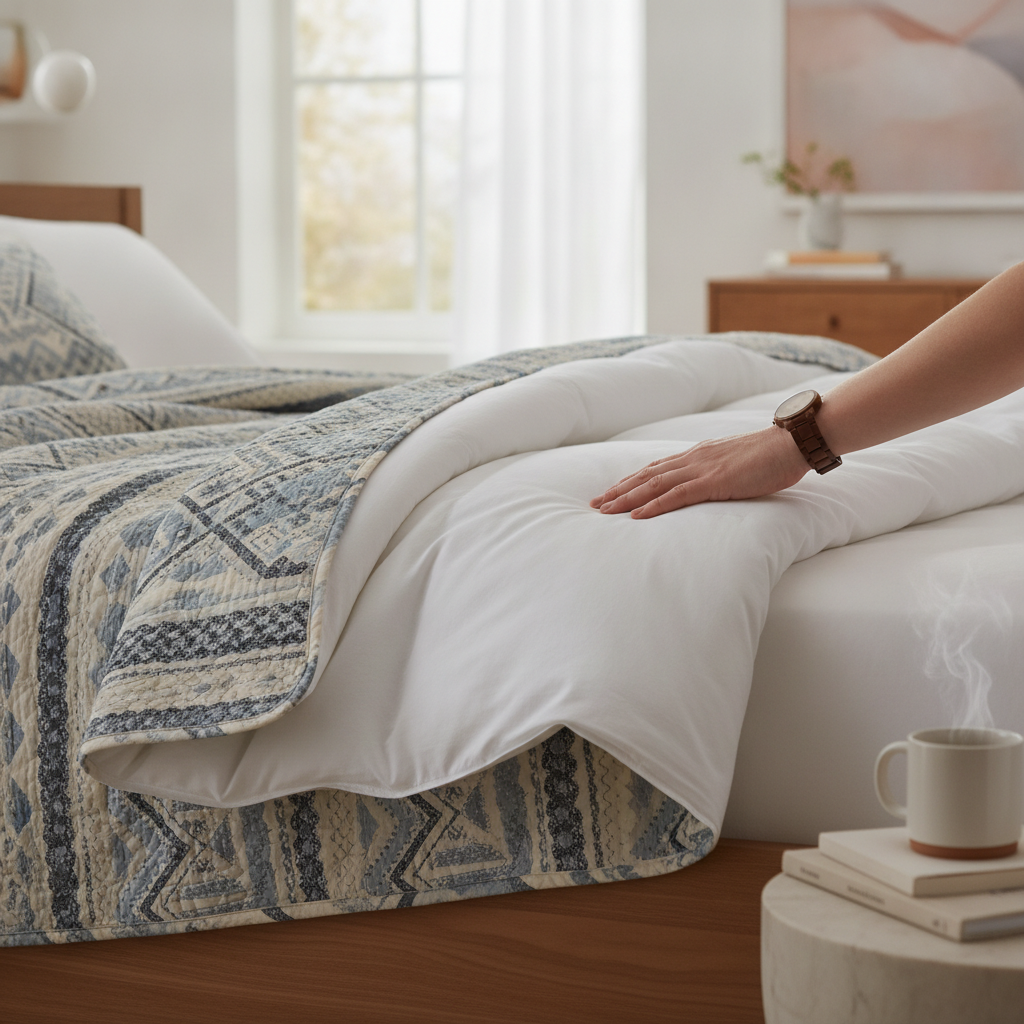
If you've ever stood in the linen aisle trying to decide between a quilted coverlet and a plush duvet insert, you're not alone. The Quilt vs duvet insert for warmth debate is one of the most common questions discerning homeowners ask when they're tired of waking up too cold, too hot, or tangled in bedding that shifts and bunches overnight. At Sierra Dreams, we hear this question constantly from customers who want a bed that actually performs, not just looks good in photos.
The short answer: a duvet insert is almost always warmer than a quilt, because it relies on loft and fill volume to trap insulating air, while a quilt's flat, stitched construction produces light-to-moderate warmth at best. But the full answer is more nuanced, and understanding the mechanics behind the Quilt vs duvet insert for warmth comparison will help you build a bed system that actually matches your climate, your body temperature, and your seasonal needs.
TL;DR, The Bottom Line
In the Quilt vs duvet insert for warmth comparison, duvet inserts win for pure heat retention because their higher loft and thicker fill trap more insulating air. Quilts are thinner, more breathable, and better suited to mild climates, hot sleepers, or layering. Warmth ultimately depends less on the label ('quilt' or 'duvet') and more on the fill type, fill weight, and loft of the insert itself, which is why a well-chosen duvet insert inside a quality cover typically outperforms a quilt for cold-weather sleep.
Quick Facts
- Warmer option: Duvet inserts generally provide more warmth than quilts due to higher loft.
- Tog range: UK bedding guidance rates duvets from about 4.5 tog (summer) to 13.5+ tog (winter).
- Ideal room temp for medium-heavy inserts: Roughly 16–18°C (61–64°F) in colder climates.
- Quilt best use case: Mild weather, hot sleepers, or as a layering piece over a lighter duvet insert.
- Key warmth driver: Fill type, fill weight, and loft, not the outer cover fabric.
Quilt vs Duvet Insert for Warmth: The Core Difference
To settle the Quilt vs duvet insert for warmth question, you first need to understand how each product is built. A quilt is a flat, three-layer textile: a top fabric, a thin batting layer, and a backing fabric, all stitched together in a pattern that holds the layers in place. Because the batting is compressed by the stitching, quilts have limited loft, the fluffy, airy thickness that traps body heat.
A duvet insert, by contrast, is a puffy pillow-like pouch filled loosely with down, down-alternative fiber, or wool, then sewn into baffled chambers that let the fill expand upward. That expansion is called loft, and loft is the single biggest predictor of warmth in bedding. The more air a material can trap around your body, the more insulation it provides, which is exactly why duvet inserts consistently outperform quilts in warmth comparisons.
So when people ask about quilt vs duvet insert for warmth, the real answer lives inside the construction: quilts compress their fill for a flat, tailored look, while duvet inserts let fill loft up freely for maximum insulation.
What Is a Quilt, and How Warm Is It Really?
Quilts are prized for their breathability, lightweight feel, and decorative stitched patterns. Traditionally, quilts were made from cotton batting sandwiched between two layers of fabric, though modern versions may use polyester or blended fills. Because the stitching pattern compresses the batting at regular intervals, a quilt cannot achieve the same loft as a duvet insert, which caps its maximum warmth potential.
In practical terms, a quilt performs best in the following scenarios:
- Warm or humid climates where excess insulation causes overheating
- Hot sleepers who wake up sweaty under heavier bedding
- Spring and summer months, or as a lightweight top layer
- Layering over a lighter duvet insert for adjustable, seasonal warmth
When homeowners specifically ask about quilt vs duvet insert for warmth in the context of a cold bedroom, a quilt alone is rarely the recommended solution unless it's paired with additional layers, because its warmth ceiling is inherently lower than that of a duvet insert.
Yes. Many discerning homeowners use a lighter-weight quilt as a top layer over a duvet insert in winter, adding a modest warmth boost and a decorative finish without needing to buy a heavier insert.
What Is a Duvet Insert, and Why Is It Warmer?
A duvet insert is designed specifically to maximize warmth through loft. Depending on the fill material, down, down-alternative microfiber, or wool, a duvet insert can range from lightweight summer-weight options to heavy winter-weight inserts rated well above 13.5 tog. Because the fill is not stitched flat but instead allowed to expand within baffled boxes, it creates thick pockets of trapped air that insulate far more effectively than a quilt's compressed batting.
This is the crux of the quilt vs duvet insert for warmth discussion: warmth is a function of trapped air volume, and duvet inserts are engineered to maximize that volume. A well-made duvet insert used inside a properly fitted cover, like those offered at Sierra Dreams, gives homeowners the flexibility to swap inserts seasonally without replacing the entire bedding system.
Quilt vs Duvet Insert for Warmth: Side-by-Side Comparison
Sometimes the clearest way to resolve quilt vs duvet insert for warmth questions is a direct comparison. Here's how the two stack up across the factors that matter most to homeowners:
| Factor | Quilt | Duvet Insert |
|---|---|---|
| Typical warmth level | Light to medium | Medium to very warm |
| Loft | Low (compressed by stitching) | High (baffled, expandable fill) |
| Best season | Spring, summer, mild climates | Fall, winter, cold climates |
| Breathability | High | Moderate to high, depending on fill |
| Customization | Fixed warmth level | Adjustable via fill weight and tog rating |
| Care/washability | Often machine washable as a whole piece | Insert usually needs occasional care; cover is easily washable |
| Ideal use case | Standalone summer bedding or decorative top layer | Primary insulating layer, especially in a duvet system |
As the table shows, the quilt vs duvet insert for warmth comparison isn't close when it comes to raw insulation, duvet inserts dominate. But quilts hold their own in breathability, ease of care, and mild-weather comfort.
Fill Type, Loft, and Tog Rating: The Real Warmth Drivers
Rather than asking simply "quilt or duvet insert," the more useful question is: what fill and loft am I actually getting? Warmth in bedding is measured most precisely by tog rating, a UK-standard metric that quantifies thermal insulation. Bedding guides commonly place summer-weight duvets around 4.5 tog, spring/autumn options around 7.5–10.5 tog, and winter-weight duvets at 13.5 tog or higher.
Quilts are rarely given formal tog ratings because their compressed construction keeps them in a narrower, lower warmth band. Duvet inserts, on the other hand, span the entire tog spectrum, which is why they offer far more flexibility when homeowners are trying to dial in exact warmth levels for their bedroom.
Three variables determine where a duvet insert falls in the quilt vs duvet insert for warmth equation:
- Fill material, Down offers the best warmth-to-weight ratio; down-alternative fibers are hypoallergenic but often need more fill weight to match down's warmth; wool regulates temperature and wicks moisture.
- Fill weight (or fill power), Higher fill power means more loft per ounce, translating to more trapped air and more warmth.
- Loft, The visible puffiness of the insert; taller baffles allow for more loft and, consequently, more insulation.
For homeowners in colder regions, bedding guides note that a medium-to-heavy duvet insert is often sufficient for bedrooms sitting around 16–18°C (61–64°F). Below that range, a heavier insert or added layering is usually necessary.
Generally yes. Tog rating is a direct measure of thermal resistance, so a 13.5 tog duvet insert will trap significantly more heat than a 4.5 tog insert, regardless of fill type. However, fill material still affects how that warmth feels, down tends to feel warmer at a lower tog than synthetic fill at the same rating.
Which Sleepers Should Choose a Quilt vs Duvet Insert for Warmth?
Not every household has the same warmth needs, which is why the quilt vs duvet insert for warmth decision should be personalized rather than one-size-fits-all. Here's a practical breakdown:
- Choose a quilt if: You run hot at night, live in a warm climate, want a lightweight decorative layer, or prefer to layer bedding rather than rely on one heavy piece.
- Choose a duvet insert if: You get cold easily, live in a region with cold winters, want adjustable warmth via swappable inserts, or want a plush, hotel-style look with maximum coziness.
- Choose both if: You want year-round flexibility, a lightweight duvet insert for summer, a heavier one for winter, and an optional quilt as a decorative or supplemental layer.
This is where modular bedding systems shine. Rather than buying entirely new bedding each season, homeowners can keep one high-quality duvet cover and simply swap the insert inside it, a strategy that directly addresses common frustrations like bedding that shifts, bunches, or fails to match the season.
How to Choose the Right Duvet Insert or Quilt for Your Climate
If you've decided a duvet insert is the better fit for your warmth needs, here's a step-by-step approach to choosing the right one:
- Assess your bedroom's typical temperature. Rooms consistently below 18°C often need a medium-to-heavy insert (10.5–13.5+ tog).
- Identify your personal temperature preference. Hot sleepers should size down in tog rating even in cold climates; cold sleepers should size up.
- Choose your fill material. Down for warmth-to-weight efficiency, down-alternative for hypoallergenic needs, wool for temperature regulation.
- Match the insert to a well-fitted cover. A properly sized cover with interior ties or corner loops prevents the common problem of the insert shifting or bunching inside the cover.
- Consider a seasonal swap system. Keep a lighter and a heavier insert on hand, and rotate them with the seasons using the same cover.
For homeowners who want to skip the guesswork, exploring a curated duvet insert collection, such as the options available at Sierra Dreams, can simplify the process of matching fill, loft, and cover size to your exact climate and comfort needs.
Common Myths in the Quilt vs Duvet Insert for Warmth Debate
Misunderstandings about bedding warmth are common, and they often lead homeowners to buy the wrong product. Let's clear up one more persistent myth.
Understanding this distinction is essential for anyone comparing quilt vs duvet insert for warmth based on appearance alone. Visual bulk is not a reliable indicator of thermal performance; only fill type, fill weight, and true loft can tell you how warm a piece of bedding will actually be.
Quilt vs Duvet Insert for Warmth: Care and Longevity Considerations
Warmth isn't the only factor in this decision, durability and ease of care matter too, especially for homeowners investing in premium bedding. Quilts, being a single stitched unit, are often easier to machine wash as a whole and dry relatively quickly due to their thinner profile. Duvet inserts, particularly down-filled ones, may require more careful laundering or occasional professional cleaning, though many modern down-alternative inserts are fully machine washable.
One advantage of the duvet system in the quilt vs duvet insert for warmth comparison is hygiene management: because the cover is removable and washable independently of the insert, homeowners can keep their bedding fresh without frequently laundering the bulkier, warmth-generating component. This modularity also extends the lifespan of the insert itself, since it's exposed to less frequent washing and handling.
Not significantly. While down inserts may need occasional professional cleaning, the removable cover system means the insert itself requires washing far less often than a quilt, which is typically laundered as a single unit each time.
Making the Final Call: Quilt, Duvet Insert, or Both?
After weighing construction, fill, tog rating, climate, and personal temperature preference, most homeowners find that the quilt vs duvet insert for warmth decision comes down to this: if warmth is the priority, a duvet insert is the superior choice, especially in cold climates or for cold sleepers. If breathability, decoration, and lightweight comfort are priorities, a quilt, either alone or layered over a lighter duvet insert, is the better fit.
For many discerning homeowners, the ideal long-term solution is a modular system: a well-fitted duvet cover paired with interchangeable duvet inserts for different seasons, supplemented by a quilt for milder months or decorative layering. This approach solves the most common bedding frustrations, shifting, bunching, and inconsistent warmth, while giving you full control over comfort year-round.
Frequently Asked Questions
Is a duvet insert always warmer than a quilt?
In most cases, yes. Duvet inserts have higher loft and more fill volume than quilts, which allows them to trap more insulating air. However, a lightweight summer-weight duvet insert could be cooler than a heavily filled quilt, so fill weight and tog rating matter more than the category label alone.
What is the difference between a quilt and a duvet insert?
A quilt is a flat, stitched three-layer textile with compressed batting, while a duvet insert is a puffier, loosely filled pouch designed to loft up inside a removable cover. This structural difference is the main reason duvet inserts generally win the quilt vs duvet insert for warmth comparison.
Can I use a quilt and duvet insert together for extra warmth?
Yes, layering a quilt over a duvet insert is a common strategy for adding warmth without switching to a heavier insert. It also adds a decorative top layer, which many homeowners appreciate for style as well as function.
What tog rating should I choose for a warm winter duvet insert?
Bedding guides typically recommend 13.5 tog or higher for winter conditions, especially in bedrooms that consistently sit below 16–18°C. Cold sleepers may want to size up even further, while hot sleepers can often stay comfortable with a slightly lower tog rating.
Do duvet inserts require a special cover, or can any quilt cover work?
Duvet inserts require a duvet cover with interior corner ties or loops to keep the insert secured and prevent shifting or bunching. A standard quilt does not use a separate cover, since the layers are stitched together as one piece.
Ultimately, the quilt vs duvet insert for warmth question isn't about which product is universally better, it's about matching the right construction, fill, and loft to your climate and sleep preferences. Sierra Dreams designs its duvet inserts and covers specifically to solve the everyday frustrations of shifting, bunching, and inconsistent warmth, so you can build a bedding system that performs as beautifully as it looks. Explore the collection at Sierra Dreams to find the insert-and-cover combination that finally gets your bedroom temperature right, season after season.