How to Keep Duvet From Clumping: 2026 Expert Guide
July 18, 2026 · 13 min read
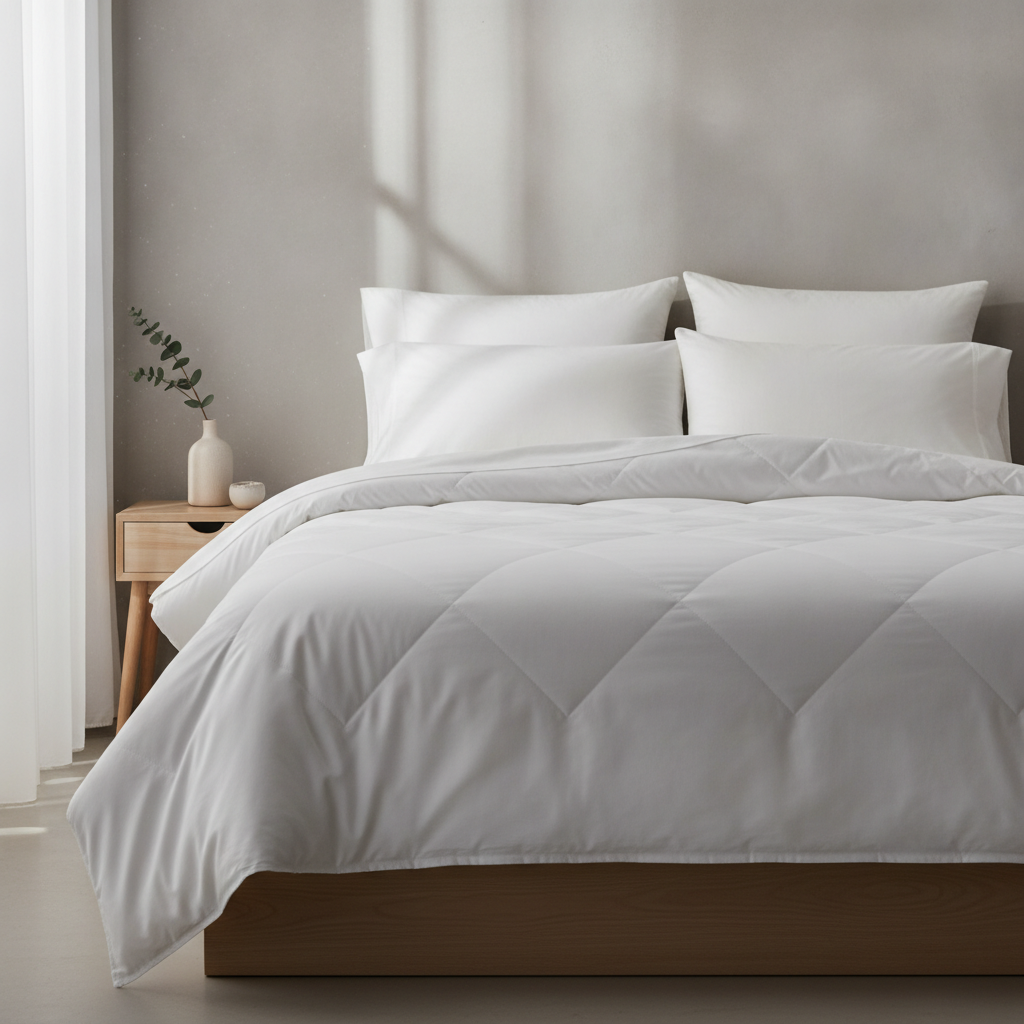
If you've ever pulled your duvet out of the wash only to find a lumpy, uneven mess, or spent five minutes shaking your comforter every morning trying to redistribute the fill, you already know the frustration. Learning how to keep duvet from clumping is one of the most searched bedding-care questions of 2026, and the answer isn't just "fluff harder." It's a combination of smart construction, correct laundering, and proper fit between insert and cover. At Sierra Dreams, we've built our bedding philosophy around solving exactly this problem, and this guide distills what actually works.
TL;DR, The Bottom Line
To keep a duvet from clumping, dry it completely on low heat with dryer balls and fluff every 20–30 minutes, use minimal mild detergent with an extra rinse, and pair a properly sized cover with corner ties or loops to anchor the insert. Choose duvets with baffle-box construction to prevent internal fill migration. Clumping is almost always a fixable combination of care, construction, and fit.
Quick Facts
- Fluffing interval during drying: Every 20–30 minutes
- Recommended full dryer cycles per year: 1–2 max
- Ideal wash temperature (down): ~30°C on gentle cycle
- Ideal wash temperature (synthetic): Up to 40°C
- Best construction for anti-clump: Baffle-box with corner loops
- Detergent rule: Use half the recommended amount, add extra rinse
Why Duvets Clump in the First Place
Before you can master how to keep duvet from clumping, it helps to understand the two root causes. First, the fill shifts during washing and drying, wet down or synthetic fibers become heavy, mat together, and settle into pockets if not agitated properly. Second, the insert moves independently inside the cover, twisting overnight and creating cold spots and lumps at the foot of the bed.
Neither problem is caused by "bad" fill. Even premium Hungarian goose down and high-fill-power synthetics will clump if they're dried at the wrong temperature or housed in an oversized cover. According to bedding-care research compiled across multiple industry sources in 2026, incomplete drying is the single largest contributor to permanent clump formation, wet clusters harden and lose loft, sometimes permanently.
The good news: nearly every clumping issue is preventable with a system-level approach. That means treating your duvet, your cover, your laundry routine, and your daily fluffing habit as one connected process, not four separate steps.
How to Keep Duvet From Clumping During Washing and Drying
The laundry room is where most damage happens. If you want to know how to keep duvet from clumping long-term, start here, because a single bad dry cycle can undo years of careful use.
Step 1: Wash Less Often, and Correctly
Duvets don't need frequent washing if you use a duvet cover. Aim to wash the insert only once or twice a year. When you do, use a front-loading machine with capacity to spare, overstuffing prevents water and detergent from circulating and guarantees clumps.
- Use a mild, low-sudsing detergent (ideally a down-specific wash for natural fills).
- Use half the recommended amount. Detergent residue is a leading cause of clumping.
- Run an extra rinse cycle to flush any lingering soap.
- Wash at ~30°C for down, up to 40°C for synthetics, on a gentle cycle.
Step 2: Dry Thoroughly on Low Heat
This is the single most important step. Damp fill mats and hardens; fully dry fill fluffs back to loft. Set your dryer to low heat and plan for a long cycle, often 2 to 4 hours for a queen or king duvet.
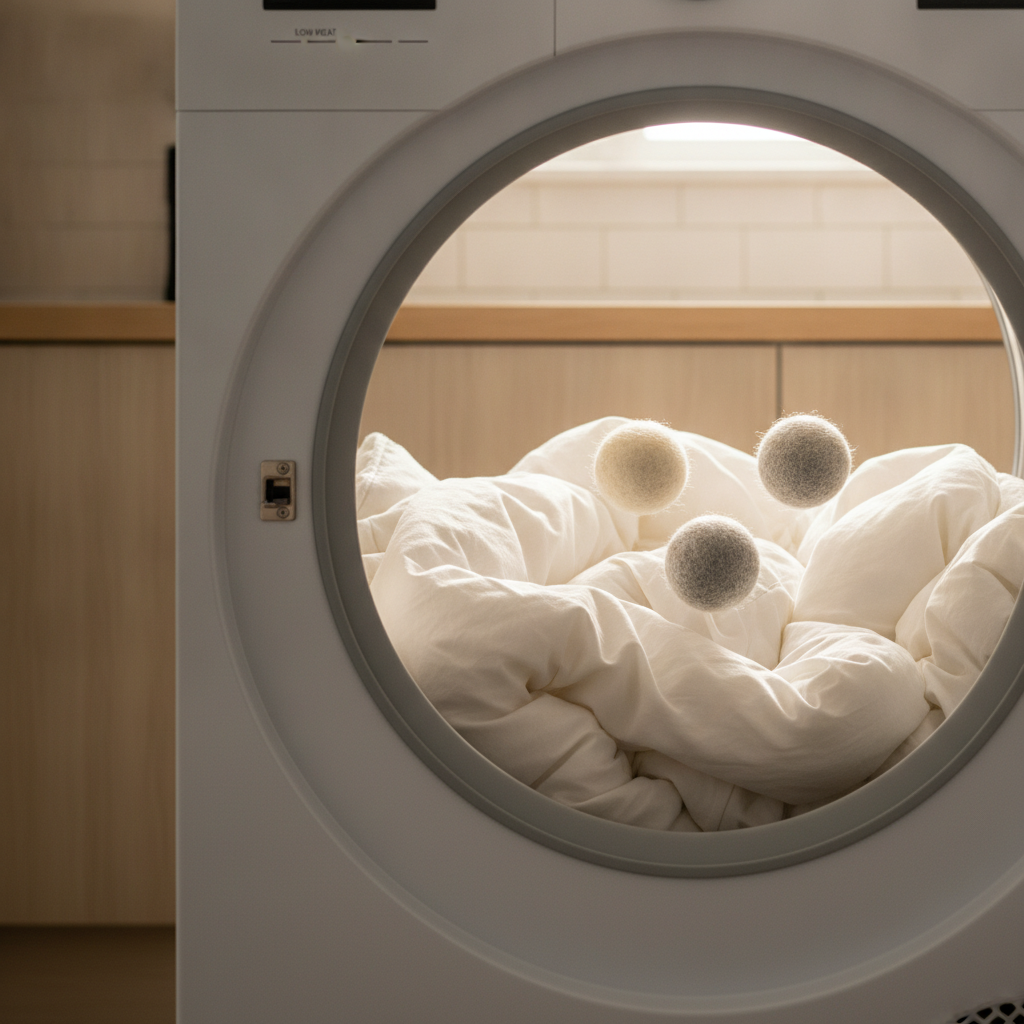
- Add 3–6 wool dryer balls or clean tennis balls to agitate the fill.
- Stop the dryer every 20–30 minutes to break up wet clusters by hand.
- Continue until the duvet is completely dry, no cool or heavy spots.
- Air the duvet flat for a few hours afterward to release residual moisture.
You can, but only in warm, low-humidity conditions with active airflow. Line-drying alone rarely gets the interior fully dry, which is exactly what causes permanent clumping. If you air-dry, finish with 30–60 minutes in a low-heat dryer with dryer balls to fluff and confirm dryness.
The Role of Construction: Why Baffle-Box Duvets Win
You can do everything right in the laundry room and still end up with a lumpy duvet if the construction is wrong. This is where product design matters enormously, and it's the reason Sierra Dreams engineers every duvet with anti-migration architecture.
Sewn-Through vs. Baffle-Box
Sewn-through construction stitches the top and bottom fabric directly together, creating flat channels. It's cheaper to produce but allows fill to shift along the seam lines and compresses loft at the stitch points, guaranteeing cold spots.
Baffle-box construction uses internal fabric walls to create three-dimensional cubes. Each cube contains a controlled amount of fill that can loft fully without migrating into neighboring compartments. It's the industry standard for premium duvets and the single most reliable structural defense against clumping.
Compartment Size and Fill Density
Smaller baffle cubes hold fill more precisely; larger cubes allow more loft. The best 2026 designs balance the two, using tighter compartments at the edges (where movement is greatest) and slightly larger ones in the center for warmth. Look for at least 30 baffle boxes on a queen-size duvet.
How to Keep Duvet From Clumping Inside the Cover
Even a perfectly built duvet will bunch overnight if it slides freely inside an oversized or poorly designed cover. This is the second half of the clumping equation, and one of the easiest to fix.
Match the Sizes Exactly
A queen insert belongs in a queen cover, not a king. Oversized covers create empty space that the duvet migrates into, twisting and bunching as you move at night. Check both dimensions (length and width) against the manufacturer's spec, and account for any shrinkage after the first wash.
Use Corner Ties, Loops, and Snaps
Nearly every clump complaint from cover-shift can be solved by anchor points. A quality duvet insert should have reinforced loops at all four corners (and ideally at the mid-points of the long sides). A quality cover should have matching interior ties or snap points.
- Turn the cover inside out.
- Tie each corner of the insert to the corresponding cover corner using a secure double knot.
- Flip the cover right-side out over the anchored insert.
- Shake vigorously to distribute fill evenly.

Choose a Cover With Grip Fabric
Some premium 2026 covers now include silicone grip strips or brushed inner surfaces that add friction against the insert. Combined with corner ties, these effectively eliminate internal movement.
Sew loops yourself using a 3-inch length of cotton twill tape at each corner, or use safety pins as a temporary fix. Better still, invest in a duvet insert designed with integrated corner loops. It's a small detail that transforms nightly performance.
Daily Habits That Prevent Long-Term Clumping
Beyond laundry and construction, the everyday routine matters. Small habits compound over months into either a lofty, even duvet or a permanently matted one.
Shake and Fluff Every Morning
When you make the bed, grasp two corners of the duvet and snap it in the air a few times. This redistributes fill, restores loft, and prevents compression at the areas where you sleep most. Thirty seconds a day is all it takes.
Air the Duvet Weekly
Once a week, pull the duvet back and let it breathe for a few hours, ideally with a window open. Moisture from sleep (the average adult loses about half a liter of water vapor per night) accumulates inside the fill and contributes to matting over time.
Rotate the Duvet Regularly
Every month or so, rotate the duvet 180 degrees so the foot becomes the head. This distributes wear evenly across all baffle compartments and prevents one end from compressing faster than the other.
Store It Properly in the Off-Season
If you swap duvets seasonally, never store in a compressed vacuum bag long-term. Use a breathable cotton storage bag and keep the duvet loosely folded. Compression collapses fiber structure and creates permanent clumps that no amount of drying can restore.
Down vs. Synthetic: Does Fill Type Change the Anti-Clump Strategy?
Both down and synthetic fills can clump, but the mechanisms differ slightly. Understanding this helps you tailor your care routine.
| Factor | Down Fill | Synthetic Fill |
|---|---|---|
| Clumping cause | Wet clusters mat together | Fibers tangle and compress |
| Wash temperature | ~30°C, gentle | Up to 40°C, gentle |
| Detergent | Down-specific, low-sudsing | Mild liquid, half dose |
| Drying time | 2–4 hours, low heat | 1.5–3 hours, low heat |
| Recovery from clumping | Excellent with proper drying | Moderate; severe matting may be permanent |
| Ideal construction | Baffle-box | Baffle-box or ultrasonic-welded pockets |
The takeaway: fill type matters less than fiber length, fill power, compartment design, and drying protocol. A well-built synthetic duvet will outperform a poorly built down one every time.


The Sierra Dreams Anti-Clump System
Everything above is why we built the Sierra Dreams duvet line the way we did. Our approach to how to keep duvet from clumping is engineered, not accidental:
- Baffle-box construction with 32+ compartments on queen size to control fill migration.
- Reinforced corner loops at all four corners plus mid-side attachment points.
- Matched cover system, covers designed to exact insert dimensions with interior ties at every anchor point.
- Care-tested fabrics that tolerate the low-heat drying and gentle wash cycles required to preserve loft.
- Detailed care guidance included with every purchase, because performance depends on maintenance as much as materials.
Explore the full range at Sierra Dreams to see how construction, fit, and care come together in a single system.
"Clumping is almost never a fill problem, it's a system problem, and it's solvable."
Troubleshooting: What to Do If Your Duvet Is Already Clumped
If you've inherited a clumped duvet, don't throw it out yet. Many can be rescued with a focused restoration routine.
- Assess the damage. Feel each baffle compartment. If fill still moves freely inside, restoration is possible. If it's hardened and immobile, the fibers may be permanently matted.
- Rewash carefully. Use minimal down-specific detergent, an extra rinse, and warm (not hot) water on gentle.
- Dry aggressively with dryer balls. Use 6+ wool dryer balls and stop every 20 minutes to manually break up clumps.
- Extend drying time. Restoration cycles often take 4–6 hours. Do not stop until the duvet feels uniformly light and dry throughout.
- Fluff daily for a week. Snap and shake the duvet each morning to help fibers re-loft.
If the duvet still feels dense after this process, it's likely at the end of its life. A typical quality duvet lasts 10–15 years with proper care; heavily clumped ones past that mark are worth replacing.
Frequently Asked Questions
How often should I wash my duvet to prevent clumping?
Wash the insert only once or twice a year, and always inside a duvet cover to protect it between washes. Over-washing accelerates fiber breakdown and increases clump risk. Wash the cover every 1–2 weeks instead.
What's the best way to fluff a duvet daily?
Grab two adjacent corners, lift the duvet, and snap it downward two or three times to force air through the fill. Then rotate 90 degrees and repeat. This takes 30 seconds and dramatically extends duvet life.
Do dryer balls really help keep a duvet from clumping?
Yes. Wool dryer balls (or clean tennis balls) bounce through the duvet during drying, breaking up wet fill clusters and shortening drying time by up to 25%. Use at least 3–6 for a queen or king duvet.
Why does my duvet clump only at the foot of the bed?
This is a classic sign of insert-in-cover migration. Your cover is either oversized or lacks corner ties, so nightly movement pushes the insert downward and bunches fill at the foot. Add corner ties or upgrade to a matched cover system to fix it.
Can a clumped duvet be fixed, or do I need a new one?
Most clumped duvets can be restored with a careful rewash, extended low-heat drying with plenty of dryer balls, and daily fluffing for a week. If the fill is hardened and immobile after that, replacement is usually the better investment.
Conclusion: A System, Not a Trick
Knowing how to keep duvet from clumping comes down to three coordinated pillars: construction (baffle-box design with corner loops), care (low-heat drying, minimal detergent, thorough fluffing), and fit (matched cover with anchor ties). Get all three right and clumping essentially disappears from your bedding vocabulary. Get one wrong and no amount of shaking will fully save you.
At Sierra Dreams, we design bedding that removes the guesswork, so you can spend less time fluffing and more time sleeping. Ready to upgrade to a duvet system built to stay lofty and even, night after night? Visit Sierra Dreams to explore our 2026 collection and find the anti-clump duvet that matches your sleep style.