Architectural Steam Room Specifications: Full Guide
May 17, 2026 · 16 min read
TL;DR — The Bottom Line
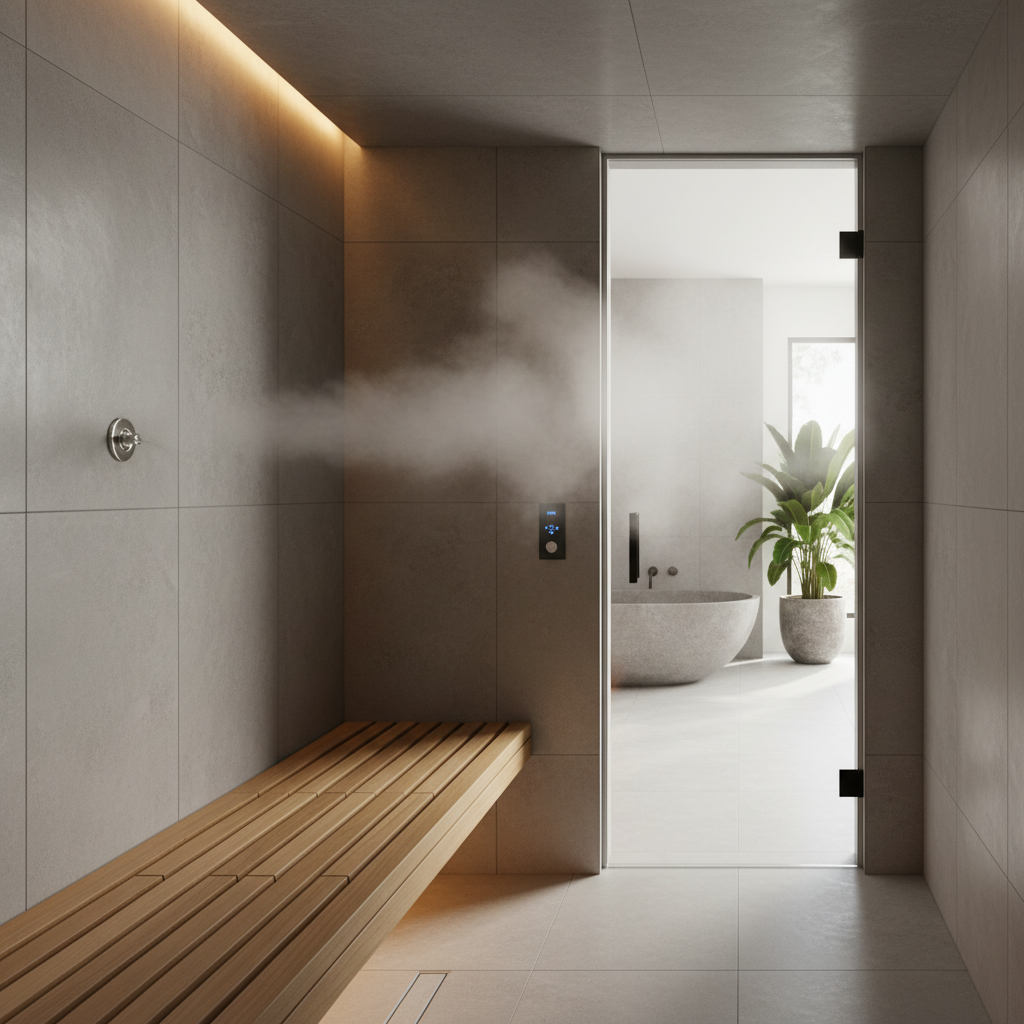
Getting architectural steam room specifications right from the start saves thousands in remediation costs and ensures long-term performance. The critical variables are room size (0.55–0.75 m² per person), ceiling height (213–244 cm), continuous vapour-proof waterproofing, and correctly sized steam generators. Whether you're designing a residential retreat or a commercial wellness facility, this guide covers every specification you need to build a steam room that performs beautifully for decades.
Whether you're an architect drawing up plans for a boutique hotel in Queenstown, a homeowner in Sydney wanting a private wellness sanctuary, or a commercial designer fitting out a resort spa in Bali, understanding architectural steam room specifications is non-negotiable. Get them right and you'll have an energy-efficient, luxurious space that holds its value and performs flawlessly. Get them wrong and you're looking at expensive remediation: failed waterproofing, mould growth, stratified steam, uncomfortable temperatures, and structural damage. This comprehensive guide walks through every dimension of architectural steam room specifications — from floor area and ceiling geometry through to material selection, vapour management, generator sizing, and commercial-grade fitout standards.
Quick Facts
- Floor area per person: 0.55–0.75 m² (6–8 sq ft) per seated user
- Recommended ceiling height: 213–244 cm (84–96 in)
- Minimum residential footprint: Approximately 1.0 x 1.2 m internal
- Ceiling slope for condensation control: 2.5–5 cm per 30 cm run
- Typical 2-person steam room size: 1.2 x 1.8 m (4' x 6')
- Typical 4–5 person steam room size: 1.8 x 2.4 m (6' x 8')
Why Architectural Steam Room Specifications Matter
A steam room is not simply a tiled shower with a generator bolted on. It is a high-humidity, high-temperature enclosure that must be engineered to manage condensation, vapour pressure, thermal loads, and occupant comfort simultaneously. Poorly specified steam rooms are among the most common causes of bathroom and wellness area remediation in residential and commercial projects across Australia and New Zealand.
Unlike a standard wet room, a steam room operates at near-100% relative humidity and temperatures typically between 40°C and 50°C. This environment places extraordinary demands on substrates, adhesives, grouts, membranes, and finishes. Architectural steam room specifications exist precisely to codify the design decisions that make the difference between a space that lasts 20 years and one that fails in 18 months.
Research suggests that the majority of steam room failures in residential and light-commercial settings stem not from equipment faults but from inadequate specification of the building envelope — specifically the vapour barrier, substrate choice, and ceiling geometry. This is why architects, designers, and builders across Australasia are increasingly treating steam rooms as a distinct building typology, not merely a bathroom variant.
For a broader look at how steam rooms fit into a holistic home wellness strategy, see our Luxury Spa at Home Australia: The Complete Guide, which covers the full spectrum of residential wellness design decisions.
Room Size, Occupancy, and Dimensional Planning
The foundation of sound architectural steam room specifications is dimensional planning. Every other decision — generator sizing, ventilation strategy, heating time — flows from the room's volume and intended occupancy.
Floor Area by Occupancy
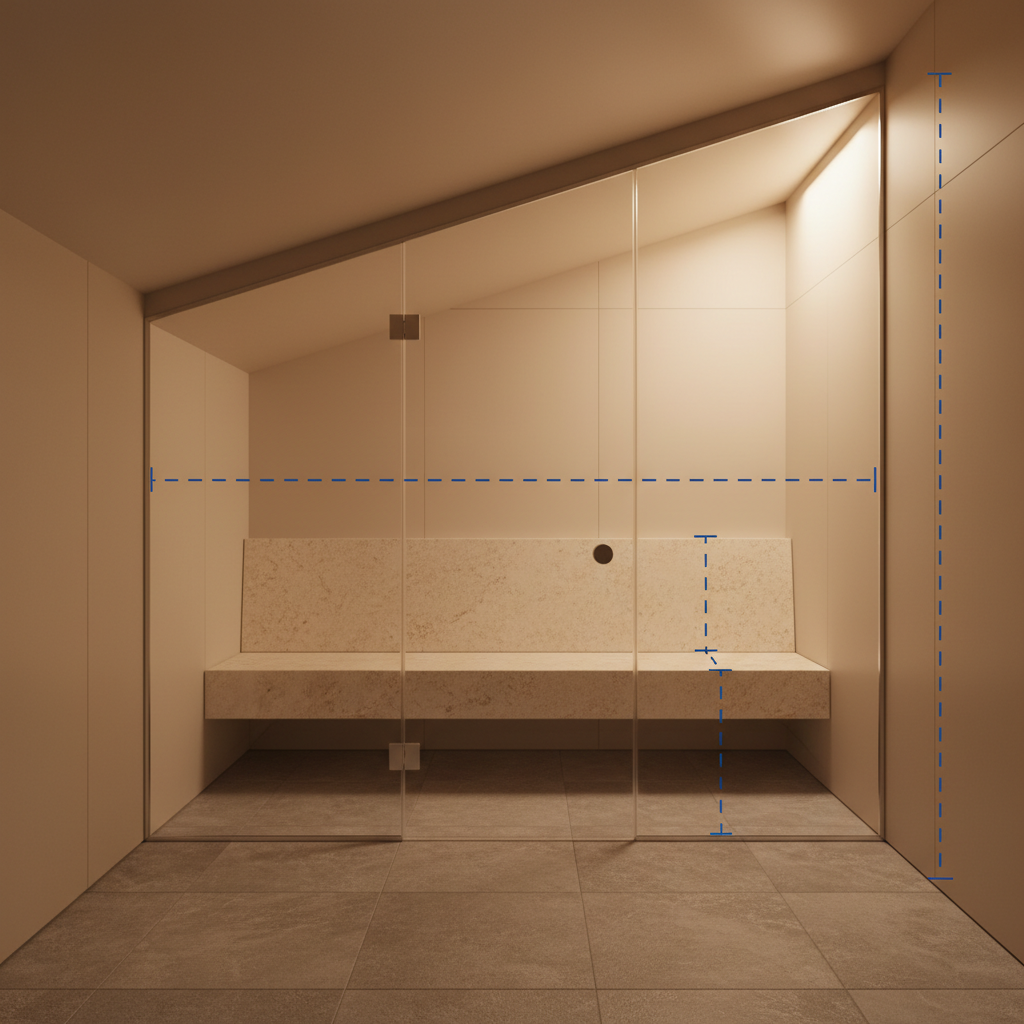
The industry standard for seating allocation is 0.55–0.75 m² (6–8 sq ft) per seated person on a single bench level. This accounts for comfortable seated posture and the minimum safe clearance for circulation. Multi-level bench configurations require additional depth for safe legroom and passage between levels.
For residential projects in Australia and New Zealand, the most common configurations are:
- 2-person steam room: approximately 1.2 x 1.8 m (4' x 6') to 1.5 x 1.8 m (5' x 6') internal dimensions
- 4–5 person steam room: approximately 1.8 x 2.4 m (6' x 8') to 2.1 x 2.4 m (7' x 8') internal dimensions
- Practical absolute minimum: no smaller than 1.0 x 1.2 m internal, to safely accommodate a bench, door swing, and steam head positioning
For commercial applications — hotel wellness facilities, gym steam rooms, resort spas — larger configurations are typical, often accommodating 8–20 users. In these cases, the same per-person area allowance applies, but generator sizing, drainage capacity, and ventilation rates scale considerably.
Ceiling Height and Steam Stratification
Ceiling height is one of the most consequential — and most misunderstood — elements in architectural steam room specifications. The recommended ceiling height range is 213–244 cm (84–96 inches). This range is not arbitrary; it is derived from the thermodynamic behaviour of steam.
When ceiling height exceeds 244 cm, steam stratifies near the top of the room. The consequence is a significant temperature differential: the upper zone becomes uncomfortably hot while the bench level remains cooler than intended. This forces the generator to work harder to achieve consistent comfort at occupant level, increasing energy consumption and accelerating wear on equipment.
Conversely, ceilings below 213 cm can create an oppressive, overly hot environment with poor air distribution. The 213–244 cm sweet spot balances comfortable steam distribution, energy efficiency, and occupant experience.
Yes, but you'll need to compensate by either lowering the ceiling within the steam enclosure using a dropped tile or panel ceiling, or by significantly upscaling the generator. A 270 cm ceiling creates a room volume roughly 10–12% larger than the upper recommended height, which means steam stratification is likely without compensatory design. Most architectural steam room specifications for bespoke residential projects address this by constructing the steam enclosure as a self-contained pod within a larger bathroom volume.
Ceiling Geometry and Condensation Management
One of the most practically important elements of architectural steam room specifications — and one that surprises many first-time clients — is ceiling slope. A perfectly flat ceiling in a steam room is actually a design error.
Slope Requirements
Condensation forms continuously on all surfaces in an operating steam room. On a flat ceiling, this condensation drips directly onto occupants — an uncomfortable and potentially safety-relevant issue (cold drips can cause thermal shock, and repeated wetting of benches contributes to mould). Correct specifications require a slope of approximately 2.5–5 cm per 30 cm run (1–2 inches per linear foot), angled toward a wall rather than toward the bench seating area.
For rooms wider than approximately 1.8 m (6 ft), a coved or gently domed ceiling is the preferred solution. A coved ceiling directs condensation to all four walls simultaneously, completely eliminating drip zones over benches regardless of room width. This detail is a hallmark of high-quality architectural steam room specifications and is standard practice in well-designed residential and commercial installations throughout Australasia.
Waterproofing the Ceiling
The ceiling is actually the most vapour-stressed surface in a steam room. Hot, moisture-laden air rises and contacts the ceiling continuously. Architectural steam room specifications must require the same — or greater — level of waterproofing and vapour management on the ceiling as on the walls. This is frequently overlooked in projects where bathroom tilers are working from generic specifications rather than steam-specific ones.
Construction, Waterproofing, and the Thermal Envelope
The construction envelope is the core of all architectural steam room specifications. No amount of premium tile or high-end steam generators will compensate for a failed vapour barrier or inadequate substrate. This section covers the complete construction stack.
Substrate and Vapour Barrier Requirements
Steam rooms operate at significantly higher humidity and for longer continuous periods than standard shower enclosures. The construction approach must reflect this. The recommended assembly for residential and light-commercial applications includes:
- Closed-cell insulation (rigid board or spray foam) applied to all walls and the ceiling to prevent thermal bridging and condensation within the wall cavity
- Cementitious or foam-based backer board rated specifically for steam applications — standard plasterboard or fibre-cement sheet is not appropriate
- Continuous vapour-proof membrane (liquid-applied or sheet-type, compliant with relevant Australian waterproofing standards) applied to all surfaces including wall-floor junctions, ceiling perimeter, and all penetrations
- Full sealing of all seams, penetrations, and corners with compatible tape and sealant systems
- Tile or stone finish layer adhered with a flexible, steam-rated adhesive system
For commercial and high-duty applications — including hotel spas, resort wellness facilities, and gym steam rooms — the specification escalates to commercial-grade tile systems, higher-performance membranes, epoxy grout systems, and assemblies rated for continuous-duty operation with frequent chemical cleaning.
Thermal Bridging and Insulation
Thermal bridges — areas of high thermal conductivity that short-circuit the insulation envelope — are a significant energy and performance concern in steam room design. Common thermal bridge locations include:
- Exposed concrete or steel structural elements at external walls
- Bench supports that connect through the wall to an uninsulated exterior
- Door frames with metal cores
- Penetrations for plumbing, electrical, and steam supply lines
A well-insulated, thermally continuous envelope reduces warm-up times, lowers ongoing energy costs, stabilises steam density for consistent comfort, and allows the steam generator to be correctly sized rather than oversized to compensate for heat loss.
Materials, Finishes, and Surface Specifications
Material selection is where architectural steam room specifications intersect most visibly with design intent. The good news is that the highest-performing materials for steam environments are also among the most aesthetically versatile.
Wall and Ceiling Finishes
The following materials are appropriate for steam room wall and ceiling applications when installed over a correctly specified vapour barrier and substrate:
- Porcelain tile: The most widely specified and recommended material. Non-porous, durable, easy to clean, and available in virtually any format from small mosaic to large-format slab. Large-format porcelain (600 x 600 mm and above) minimises grout joints, which is a hygiene and maintenance advantage.
- Engineered stone and dense natural stone: Luxurious appearance with excellent durability. Requires appropriate sealing (stone-dependent) and a correctly specified waterproofing system beneath. Popular in high-end residential and resort applications across Australia and New Zealand.
- Tempered glass panels: Used for full or partial walls, particularly where visual openness or connection to an adjacent bathroom is desired. Raises heat loss through the envelope slightly, which should be factored into generator sizing.
- Acrylic and fibreglass panels: Functional and budget-efficient, most commonly seen in prefabricated steam room pods rather than bespoke architect-designed installations.
Untreated timber should not be used on internal steam surfaces. It will swell, stain, and harbour mould under continuous moisture exposure. If timber accents are specified for design reasons, only species and treatment systems rated for high-humidity environments should be used, with detailing that prevents standing water.
Floor Finishes and Drainage
Steam room floors must be slip-resistant — this is both a safety requirement and a common-sense specification. Appropriate options include textured porcelain, honed natural stone with a grip finish, or purpose-made anti-slip tile formats. The floor should be sloped at approximately 1–2% toward the drain to prevent water pooling, with the drain positioned to capture condensation runoff from the walls.
Grout Selection
Grout selection is a specification detail that is frequently underspecified in steam room projects. Standard cementitious grout is porous, absorbs moisture and contaminants, and is vulnerable to mould growth under the thermal cycling conditions of a steam environment. Epoxy grout or other low-porosity, stain-resistant systems are the correct specification for steam room applications, particularly in commercial settings where cleaning frequency and hygiene standards are high.
Epoxy grout is the preferred specification for steam room applications. It is non-porous, resistant to staining and mould, chemically inert, and performs well under repeated thermal cycling. While it costs more than standard cementitious grout and requires more skilled installation, it significantly reduces ongoing maintenance and extends the service life of the tiled finish. For large-format tile installations with minimal grout joints, a high-performance modified cementitious grout with anti-mould additive is an acceptable alternative in residential settings.
Steam Generator Sizing and Positioning
No section on architectural steam room specifications would be complete without addressing the steam generator — the mechanical heart of the installation. Generator sizing is a calculation, not a guess, and the inputs are all architectural.
Sizing Methodology
Generator output is typically specified in kilowatts (kW), and the correct sizing depends on the following variables:
- Room volume (m³): Calculated from internal dimensions including ceiling height
- Surface materials: Non-porous surfaces (porcelain, glass) require less generator capacity than porous materials (natural stone, cement-look tiles) which absorb more heat and moisture
- Insulation quality: A well-insulated room requires a smaller generator than a poorly insulated one of the same volume
- Ambient temperature: Installations in cooler climates or air-conditioned commercial environments may require uprated generators
- Target warm-up time: Commercial facilities typically specify faster warm-up times than residential applications
Research suggests that generator undersizing is the single most common cause of unsatisfactory steam room performance. An undersized generator will fail to reach target temperature and humidity within a reasonable time and will run continuously, accelerating wear and increasing energy costs. Correct architectural steam room specifications include a documented generator sizing calculation, not merely a brand recommendation.
For detailed guidance on selecting the right steam generator for your specific room configuration, our Steam Generator for Home Shower: Complete 2026 Guide provides a step-by-step sizing methodology applicable to both residential and light-commercial steam room installations.
Steam Head and Generator Positioning
The steam head (the outlet through which steam enters the room) should be positioned low on the wall — typically 200–300 mm above floor level — so that steam rises naturally through the occupant zone. Positioning it high on the wall or near the ceiling wastes energy by delivering steam directly to the stratification zone. The generator unit itself should be located outside the steam room in a dry, ventilated service area, typically within 3–5 m of the steam head to minimise heat loss through supply piping.
Doors, Glazing, and Access Design
The steam room door is a critical component of the architectural specification, yet it is often selected on aesthetics alone. A correctly specified steam room door must:
- Open outward (never inward — an unconscious or unwell occupant could block an inward-opening door, creating a safety hazard)
- Be fabricated from tempered glass, aluminium, or stainless steel — materials that will not swell, warp, or degrade under steam conditions
- Include a magnetic or positive-engagement seal that is steam-tight when closed but openable without a key from the inside
- Incorporate a thermally broken frame to reduce condensation on the door surround
Full-height tempered glass doors are the current premium residential standard in Australasia, offering a clean aesthetic while allowing natural light to penetrate the space. For commercial facilities, frameless or minimally framed heavy glass doors (typically 10–12 mm toughened) with magnetic seals are the specification standard.
Ventilation, Drainage, and Electrical Specifications
Architectural steam room specifications are incomplete without addressing the supporting systems that enable the steam room to function safely and hygienically.
Ventilation
A steam room requires a dedicated exhaust ventilation system. Unlike a bathroom, the ventilation in a steam room serves two distinct functions: post-session purge (rapid moisture removal after use to prevent mould development) and controlled fresh-air introduction during use (to maintain safe CO₂ levels in occupied commercial steam rooms). Residential steam rooms typically rely on passive post-session ventilation through a correctly sized wall or ceiling exhaust duct, activated automatically or manually when the session ends.
Drainage
A linear or centre floor drain is required in all steam room specifications. The drain must be sized for the condensation runoff expected from the wall and ceiling surface areas, not merely for occupant showering. Commercial steam rooms require larger drain bodies and trap primers to prevent trap evaporation during idle periods.
Electrical Requirements
Steam generators require a dedicated electrical circuit. Residential generators typically draw 6–12 kW, requiring a 32–50 amp dedicated circuit depending on specification. Commercial generators may draw 15–60 kW, requiring three-phase supply in most cases. All electrical work in or adjacent to a steam room must comply with Australian and New Zealand wiring standards (AS/NZS 3000) and the relevant bathroom zone classifications.
Controls — including digital touch panels, chromotherapy lighting, aromatherapy diffusers, and audio systems — should all be rated for the high-humidity steam room environment. Controls are typically located immediately outside the steam room enclosure or on thermally and vapour-isolated panels.
Commercial vs Residential Specifications: Key Differences
While the fundamental principles of architectural steam room specifications apply equally to residential and commercial projects, the commercial context introduces additional requirements.
| Specification Element | Residential | Commercial / Resort |
|---|---|---|
| Occupancy | 2–6 persons | 8–30+ persons |
| Operating hours | 1–2 sessions/day | Continuous / 8–18 hrs/day |
| Generator rating | 6–18 kW typically | 15–60+ kW, often 3-phase |
| Grout system | Epoxy recommended | Epoxy mandatory |
| Membrane system | ANSI A118.10 compliant | Commercial continuous-duty rated |
| Drainage | Single floor drain | Multiple drains, trap primers |
| Warm-up time target | 15–25 minutes | 8–15 minutes |
| Accessibility | Optional | BCA/NCC compliance required |
For ongoing maintenance guidance relevant to both residential and commercial steam rooms after installation, our Sauna and Steam Room Maintenance Tips for 2026 provides a complete maintenance schedule covering cleaning, generator servicing, grout and membrane inspection, and drain maintenance.