Tampa Bay Real Estate Market Forecast 2025: What to Expect
August 11, 2026 · 13 min read

The Tampa Bay real estate market forecast 2025 points to a market that is cooling from its pandemic-era highs but far from collapsing. Home values are expected to hold roughly steady to slightly lower, inventory is climbing, and buyers finally have more room to negotiate than they've had in years. Whether you're a first-time buyer, a homeowner thinking about selling, or a professional relocating to the region, understanding these shifts now will help you make smarter decisions in the months ahead.
TL;DR — The Bottom Line
The Tampa Bay real estate market forecast 2025 shows a balanced-to-slightly-softer market: median home prices sit in the $370,000–$410,000 range, inventory is up roughly 15%–20% year over year, and mortgage rates are expected to stay near 6.0%–7.0% for much of the year. Overall prices may dip modestly (around -2% to flat), but luxury and waterfront segments could still see gains of 2%–6%. Buyers will find more negotiating leverage, while sellers need to price realistically and prepare homes carefully to stand out among rising competition.
Quick Facts
- Median home value: ~$370,924–$412,000 depending on source and geography
- 2025 price forecast: roughly -2% to flat overall, with premium segments up 2%–6%
- Inventory growth: +15% to +20% year over year in most local forecasts
- Months of supply: approximately 5–6 months, a more balanced market
- Median days on market: 36–54 days, up from about 29 days in 2024
- Mortgage rate range: roughly 6.0%–7.0% for much of 2025
Tampa Bay Real Estate Market Forecast 2025: The Big Picture
If you're trying to make sense of the Tampa Bay real estate market forecast 2025, the short version is this: the frenzied bidding wars of 2021–2022 are gone, and a more normal, negotiated market has taken their place. Local forecasts put the Tampa Bay metro median home price somewhere between $385,000 and $412,000, depending on which submarket and data source you're looking at, according to local market analysts and a 2025 metro update from Truvera Title.
Some reports link Tampa Bay home values closer to $370,924, with an expected 2% price decline in 2025, based on Zillow-style data cited in Tampa Realtors coverage. Other local forecasts describe the market as being in a "corrective plateau" rather than a downturn — prices leveling off after years of rapid appreciation rather than crashing.
Despite the cooling, demand hasn't disappeared. Realtor.com data cited by Tampa Realtors ranked the Tampa Bay metro as the 22nd hottest housing market in the country for year-over-year median sale price growth, a signal that underlying demand remains healthy even as the market rebalances.
For context, a "seller's market" typically has less than 3 months of supply, while a "buyer's market" usually has more than 6 months. Tampa Bay's current 5–6 month range puts it squarely in balanced territory — a meaningful shift from the under-2-month supply levels seen during the 2021 boom.
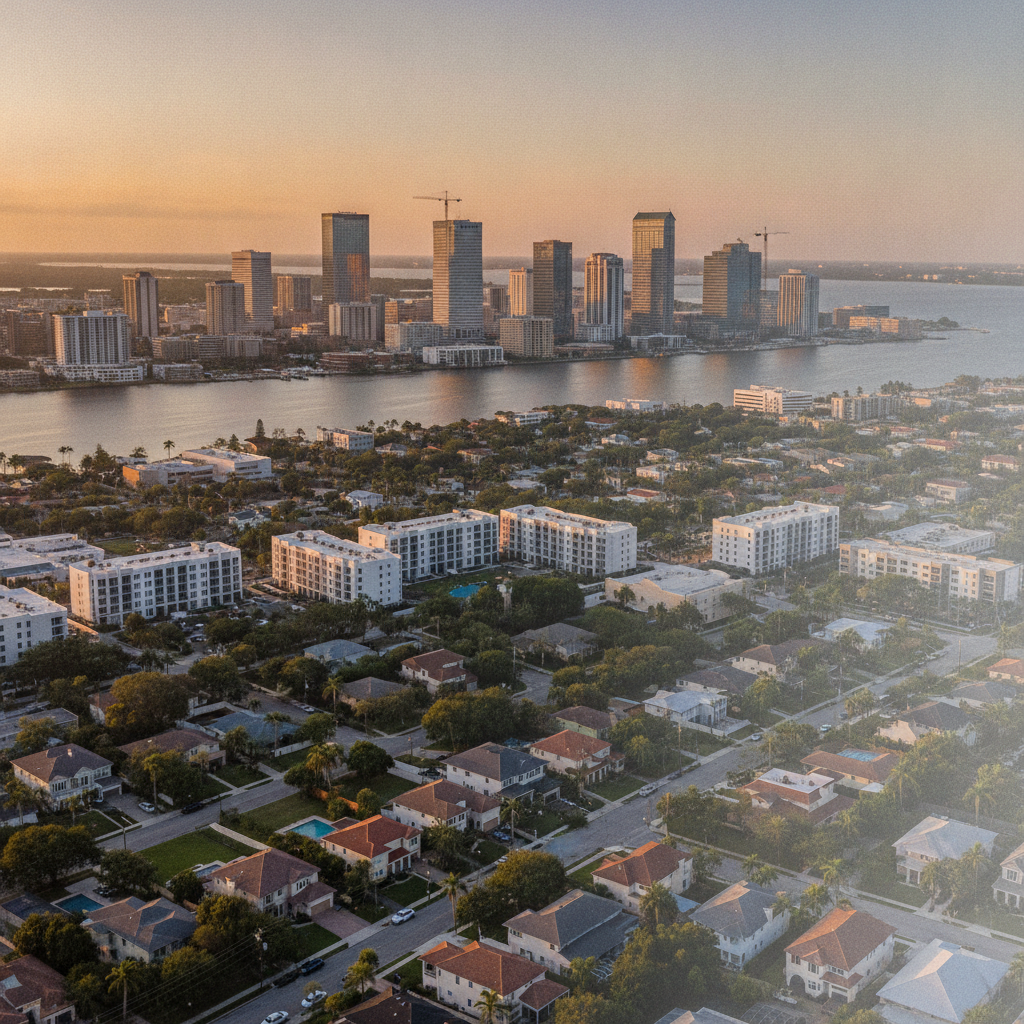
Home Prices in 2025: How Much Will Tampa Bay Values Shift?
Pricing is the question every buyer and seller wants answered first. Across multiple 2025 forecasts, the consensus is that overall Tampa Bay home values will move somewhere between a modest 2%–3% decline and roughly flat, rather than the double-digit swings seen earlier this decade.
That said, averages hide a lot of variation. Local analysts consistently note that Tampa Bay is behaving less like one market and more like several markets layered on top of each other:
- Entry-level and mid-market homes: Likely flat to slightly down as increased supply gives buyers more choices and less urgency.
- Luxury and waterfront properties: Forecasts suggest potential gains of 2%–6%, supported by limited supply of premium coastal inventory and continued relocation demand.
- Older or flood-exposed homes: Facing more price pressure due to rising insurance costs and buyer caution around flood risk.
Most forecasts point to a modest decline of around 1%–3% at the metro level, or roughly flat pricing, rather than a sharp drop. Premium and waterfront segments may still see gains even as entry-level pricing softens slightly.
One useful way to think about this: pricing in 2025 is less about broad market direction and more about property-specific fundamentals — condition, location, flood zone, and insurance costs matter more now than they did when almost everything sold quickly regardless of condition.
Inventory and Days on Market: Why Buyers Have More Leverage
One of the clearest signals in the Tampa Bay real estate market forecast 2025 is the growth in active inventory. Multiple local forecasts cite inventory increases in the 15%–20% range year over year, with some projections estimating further increases of 10%–20% by the end of the year.
More listings mean more competition among sellers and more choice for buyers. That shift shows up clearly in days-on-market data: one 2025 metro update from Truvera Title reports a median of 36–54 days on market, up notably from about 29 days in 2024. Fewer homes are selling above asking price than during the 2021–2022 boom, and buyers are negotiating repairs, closing cost credits, and price reductions more often.
| Metric | 2024 Approx. | 2025 Forecast |
|---|---|---|
| Median days on market | ~29 days | 36–54 days |
| Months of supply | ~3–4 months | 5–6 months |
| Active inventory growth | Baseline | +15% to +20% YoY |
| Homes selling above asking | Higher share | Meaningfully lower share |
For buyers, this is arguably the most encouraging part of the Tampa Bay real estate market forecast 2025: less pressure to waive inspections, more time to evaluate a property, and more realistic room to ask sellers for concessions.
Mortgage Rates and Affordability in 2025
Mortgage rates remain the biggest wildcard in any housing forecast, and Tampa Bay is no exception. Most 2025 projections expect rates to stay in the 6.0%–7.0% range for much of the year, which continues to weigh on affordability even as home prices soften slightly.
This "higher-for-longer" rate environment has a secondary effect worth understanding: many current homeowners locked in mortgage rates below 4% during 2020–2021 and are reluctant to sell and trade into a 6%–7% rate on a new loan. This "rate lock-in" effect is one reason inventory, while rising, hasn't flooded the market — sellers are moving only when they need to, not simply because prices have leveled off.
Most forecasts do not predict a sharp drop. Rates are expected to remain roughly in the 6.0%–7.0% range for much of 2025, with only modest fluctuations likely depending on broader economic conditions.
For first-time buyers, this means affordability will still be a challenge, even with more inventory and softer prices. Insurance costs — a growing concern across Florida — add another layer, since higher premiums in flood-prone or older homes can offset some of the savings from a lower purchase price.
Which Tampa Bay Segments Will Outperform in 2025?
Not every corner of the Tampa Bay real estate market forecast 2025 looks the same. Understanding segment-level differences is one of the most actionable insights buyers and sellers can use.
Segments likely to hold up better
- Waterfront and luxury coastal homes: Limited supply and continued relocation demand support potential 2%–6% appreciation in select areas.
- Updated, move-in-ready homes: Buyers are less willing to take on renovation projects in a market where they have more choices, so well-maintained homes command more attention.
- Homes outside high-risk flood zones: Lower insurance costs make these properties more attractive relative to comparable homes in flood-prone areas.
Segments facing more pressure
- Entry-level homes with rising competition: More new listings in this price band mean sellers need to be more competitive on price and condition.
- Older homes needing updates: With more inventory to choose from, buyers increasingly prefer newer or renovated properties over fixer-uppers.
- Properties with high insurance premiums: Rising insurance costs are increasingly factored into buyer offers and lending approval.
For many buyers, 2025 offers more favorable conditions than the past several years — more inventory, longer decision windows, and more negotiating room — even though mortgage rates remain elevated. The right timing depends on your budget, target neighborhood, and how competitive that specific segment is.
Local market expertise matters more than ever in this environment, since broad metro averages can mask meaningful differences between neighborhoods just a few miles apart. Working with a professional who understands hyperlocal conditions — not just metro-wide statistics — can make a significant difference in how you approach pricing, offers, and timing. If you're navigating these decisions, the team at Hollister Real Estate can help you interpret local data for your specific neighborhood.
What Buyers Should Do in the 2025 Tampa Bay Market
Buyers navigating the Tampa Bay real estate market forecast 2025 should approach the process with a plan rather than reacting to headlines. Here's a practical framework:
- Get pre-approved and understand your real budget. With rates near 6.0%–7.0%, run the numbers on monthly payments, not just purchase price, and include estimated insurance and property tax costs.
- Expand your search radius slightly. With inventory up across most price bands, you may find more competitive options in adjacent neighborhoods.
- Negotiate confidently. With days on market rising to 36–54 days on average, there is more room to request price adjustments, repair credits, or closing cost assistance than there was in 2021–2022.
- Prioritize flood zone and insurance research early. Ask for insurance quotes before finalizing an offer, since premiums can vary significantly even between similar homes.
- Avoid waiving inspections just to compete. The pressure to skip due diligence has eased significantly compared to the peak pandemic market.
What Sellers Should Do in the 2025 Tampa Bay Market
Sellers face a different set of considerations in this more balanced environment. Pricing discipline and presentation matter more than they have in years.
- Price near current market value, not 2021–2022 peaks. With inventory up 15%–20% and days on market lengthening, overpricing risks stale listings and eventual price cuts.
- Expect longer marketing timelines. Plan for 36–54 days on market or more, rather than the near-instant offers common a few years ago.
- Invest in presentation. With more competing listings, buyers are more selective, so professional photography, minor repairs, and decluttering carry more weight.
- Be prepared to negotiate. Fewer homes are selling above asking price, so factor in some flexibility on price or concessions from the outset.
- Highlight segment-specific strengths. If your home is updated, well-located, or outside a high-risk flood zone, make sure that's emphasized clearly in your listing.
Both buyers and sellers benefit from working with someone who tracks these shifts closely rather than relying on outdated assumptions from the 2021–2022 market. If you're weighing your next move, Hollister Real Estate can walk you through current neighborhood-level data before you list or make an offer.
Long-Term Demand Drivers Behind the 2025 Forecast
Even with short-term softening, several structural factors continue to support Tampa Bay's housing demand over the medium and long term:
- Population growth and in-migration: Tampa Bay continues to attract residents relocating from higher-cost states, sustaining baseline housing demand.
- Diversified job growth: Expansion in healthcare, technology, and finance sectors supports household formation and homebuying capacity.
- Firm rental demand: Multifamily research projects healthy apartment absorption in 2025, suggesting that even as for-sale conditions soften, overall housing demand in the region remains resilient.
- No state income tax: Florida's tax structure continues to be a draw for relocating professionals and retirees alike.
These drivers are a key reason most forecasts describe 2025 as a rebalancing rather than a downturn. The Tampa Bay real estate market forecast 2025 reflects a market finding its footing after years of unsustainable growth, not a market in decline.
Frequently Asked Questions
What is the Tampa Bay real estate market forecast 2025?
The 2025 forecast points to a balanced-to-slightly-softer market, with median home prices roughly between $370,000 and $412,000, inventory up 15%–20% year over year, and overall price movement between a modest 2% decline and roughly flat, while luxury and waterfront segments may see 2%–6% gains.
Will home prices go down in Tampa Bay in 2025?
Most forecasts expect prices to be flat to modestly lower overall, generally in the range of 0% to -2% to -3%, rather than a sharp decline. Certain segments, particularly entry-level and older homes, may see more noticeable softening than premium properties.
Is it a good time to buy a house in Tampa Bay?
For many buyers, 2025 offers more favorable conditions than recent years, with more inventory, longer days on market, and more room to negotiate. However, mortgage rates near 6.0%–7.0% and rising insurance costs remain important affordability factors to plan around.
How much inventory is available in the Tampa Bay housing market in 2025?
Local forecasts estimate active inventory growth of roughly 15% to 20% year over year, with some projections suggesting further increases of 10%–20% by the end of 2025, pushing the market toward 5–6 months of supply.
Should I sell my house in Tampa Bay in 2025 or wait?
If your home is updated, well-located, or in a lower-risk flood zone, 2025 can still be a reasonable time to sell, provided you price near current market value rather than 2021–2022 peaks. Waiting could mean facing even more competing inventory, so realistic pricing now is often more effective than delaying.
Final Thoughts on the Tampa Bay Real Estate Market Forecast 2025
The Tampa Bay real estate market forecast 2025 is not a story of boom or bust — it's a story of rebalancing. Prices are leveling off, inventory is growing, and both buyers and sellers have more room to negotiate than they've seen in years. At the same time, well-located, updated, and lower-risk properties continue to show resilience, which means success in this market depends less on timing the headlines and more on understanding your specific neighborhood and price segment.
Whether you're buying your first home, selling a longtime property, or relocating into the Tampa Bay area, the smartest move is to get informed, hyperlocal guidance before you act. If you'd like a clearer picture of how the 2025 forecast applies to your specific situation, connect with Hollister Real Estate for a personalized market conversation.