Tampa Bay Real Estate Closing Costs Explained
May 15, 2026 · 13 min read

TL;DR — The Bottom Line
Tampa Bay real estate closing costs explained in brief: buyers typically pay 2–5% of the purchase price in closing costs (roughly $8,000–$20,000 on a $400,000 home), while sellers pay documentary stamp taxes, title insurance, and often real estate commissions. A major 2024 rule change now means buyer's agent compensation is negotiable and no longer automatically paid by sellers. Working with a knowledgeable local agent is the best way to plan your cash-to-close number before you ever make an offer.
Quick Facts
- Buyer closing costs (typical): 2–5% of the purchase price
- On a $400,000 home: Approximately $8,000–$20,000
- Real-world Florida example: ~$14,179 on a $450,000 purchase (3.7%)
- Tampa average total commission: ~5.5–5.7% of sale price
- Largest seller cost: Documentary stamp tax + real estate commission
- 2024 NAR rule change: Buyer's agent compensation is now negotiated separately
Whether you're buying your first home in St. Petersburg, selling a waterfront property in Clearwater, or relocating to the region for work, understanding Tampa Bay real estate closing costs explained in plain language can save you thousands of dollars and eliminate last-minute surprises at the settlement table. Closing costs are one of the most misunderstood aspects of any real estate transaction, and in the Tampa Bay market specifically, there are unique Florida-specific fees, recent rule changes, and local customs that every buyer and seller needs to know before signing on the dotted line.
This comprehensive guide breaks down exactly what closing costs are, who pays what, how much you should budget, and how the 2024 National Association of Realtors (NAR) settlement has changed the way buyer's agent compensation works in Tampa Bay and across Florida. Let's get into it.
What Are Closing Costs and Why Do They Matter in Tampa Bay?
When most people think about buying or selling a home, they focus on the purchase price and the down payment. But Tampa Bay real estate closing costs explained properly reveals a third major financial layer that can catch unprepared buyers and sellers completely off guard. Closing costs are the collection of fees, taxes, prepaid items, and service charges that are finalized at closing — the day legal ownership transfers from seller to buyer.
In the Tampa Bay area, which encompasses Hillsborough County (Tampa), Pinellas County (St. Petersburg and Clearwater), Pasco County, and Hernando County, the closing cost experience reflects Florida's specific legal and tax environment. Florida has no state income tax, but it does levy documentary stamp taxes on both deed transfers and mortgage notes — and those costs fall primarily on the buyer and seller at closing. Understanding these costs early in your home search or sale preparation will help you build an accurate budget, negotiate more effectively, and avoid stressful surprises.
For buyers relocating to the area, this context is especially important. If you're moving from a state like California or New York, some Florida-specific costs may be unfamiliar. For sellers, knowing your net proceeds in advance helps you plan your next move with confidence. If you're planning a move to the region, our detailed relocating to Tampa Bay guide for professionals is an excellent companion resource to this post.
Tampa Bay Real Estate Closing Costs Explained for Buyers
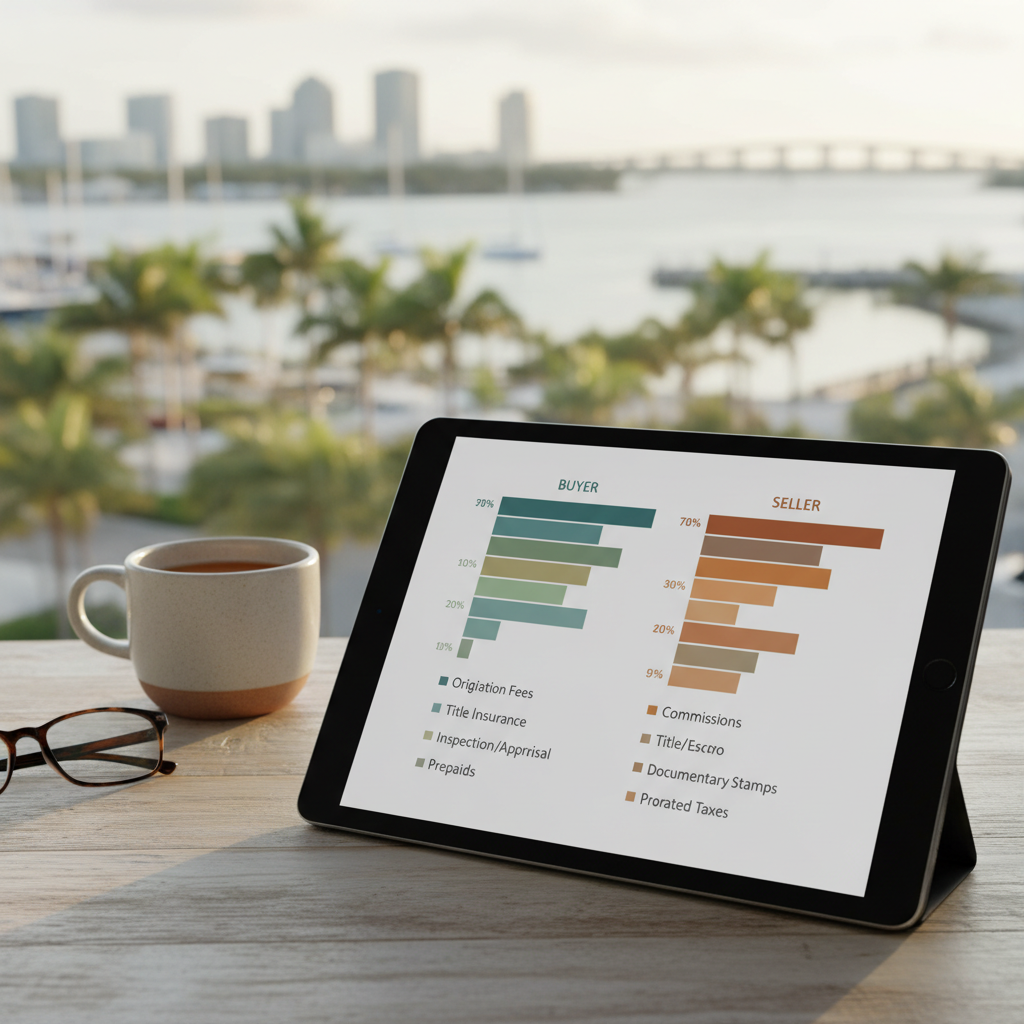
For buyers, Tampa Bay real estate closing costs explained in full includes two broad categories: lender-related fees and third-party/government fees. Together, these typically total between 2% and 5% of the purchase price. On a $400,000 home, that means budgeting anywhere from $8,000 to $20,000 in closing costs, on top of your down payment.
Lender-Related Fees
If you're financing your purchase with a mortgage, your lender will charge a series of fees to process, underwrite, and fund your loan. These typically include:
- Loan origination fee: Usually 0.5–1% of the loan amount; covers the lender's cost of creating the loan
- Underwriting fee: Typically $400–$900; the cost of evaluating your creditworthiness
- Credit report fee: Usually $30–$75
- Application fee: Varies by lender; sometimes waived
- Rate lock fee: May apply if you lock your interest rate for an extended period
Combined, lender fees in Florida typically range from $1,500 to $3,000 or more, depending on loan size and lender.
Title and Settlement Fees
Florida is an "attorney state" in some respects, but title companies most commonly handle residential closings in the Tampa Bay area. Buyers pay for the lender's title insurance policy, while sellers customarily pay for the owner's title insurance policy (more on that in the seller section). Buyer-side title and settlement costs typically include:
- Title search and examination: Approximately $300–$500
- Settlement/closing fee: Typically $500–$800
- Lender's title insurance: Based on loan amount; usually $500–$1,200
- Endorsements: Additional title policy endorsements, $50–$200 each
Government Fees and Taxes
Florida imposes a documentary stamp tax on the promissory note (mortgage) at a rate of $0.35 per $100 of the loan amount. On a $350,000 loan, that's $1,225. Buyers also pay recording fees for the deed and mortgage, which typically total $300–$500 depending on the number of pages.
Prepaid Items and Escrow Reserves
These are not technically fees — they're payments collected in advance for ongoing costs associated with homeownership. But they add meaningfully to your cash-to-close figure:
- First-year homeowners insurance premium: $1,500–$3,000+ (Florida insurance costs are notably higher than national averages due to hurricane and flood risk)
- Property tax escrow reserves: Typically 2–4 months of estimated taxes, often $1,500–$3,000
- Insurance escrow reserves: 2–3 months of insurance premium
- Prepaid interest: Prorated daily interest from closing date to end of month
Other Buyer Costs
- Home inspection: $400–$600 (paid before closing, not at closing)
- Appraisal: $500–$700 (also typically paid upfront)
- Survey: $400–$600 for a standard residential lot survey
- HOA transfer fee: $150–$500 if purchasing in a community with a homeowners association
Research suggests that a real-world closing in Florida on a $450,000 home totaled approximately $14,179 — about 3.7% of the purchase price — before the down payment. This is a useful benchmark for budgeting your own Tampa Bay purchase.
Yes — and it's common practice. Sellers can offer closing-cost credits (also called seller concessions) as part of the negotiated purchase agreement. In a buyer-friendly market, or when sellers want to attract more offers, these credits can significantly reduce your out-of-pocket cash at closing. However, there are lender-imposed limits on how much a seller can contribute, typically 3–6% of the purchase price depending on loan type.
Tampa Bay Real Estate Closing Costs Explained for Sellers
Sellers in the Tampa Bay area face a different — and often larger — set of closing costs than buyers. While buyers pay lender fees and prepaid items, sellers typically bear the cost of transferring ownership legally and compensating real estate professionals. Getting Tampa Bay real estate closing costs explained from the seller's perspective helps you calculate your true net proceeds before accepting any offer.
Documentary Stamp Tax on the Deed
In Florida, the seller pays the documentary stamp tax on the deed (not the mortgage — that's the buyer's responsibility). The rate is $0.70 per $100 of the sale price in most Florida counties. On a $400,000 sale, that's $2,800. In Miami-Dade County the rate is higher, but throughout the Tampa Bay area (Hillsborough, Pinellas, Pasco), the standard $0.70 rate applies.
Owner's Title Insurance
In Tampa Bay, it is customary for the seller to pay for the owner's title insurance policy that protects the buyer. This is a one-time premium calculated on a tiered rate based on the sale price. On a $400,000 sale, the owner's title insurance premium is typically around $1,500–$2,000. This is one of those Florida customs that surprises sellers who've previously sold homes in other states where the buyer pays for this coverage.
Real Estate Commission
Historically, the seller paid both the listing agent's commission and the buyer's agent commission out of the sale proceeds. Research suggests the total average real estate commission in Tampa is approximately 5.5–5.7% of the sale price. On a $400,000 home, that's $22,000–$22,800. However, this is changing significantly — see the section below on the 2024 NAR rule changes.
Additional Seller Costs
- Prorated property taxes: Sellers credit the buyer for property taxes accrued but not yet paid at closing
- HOA fees and estoppel certificate: $150–$350 if the property is in an HOA
- Title search and settlement fee: Often split with or paid by the seller depending on the contract
- Outstanding liens or mortgage payoff: Any remaining mortgage balance is paid from proceeds at closing
If you're preparing to list, reviewing your full cost picture early is essential. Our guide on what to do before listing your home in Tampa Bay covers pre-listing preparation steps that can also affect your net proceeds at closing.
The 2024 NAR Rule Change: What Tampa Bay Buyers and Sellers Must Know
One of the most significant shifts in how Tampa Bay real estate closing costs explained relates to agent compensation happened in 2024, when the National Association of Realtors reached a landmark settlement that fundamentally changed how buyer's agent commissions work across the country — including in Tampa Bay.
What Changed?
Under the old system, when a home was listed on the MLS, the seller's listing agreement typically included an offer of compensation to the buyer's broker. This meant sellers were essentially pre-agreeing to pay the buyer's agent, often without realizing it was negotiable. Under the new rules that took effect in August 2024:
- Buyers must sign a written buyer representation agreement with their agent before touring homes, and that agreement must define how the agent will be compensated.
- Sellers are no longer required to offer buyer's agent compensation — it is now an optional seller contribution, not a mandatory one.
- Buyers may be responsible for paying their own agent's commission directly, unless the seller agrees to offer a credit or concession to cover it.
- Sellers may choose to offer buyer-broker compensation as a marketing incentive to attract more buyers and offers.
What This Means for Tampa Bay Buyers
Buyers now need to have a candid conversation with their agent upfront about compensation. In many cases, sellers in Tampa Bay are still offering buyer-agent compensation as a competitive strategy — but it is no longer guaranteed. Buyers should budget for the possibility that they'll need to pay their agent directly, either out of pocket or through a negotiated seller credit. This is a new line item in Tampa Bay real estate closing costs explained that didn't exist as an explicit concern before 2024.
What This Means for Tampa Bay Sellers
Sellers now have more flexibility. Rather than automatically building the buyer's agent commission into the transaction, you can decide whether to offer it, how much to offer, or whether to provide a closing-cost credit instead. This can be a powerful negotiating tool in both competitive and slow markets.
How to Reduce Your Closing Costs in Tampa Bay
Understanding Tampa Bay real estate closing costs explained is only half the battle — knowing how to reduce them is where the real value lies. Here are actionable strategies for both buyers and sellers.
For Buyers: Steps to Lower Your Cash to Close
- Negotiate seller concessions: In any market, it's worth asking the seller to contribute to your closing costs. Even $5,000–$10,000 in seller credits can dramatically reduce your upfront cash requirement.
- Shop lenders: Lender fees vary significantly. Getting loan estimates from at least three lenders lets you compare origination fees, points, and rate-related costs side by side.
- Close at the end of the month: Prepaid interest is calculated from your closing date to the end of the month. Closing on the 28th instead of the 5th can reduce prepaid interest by hundreds of dollars.
- Review your Loan Estimate carefully: Your lender is required to provide a Loan Estimate within three business days of your application. Review every line item and ask about anything that seems high or unclear.
- Ask about lender credits: You can sometimes accept a slightly higher interest rate in exchange for lender credits that offset your closing costs. This makes sense if you plan to sell or refinance within a few years.
For Sellers: Steps to Protect Your Net Proceeds
- Price strategically: A well-priced home attracts more competitive offers, which may reduce the need to offer large seller concessions.
- Negotiate commission thoughtfully: Under the new rules, consider whether — and how much — to offer in buyer-broker compensation. Discuss this carefully with your listing agent.
- Address issues before listing: Deferred maintenance items that show up on a buyer's inspection can result in price reductions or credits that reduce your net proceeds — often more than the cost of fixing them upfront.
- Review the settlement statement in advance: Ask your title company or agent for a preliminary HUD-1 or Closing Disclosure before closing day so there are no surprises.
Florida charges a documentary stamp tax on two types of documents in a real estate transaction. The seller pays the doc stamp on the deed at a rate of $0.70 per $100 of the sale price (for example, $2,800 on a $400,000 sale). The buyer pays the doc stamp on the mortgage/promissory note at a rate of $0.35 per $100 of the loan amount. Both are paid at closing and are non-negotiable government charges.
Tampa Bay Closing Costs: A Side-by-Side Comparison Table
To make Tampa Bay real estate closing costs explained as practical as possible, here is a summary comparison of typical costs for buyers versus sellers on a $400,000 transaction in the Tampa Bay area.
| Cost Item | Typically Paid By | Estimated Amount |
|---|---|---|
| Loan origination & lender fees | Buyer | $1,500–$3,000 |
| Lender's title insurance | Buyer | $500–$1,200 |
| Title search & settlement fee | Buyer or split | $800–$1,300 |
| Survey | Buyer | $400–$600 |
| Appraisal | Buyer | $500–$700 |
| Doc stamp on mortgage note | Buyer | $0.35 per $100 of loan |
| Prepaid insurance & tax escrow | Buyer | $3,000–$6,000+ |
| Owner's title insurance | Seller | $1,500–$2,000 |
| Doc stamp on deed | Seller | $0.70 per $100 of price |
| Real estate commission | Seller (listing agent; buyer agent now negotiable) | 2.5–5.7% of sale price |
| HOA estoppel/transfer fee | Seller/Buyer (varies) | $150–$500 |
| Recording fees | Buyer | $300–$500 |
Note: Amounts are estimates for the Tampa Bay area. Actual costs vary based on purchase price, lender, title company, and negotiated terms. Always request a Loan Estimate from your lender and a preliminary closing statement from your title company.
Common Questions About Tampa Bay Real Estate Closing Costs Explained
How much are closing costs for a buyer in Tampa Bay, Florida?
Buyers in Tampa Bay typically pay between 2% and 5% of the purchase price in closing costs, not including the down payment. On a $400,000 home, that means roughly $8,000 to $20,000. This includes lender fees, title and settlement charges, government taxes, prepaid homeowners insurance, property tax escrow reserves, and other third-party costs. Research suggests a real-world Florida closing on a $450,000 home totaled approximately $14,179 — about 3.7% of the purchase price.
Who pays closing costs in Florida — the buyer or the seller?
Both parties pay closing costs in Florida, but for different items. Sellers typically pay the documentary stamp tax on the deed, owner's title insurance, and real estate commissions. Buyers typically pay lender fees, the documentary stamp tax on the mortgage note, lender's title insurance, survey, appraisal, and prepaid items like homeowners insurance and property tax escrow. Some fees, like the settlement/closing fee, may be negotiated or split between parties.
Does the seller have to pay the buyer's agent commission in Tampa Bay after the 2024 NAR settlement?
No — as of August 2024, sellers in Tampa Bay are no longer required to offer compensation to the buyer's agent. This was a major change resulting from the National Association of Realtors settlement. Sellers may still choose to offer buyer-broker compensation as a marketing incentive, but buyers and their agents now negotiate compensation directly through a written buyer representation agreement. Buyers should budget for this cost and discuss it with their agent upfront.
Can closing costs be rolled into a mortgage in Florida?
Generally, closing costs cannot be rolled directly into a purchase mortgage in Florida — you must bring cash to cover them at closing. However, there are strategies to effectively reduce your out-of-pocket costs: you can negotiate seller concessions (seller credits toward closing costs), accept lender credits in exchange for a slightly higher interest rate, or ask your lender about specific loan programs that allow for financing of certain fees. On refinances, closing costs can sometimes be rolled into the new loan.
What is the documentary stamp tax in Tampa Bay Florida?
Florida's documentary stamp tax is a state-imposed tax on certain documents recorded with the government. In Tampa Bay real estate transactions, it applies in two ways: sellers pay $0.70 per $100 of the home's sale price on the deed transfer, and buyers pay $0.35 per $100 of the loan amount on the promissory note. For example, on a $400,000 home with a $320,000 mortgage, the seller pays $2,800 in doc stamps on the deed and the buyer pays $1,120 in doc stamps on the note.
Why Working With a Local Tampa Bay Expert Matters
National real estate websites and generic closing cost calculators can give you a rough ballpark, but they frequently miss Florida-specific nuances that significantly impact your actual costs. The high cost of homeowners insurance in coastal and flood-prone areas of Pinellas and Hillsborough counties, the documentary stamp tax structure, HOA estoppel requirements, and the evolving buyer-agent compensation landscape all require local expertise to navigate accurately.
When you work with an agent who knows the Tampa Bay market deeply, you get more than transaction management — you get a clear-eyed projection of your real costs and a strategy to minimize unnecessary expenses. Understanding Tampa Bay real estate closing costs explained in full detail is one of the core ways Kyle Hollister helps clients prepare for the financial reality of their transaction, whether they're buying their first home, selling an investment property, or relocating from out of state.
A quotable truth worth remembering: "The best time to understand your closing costs is before you make your offer — not the day before you're scheduled to close."
Final Thoughts and Next Steps
Having Tampa Bay real estate closing costs explained clearly before you enter the market is one of the most empowering things you can do as a buyer or seller. Whether you're surprised by the documentary stamp tax, uncertain about how the 2024 NAR rule changes affect your transaction, or simply trying to build an accurate budget for your next move, knowing these numbers in advance gives you a meaningful advantage.
To summarize the key points:
- Buyers in Tampa Bay pay 2–5% of the purchase price in closing costs, including lender fees, title costs, government taxes, and prepaids
- Sellers pay the documentary stamp tax on the deed, owner's title insurance, and (typically) real estate commissions
- The 2024 NAR settlement changed buyer-agent compensation — it's now negotiated separately and is no longer automatically a seller responsibility
- Seller concessions, smart lender shopping, and strategic closing timing can reduce your out-of-pocket costs
- Florida's higher-than-average insurance costs mean prepaid and escrow items can add significantly to buyer closing costs
If you have questions about what your closing costs will look like on a specific property in Tampa, St. Pete, Clearwater, or anywhere else in the Tampa Bay area, Kyle Hollister is here to walk you through the numbers with full transparency. Reach out today for a personalized closing cost estimate and market consultation — because in real estate, what you don't know can cost you.