Moving to Tampa Bay with Kids Guide for Families 2026
September 25, 2026 · 13 min read
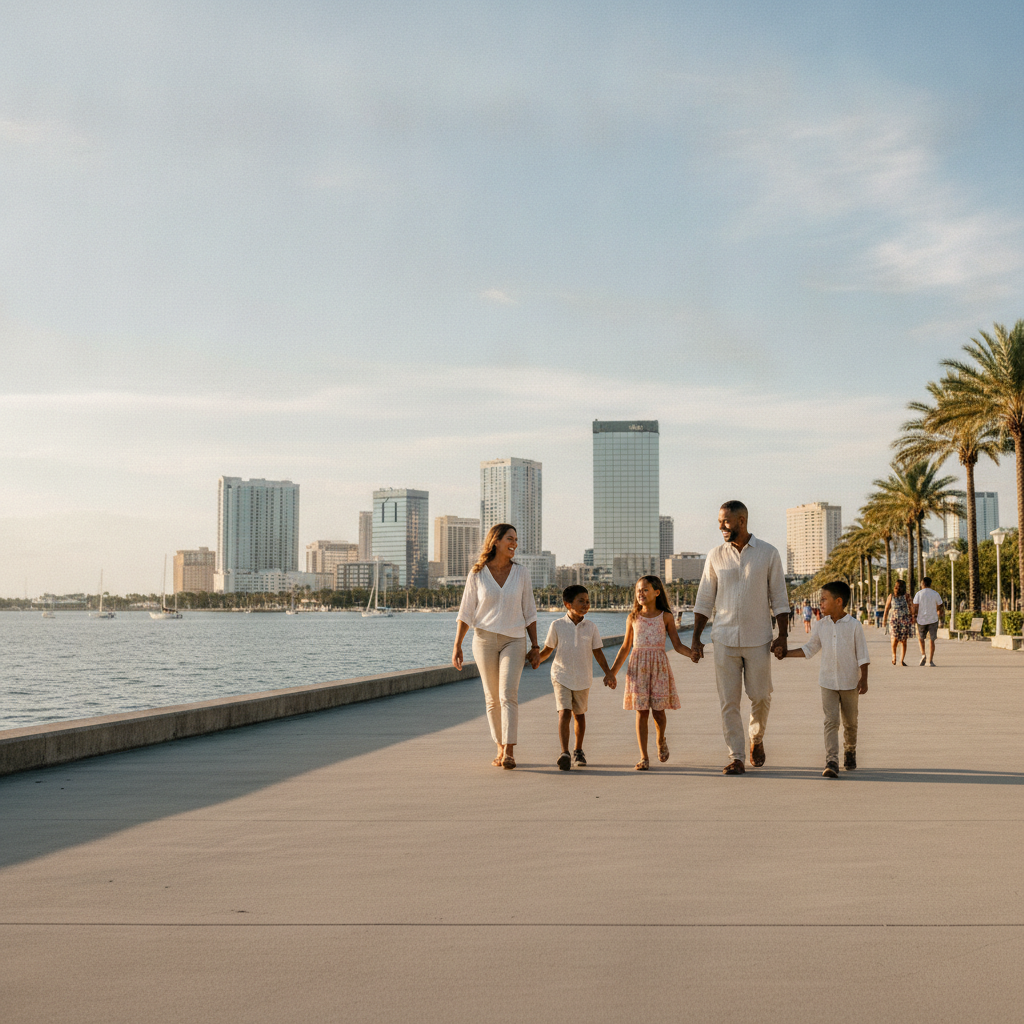
Relocating a household with children is a different project than moving as a single professional or a retired couple, and this moving to Tampa Bay with kids guide is built specifically around that reality. School zoning, pediatric care, hurricane preparedness, and the emotional adjustment of children all factor into decisions that a generic relocation checklist simply won't address. Whether you're a first-time buyer starting a family or a growing household relocating from out of state, this guide walks through the family-specific details that matter most when moving to Tampa Bay with kids.
TL;DR — The Bottom Line
Families moving to Tampa Bay with kids should prioritize school zone verification, flood and insurance research, and a realistic total-cost budget before falling in love with a house. The 2026 market offers more negotiating room than in prior years, but school enrollment windows, hurricane-season timing, and childcare availability vary significantly by county — so timing and location research matter as much as price.
Quick Facts
- Core counties: Hillsborough, Pinellas, Pasco, and parts of Hernando
- Median list price (Tampa area, 2026): roughly $400,000, down about 4.6% year over year
- Single-family months of supply: approximately 3.8 months, giving buyers more leverage
- Typical days on market: around 46 days for closed sales
- Hurricane season: June 1 through November 30 each year
- School enrollment: most districts open registration in early spring for the following fall
What Makes Moving to Tampa Bay with Kids Different
Adults relocating solo can prioritize commute time and nightlife; families relocating with children must weigh an additional layer of variables. A moving to Tampa Bay with kids guide needs to account for zoned schools, after-school logistics, pediatric networks, youth sports and activities, and the practical reality that hurricane evacuations look very different with toddlers, teenagers, or children with medical needs. Tampa Bay's sprawling geography — spanning Hillsborough, Pinellas, Pasco, and northern Hernando counties — means two homes ten miles apart can sit in entirely different school districts, flood zones, and insurance tiers.
Families relocating to Tampa Bay also tend to prioritize different housing features than other buyer segments: fenced yards, bedroom counts, proximity to parks, and distance to grandparents or extended family flying in for visits (Tampa International Airport and St. Pete-Clearwater International Airport both serve the region). None of these factors show up on a standard listing sheet, which is why working through a family-specific framework before touring homes saves time and reduces the odds of a mismatched purchase.
Understanding School Zones and Enrollment in Tampa Bay
One of the most common mistakes families make is assuming a home's city name or ZIP code guarantees a specific school. In reality, school assignment is determined by district attendance boundaries, which can split neighborhoods, subdivisions, and even streets. Before writing an offer, confirm the exact zoned elementary, middle, and high school using the county school district's official address-lookup tool rather than relying on listing descriptions or online estimates, which are sometimes outdated.
Hillsborough County Public Schools, Pinellas County Schools, and Pasco County Schools each operate their own enrollment calendars, school-choice application windows, and specialty program applications (magnet schools, International Baccalaureate programs, and career academies). Most districts open registration for the following school year in the winter or early spring, with choice-program applications often due even earlier. Families planning a move should start this research four to six months ahead of a target move date whenever possible, particularly if they hope to apply for a school-choice seat outside their zoned boundary.
Answer: In most cases your child is assigned to a zoned school based on your home address, but Hillsborough, Pinellas, and Pasco counties all offer school-choice and magnet-program applications that allow families to apply for seats outside their zoned boundary, subject to availability and application deadlines.
Comparing Tampa Bay School Districts for Families
Because this guide focuses on the family relocation process rather than ranking neighborhoods, it's more useful to compare the structural differences between the three largest districts families typically consider.
| District | Coverage Area | Notable for Families |
|---|---|---|
| Hillsborough County Public Schools | Tampa, Brandon, Riverview, Wesley Chapel (partial) | Largest district by enrollment; wide range of magnet and IB programs |
| Pinellas County Schools | St. Petersburg, Clearwater, Dunedin, Palm Harbor, Safety Harbor | Established neighborhoods; strong arts and STEM choice programs |
| Pasco County Schools | Wesley Chapel, Land O' Lakes, New Port Richey | Fast-growing district with newer school construction tied to development |
Because Pasco County continues to add residential subdivisions rapidly, some newer communities experience school capacity adjustments or rezoning more frequently than established Pinellas neighborhoods. Any comprehensive moving to Tampa Bay with kids guide should encourage buyers to ask directly whether a target school has a pending capacity or boundary review before closing, since this information isn't always disclosed by sellers or listing agents.
Childcare, Pediatricians, and Family Healthcare Access
Beyond K-12 schooling, families relocating with younger children need to research licensed childcare availability, which can have waitlists of several months in high-growth suburban areas like Wesley Chapel and Riverview. It's worth contacting two or three licensed providers near a prospective home before finalizing an offer, particularly for infant and toddler care, which tends to fill first.
Tampa Bay is home to several major pediatric health systems, including Johns Hopkins All Children's Hospital in St. Petersburg and Tampa General Hospital's pediatric services, along with numerous independent pediatric practices throughout Hillsborough, Pinellas, and Pasco counties. Families with children who have ongoing medical needs should confirm that in-network specialists and therapy providers are reasonably accessible from a target neighborhood, since traffic patterns during peak commute hours can meaningfully extend drive times across the bay bridges connecting Tampa and St. Petersburg.
Hurricane Season Prep for Families with Kids
Hurricane season runs from June 1 through November 30, and families new to Florida often underestimate how much planning it requires with children in the household. A family emergency plan should include a designated evacuation route, an out-of-area contact person, a stocked supply kit with child-specific items (diapers, formula, medications, comfort items), and a plan for pets. Families should also research whether a target home sits in a mandatory evacuation zone, since this affects both insurance requirements and how seriously a storm approach needs to be treated each season.
According to the Florida Division of Emergency Management, households should maintain enough food, water, and medication for at least seven days during hurricane season, given the potential for extended power outages even when a storm doesn't make a direct landfall.
Ready.gov's hurricane preparedness guidance recommends practicing the evacuation plan with children before storm season begins, so it feels familiar rather than frightening if it's ever needed. This is a step many relocating families skip in their first year, often because they don't yet understand how routine hurricane preparation is for long-term Florida residents.
Answer: No. Flood insurance is typically required by lenders only for homes located in a FEMA-designated high-risk flood zone, though many families near the coast or in low-lying areas choose to carry it voluntarily given the region's storm exposure and the financial risk of going without coverage.
Budgeting for a Family Move to Tampa Bay
Housing affordability discussions often stop at the mortgage payment, but a realistic moving to Tampa Bay with kids guide has to include the recurring costs specific to raising children in the region. Beyond principal, interest, taxes, and insurance, families should budget for:
- Before- and after-school care or extended-day programs
- Summer camps, which run for roughly 10–12 weeks depending on the school calendar
- Youth sports league fees, equipment, and travel
- School supply and technology fees not covered by tuition-free public enrollment
- Higher auto insurance once teens begin driving
On the housing side, one August 2026 market analysis found Tampa Bay home values generally down 1%–2% year over year, with median asking prices down roughly 4.2% and single-family supply sitting near 3.8 months — a meaningfully more balanced market than the multiple-offer conditions of a few years earlier. A separate summer 2026 review cited a Tampa-area median list price near $400,000, down about 4.6% year over year, while Redfin data for the three months ending August 2026 showed a median sale price near $479,000 with homes typically taking about 46 days to sell. These figures can look contradictory at first glance, but they usually reflect different measurements — list price versus closed sale price versus underlying value estimates — rather than opposing trends.
For families, the practical takeaway is that there is more room to negotiate repairs, closing cost credits, and even price than in the recent past, but well-priced homes in strong school zones with manageable insurance still move quickly.
Timing Your Move: When to Relocate with School-Age Kids
Families frequently ask when the best time of year is to relocate to Florida with children already enrolled in school. There is no perfect answer, but a few patterns are worth considering:
- Summer moves (June–August) allow children to start the new school year with classmates on day one, but they also overlap with the start of hurricane season and the busiest part of the local moving and home-inspection calendar.
- Winter break moves (December–January) can minimize disruption to the school semester but require navigating enrollment paperwork during the holiday closures many districts observe.
- Spring moves (March–April) often align with school-choice and magnet application deadlines, which can be an advantage for families hoping to apply into a specific program for the following fall.
Whichever window you choose, request official transcripts, immunization records, and any Individualized Education Program (IEP) or 504 plan documentation well ahead of the move, since Florida districts require these before finalizing enrollment.
Helping Kids Settle Into Their New Tampa Bay Community
The house search is only part of a successful relocation. Children adjust faster when they have a sense of community before the first day of school. Tampa Bay offers an extensive network of public libraries with children's programming, county and municipal recreation centers, youth sports leagues, and free or low-cost museums such as the Glazer Children's Museum in Tampa and the Great Explorations Children's Museum in St. Petersburg. Scheduling a visit to a target neighborhood's park or library branch during the house-hunting trip can give children an early, low-pressure introduction to their future community.
Involving kids in age-appropriate parts of the decision — choosing their bedroom, researching a nearby park, or picking out a new backpack for their zoned school — can also ease the emotional transition that often gets overlooked in a purely financial relocation plan.
What is the best area in Tampa Bay for families with kids?
There is no single best area; the right fit depends on zoned school quality, commute distance, flood zone exposure, and budget. Suburban communities in Hillsborough, Pasco, and northern Pinellas counties tend to offer newer construction and larger lots, while established Pinellas neighborhoods often provide shorter commutes and mature tree canopy.
How do I find out which school my new home is zoned for?
Use the official address-lookup tool provided by Hillsborough County Public Schools, Pinellas County Schools, or Pasco County Schools, since these are updated for the most current boundary lines and are more reliable than third-party listing estimates.
Is Tampa Bay a good place to raise kids in 2026?
Tampa Bay offers strong job growth, year-round outdoor recreation, and a wide range of school and childcare options, but families need to budget carefully for property insurance, flood exposure, and hurricane preparedness as part of the overall cost of raising children in the region.
How much does it cost to move a family to Tampa Bay?
Total costs vary widely based on distance and household size, but families should budget beyond the mortgage for insurance, childcare, camps, and moving logistics; local median list prices in the Tampa area were near $400,000 in 2026, according to recent market data.
When should I start the school enrollment process before moving?
Most districts recommend starting four to six months before your move date, especially if you plan to apply for a school-choice or magnet program, since those application windows typically close earlier than standard zoned enrollment.
Working With a Family-Focused Tampa Bay Agent
A generalist real estate agent can find you a house. A family-focused advisor can help you cross-reference zoned schools, flood maps, insurance quotes, and commute patterns before you ever fall in love with a listing photo. This is the core value of working with an agent who understands the full picture, not just square footage and price per square foot.
Kyle Hollister works with families relocating to Tampa Bay from across the country, helping them evaluate school zones, insurance exposure, and total ownership costs as part of a coordinated home search rather than an afterthought. If you're in the early stages of planning a move, reach out through Hollister Real Estate to start building a relocation plan around your family's specific needs, not just a list of available homes.
Every family's version of "the right neighborhood" looks different once school zones, insurance costs, and commute realities are factored in — and that individualized analysis is exactly what a thorough moving to Tampa Bay with kids guide should provide before you sign a contract.
Conclusion: Building Your Family's Tampa Bay Relocation Plan
Moving to Tampa Bay with kids involves more moving parts than a standard relocation: school zone verification, enrollment timelines, childcare research, hurricane preparedness, and a realistic family budget that goes beyond the mortgage payment. The 2026 housing market offers more negotiating room than in recent years, but the families who navigate it most successfully are the ones who research schools, insurance, and flood exposure before touring homes rather than after making an offer. Use this moving to Tampa Bay with kids guide as a starting checklist, then work with a local advisor who can translate district boundary maps, flood zone data, and insurance quotes into a clear picture of what a specific home will actually cost your family to own.
Ready to start your family's relocation plan? Connect with Kyle Hollister for a school-zone-aware, insurance-conscious home search built around your family's timeline.