Luxury Amenities in Hotels: 2026 Wellness Trends Guide
August 29, 2026 · 13 min read
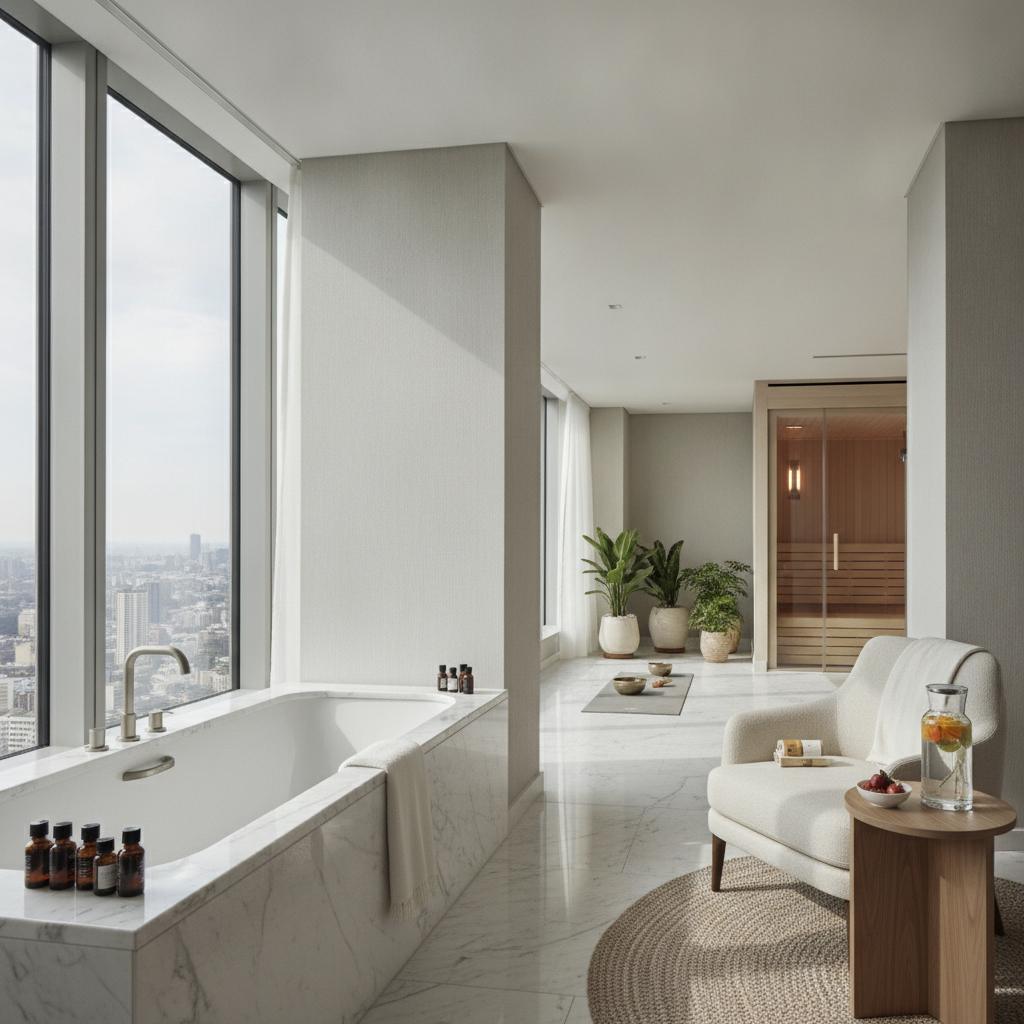
Guests no longer view luxury amenities as a bonus tucked away in a basement spa. In 2026, luxury amenities have become a core part of how hotels compete, retain guests, and justify premium rates. For General Managers, Spa & Wellness Directors, and property owners, understanding what qualifies as a true luxury amenity — and how to build a coherent portfolio of them — is now a strategic imperative rather than a design afterthought.
TL;DR — The Bottom Line
Luxury amenities in 2026 are shifting from isolated spa add-ons to integrated wellness ecosystems that combine thermal circuits, technology-driven recovery, and in-room experiences. Wellness tourism has grown into a $900 billion-plus category, and hotels that treat luxury amenities as a connected guest journey — not a single feature — capture stronger loyalty, higher rate premiums, and better utilization. Success depends less on capital-heavy construction and more on smart, modular, guest-facing programming.
What Are Luxury Amenities in Modern Hotels?
Historically, luxury amenities meant plush robes, a rooftop pool, or a single treatment room tucked behind the gym. That definition has expanded considerably. Today, luxury amenities are judged by whether they deliver a measurable outcome for the guest — better sleep, faster recovery, visible relaxation, or a genuine sense of exclusivity — rather than simply signaling cost.
The Global Wellness Institute has documented this shift clearly, noting that hotels are moving beyond basement spas toward larger hydrothermal zones, destination-scale wellness facilities, and spaces that can also serve the local community. This means the bar for what counts as "luxury" keeps rising, and properties that rely on a single legacy amenity — say, an underused steam room — risk falling behind guest expectations.
For property owners evaluating capital plans, this is good news: luxury amenities no longer require a full spa wing to compete. Modular, in-suite, and technology-forward solutions now allow properties of nearly any size to deliver a luxury amenity experience that rivals larger resorts.
The Shift From Spa Add-On to Revenue Driver
Perhaps the most important change in how hoteliers should think about luxury amenities is that they are increasingly framed as revenue and brand differentiators, not cost centers. Wellness tourism is now estimated at over $900 billion globally, according to Forbes reporting in 2026, and guests are actively selecting properties based on the depth and quality of their wellness offering.
This reframing matters for how GMs pitch amenity investments internally. Instead of asking "how much will this cost to maintain," ownership groups are increasingly asking "how much rate premium, repeat booking, and ancillary spend can this generate." Luxury amenities that are bookable, programmable, and shareable on social media tend to outperform static, decorative features.
No. Boutique and upper-midscale properties are increasingly competing on luxury amenities by choosing compact, modular solutions — in-suite recovery features, technology-driven wellness devices, and curated programming — rather than attempting to replicate a full resort spa footprint.
Core Categories of Luxury Amenities Guests Expect in 2026
When mapping out a luxury amenities strategy, it helps to separate offerings into distinct categories rather than treating "wellness" as one monolithic bucket. Below is a breakdown of the categories most frequently cited in current hospitality wellness reporting.
| Category | What It Includes | Guest Appeal |
|---|---|---|
| Thermal Circuits | Sauna, steam, plunge, and recovery lounge sequences | Full sensory ritual, strong social sharing value |
| In-Room Wellness Tech | Red light panels, PEMF mats, infrared devices | Privacy, convenience, personalization |
| Private Wellness Suites | Bookable rooms with integrated sauna/steam/soaking | Exclusivity, premium pricing power |
| Recovery Programming | Guided rituals, contrast therapy coaching, sleep programs | Perceived expertise, repeat engagement |
| Premium Fitness | Quiet, branded, low-maintenance cardio and strength equipment | Reliability and daily-use satisfaction |
Notice that no single category dominates. The strongest luxury amenities strategies blend at least two or three of these categories so that guests encounter wellness touchpoints throughout their stay — not just during a scheduled spa appointment.
Building a Luxury Amenities Portfolio: What Belongs Where
One of the most common mistakes property owners make is concentrating all wellness capital into one dedicated space, such as a spa floor, while ignoring the rest of the guest journey. A more effective approach treats luxury amenities as a layered portfolio across three zones.
1. Public Wellness Zones
These are shared thermal circuits, pools, and lounges designed for higher utilization. Communal contrast circuits — combining sauna, steam, and cooling elements — allow multiple guests to use the space simultaneously, improving the return on square footage compared to single-use treatment rooms.
2. Private and VIP Spaces
Compact plunge pools, private saunas, and bookable wellness suites are particularly attractive here because they deliver a luxury signal without requiring a large floorplate. This is where boutique properties can compete directly with larger resorts on a per-square-foot basis.
3. In-Suite Guest Rooms
In-room wellness features — from soaking tubs to recovery technology — extend the luxury amenities experience into the most private part of a guest's stay. This is increasingly where guest satisfaction scores are won or lost, since it reflects a 24-hour relationship with wellness rather than a single scheduled visit.
Solutions like those offered through HotelPlunge are frequently positioned within this third category, helping properties extend hydrothermal-style luxury amenities into individual suites without the engineering complexity of a full spa build-out.
Technology-Driven Recovery: The New Amenity Frontier
Beyond thermal water features, technology is reshaping what guests consider a luxury amenity. Red light therapy, PEMF (pulsed electromagnetic field) mats, and infrared solutions are moving from niche wellness clinics into mainstream luxury hotel spas.
The scale of this shift is notable: the global red light therapy market is projected to reach $587.5 million in 2026, with luxury hospitality cited as one of the fastest-growing commercial adoption segments. For hotel owners, this signals that technology-driven recovery amenities are not a passing fad but a maturing product category with dedicated manufacturers, service providers, and guest demand data behind it.
Red light therapy panels, PEMF recovery mats, infrared sauna blankets, and smart temperature-controlled water features are the technologies most frequently added to premium hotel spas and recovery suites this year, according to current hospitality wellness reporting.
Importantly, these technologies tend to work best when paired with human-guided programming — a trained spa attendant explaining the recovery ritual, or a printed protocol card in-room — rather than being left as unexplained equipment. Guests increasingly expect luxury amenities to come with a narrative, not just a feature list.
Measuring ROI: Key Facts and Stats on Luxury Amenities
Quantifying the return on luxury amenities can be challenging because much of the value shows up in indirect metrics — guest satisfaction scores, repeat booking rates, and social media impressions — rather than a single line item. Still, several data points help frame the size of the opportunity.
Quick Facts
- Wellness tourism market size: Over $900 billion globally (Forbes, 2026)
- Red light therapy market: Projected to reach $587.5 million in 2026
- Design trend: Multi-room thermal circuits are outpacing single-room spa concepts
- Guest expectation shift: Cooling experiences are broadening beyond single-modality cold plunges to include snow rooms, walking pools, and contrast cycles
- Utilization strategy: Communal contrast circuits are being favored over single-use treatment rooms for higher throughput
Luxury amenities are increasingly evaluated on guest outcomes rather than square footage alone — a measurable shift documented across recent hospitality wellness reporting. This reframing gives GMs a stronger internal argument: amenity investment decisions should be modeled the same way a restaurant concept or loyalty program would be, with clear KPIs tied to occupancy, rate, and repeat visitation.
Sustainability is also becoming part of the ROI conversation. Geothermal heating, lower-chemical water treatment, and energy-efficient thermal systems are increasingly marketed as both a luxury signal and an operating-cost advantage, appealing to ownership groups focused on long-term efficiency as much as guest experience.
Common Mistakes When Investing in Luxury Amenities
Even well-funded properties make avoidable errors when building out luxury amenities. The most frequent issues include:
- Treating amenities as static features. A beautiful thermal suite without programming, staff training, or booking flow underperforms a modest amenity that is well-marketed and easy to reserve.
- Over-indexing on one modality. Properties that invest heavily in a single feature — one plunge pool, one steam room — without a broader circuit often see lower repeat usage than properties offering a connected sequence of experiences.
- Ignoring in-suite opportunities. Guest rooms represent the largest surface area in most hotels, yet in-room wellness is frequently the last category to receive investment.
- Underestimating maintenance and staffing needs. Luxury amenities that break down or lack trained attendants quickly damage the brand promise they were meant to reinforce.
How to Prioritize Luxury Amenities Investments
For GMs and owners evaluating where to start, a phased approach tends to outperform trying to build every category at once.
- Audit current guest feedback. Review satisfaction surveys and review sites for recurring mentions of wellness, recovery, or relaxation gaps.
- Identify your highest-traffic zone. Determine whether public spa areas, VIP suites, or standard guest rooms see the most guest dwell time, and prioritize luxury amenities there first.
- Choose modular over monolithic. Favor amenities that can be added incrementally — such as in-suite features — over large single-phase construction projects.
- Pair equipment with programming. Every physical amenity should come with a guided ritual, instructional material, or trained staff touchpoint.
- Track outcome metrics. Monitor repeat bookings, rate premiums, and review sentiment tied directly to the new amenity before expanding further.
Companies supporting this incremental approach, including HotelPlunge, have emerged specifically to help properties add wellness-grade luxury amenities without requiring the engineering complexity of traditional spa construction.
Frequently Asked Questions
What qualifies as a luxury amenity in a hotel?
A luxury amenity is any hotel-provided feature, technology, or service that delivers elevated comfort or a measurable wellness outcome beyond basic accommodation — ranging from thermal circuits and private wellness suites to in-room recovery technology and curated guest programming.
Do luxury amenities require major renovation or construction?
Not necessarily. While full hydrothermal circuits do require significant capital planning, many modern luxury amenities — particularly in-suite wellness technology and modular private suites — can be added without extensive renovation, making them accessible to boutique and midscale properties.
Which luxury amenities are trending most in 2026?
Multi-room thermal circuits combining sauna, steam, and cooling elements are the leading trend, alongside technology-driven recovery tools like red light therapy and PEMF mats, and private, bookable wellness suites that extend hydrothermal-style experiences into more intimate settings.
How do hotels measure the ROI of luxury amenities?
ROI is typically measured through a combination of rate premiums, repeat booking rates, guest satisfaction and review sentiment, ancillary spa or wellness spend, and social media engagement tied to the amenity, rather than a single direct revenue line.
Are cold plunge features still relevant within a luxury amenities strategy?
Yes, though the trend is moving from single-modality cold plunges toward a broader "cooling menu" that may include experience showers, walking pools, and guided contrast cycles alongside traditional plunge features, giving properties more flexibility in how they deliver cold therapy as part of a wider luxury amenities offering.
Conclusion: Turning Luxury Amenities Into a Competitive Advantage
The hotels winning the loyalty of discerning travelers in 2026 are not necessarily the ones with the biggest spa footprint — they are the ones that treat luxury amenities as an integrated, guest-facing strategy spanning public wellness zones, private suites, and in-room technology. As wellness tourism continues to grow into a $900 billion-plus global category, the properties that move early on modular, well-programmed luxury amenities will be better positioned to capture rate premiums and repeat guests than those waiting for a single large capital project.
If your property is evaluating where to start, focus first on the guest touchpoints with the highest dwell time and the lowest current investment — often the guest room itself. Explore how modular, in-suite wellness solutions from HotelPlunge can help your property deliver genuine luxury amenities without the cost and complexity of a full spa renovation.