Luxury Off-Grid Architectural Homes: Investor Guide
May 27, 2026 · 13 min read
TL;DR — The Bottom Line
Luxury off-grid architectural homes have evolved from fringe lifestyle to a scalable, high-yield asset class. The global off-grid housing market is projected to nearly double from $2.4 billion in 2023 to $4.76 billion by 2032, driven by HNWIs seeking sustainability, autonomy, and immersive nature experiences. For investors and discerning travelers, brands like The Lookout Towers represent the convergence of architectural distinction, ecological resilience, and hotel-grade hospitality.
The conversation around luxury has fundamentally shifted. Where opulence was once measured in square footage and proximity to urban centers, today's affluent buyers and travelers measure it in autonomy, ecological integrity, and the architectural drama of a property's relationship to its landscape. Luxury off-grid architectural homes sit at the apex of this shift — properties that are self-sufficient in energy and utilities, designed by serious architects, and engineered to deliver hotel-grade comfort in landscapes that would otherwise be unreachable.
For investors, hospitality operators, and individual buyers, this category offers something rare: a tangible asset that appreciates on both design merit and operational yield. This guide examines the market, the architecture, the economics, and the strategic positioning of luxury off-grid architectural homes — with a particular lens on how vertical, view-driven concepts like The Lookout Towers are reshaping the segment.
Quick Facts
- Global Off-Grid Housing Market (2023): ~$2.4 billion
- Projected Market Size (2032): ~$4.76 billion
- U.S. Off-Grid Households: ~750,000, growing ~10% annually
- Unique Airbnb Stays Booked (2021): 2.5+ million nights
- Top Energy System: Solar PV + lithium battery storage (Sonnen, Enphase IQ)
- Primary Buyer Profile: HNWIs, affluent millennials, hospitality investors
Why Luxury Off-Grid Architectural Homes Are the New Status Asset
The redefinition of luxury is the single most important trend driving this category. For the previous generation of affluent buyers, status was conveyed through urban penthouses, gated coastal estates, and the visible markers of scale. Today's buyer — particularly the affluent millennial and Gen-X investor — measures status through scarcity of experience, ecological credibility, and architectural distinction.
Luxury off-grid architectural homes deliver on all three vectors simultaneously. They are scarce because they require specific topography, planning approvals, and architectural talent. They are ecologically credible because self-sufficiency is engineered into their core, not bolted on as a marketing claim. And they are architecturally distinct because, freed from suburban context and utility connections, designers can pursue dramatic forms — cantilevered volumes, mirrored facades, vertical towers — that respond purely to landscape and light.
The financial implications are significant. According to market research, the global off-grid housing market was valued at approximately $2.4 billion in 2023 and is projected to reach $4.76 billion by 2032, effectively doubling within a decade. This growth is not driven by hobbyists; it is driven by capital allocators who recognize that luxury off-grid architectural homes combine the wealth-preservation characteristics of real estate with the cash-flow potential of premium hospitality.
Both — but the financial case is now well established. Unique architectural stays achieved over 2.5 million nights booked on Airbnb in 2021 alone, and properties combining off-grid credentials with strong design routinely command 2-4x the average daily rate of conventional vacation rentals in the same region.
The Anatomy of a True Luxury Off-Grid Architectural Home
Not every cabin with solar panels qualifies. The defining characteristics of luxury off-grid architectural homes are technical depth, design rigor, and operational resilience. Understanding these characteristics is essential for buyers evaluating properties and for investors evaluating concepts.
Advanced Renewable Energy Systems
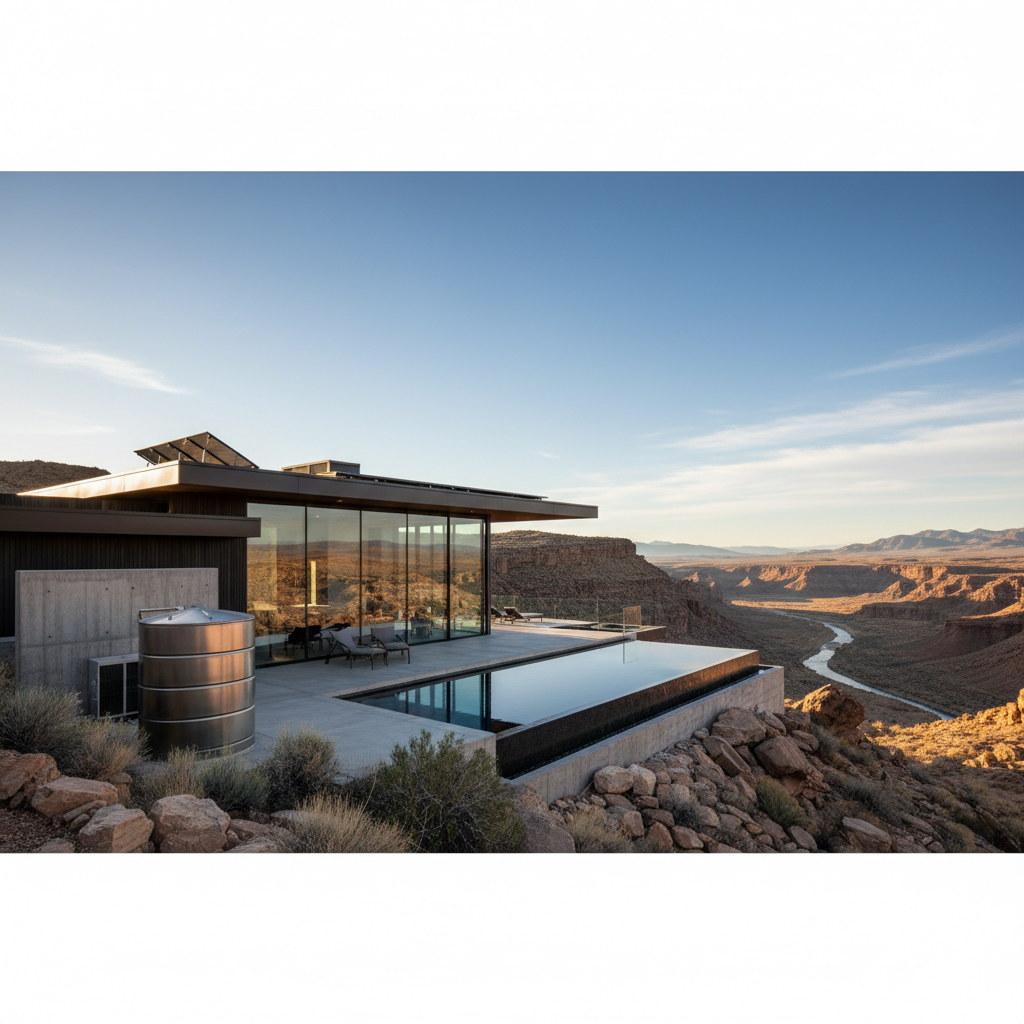
High-efficiency photovoltaic arrays remain the dominant energy source, typically sized at 150-200% of expected load to account for seasonal variance. The critical innovation has been at the storage layer: lithium battery systems from manufacturers like Sonnen and Enphase IQ enable true 24/7 grid independence, with intelligent load management that prioritizes essential systems during low-generation periods. In northern climates or shaded sites, wind turbines and geothermal ground loops supplement solar to enable year-round operation.
Water, Waste, and Resilience Infrastructure
Top-tier luxury off-grid architectural homes integrate rainwater collection, multi-stage filtration, and substantial on-site storage — often 5,000+ gallons. Wastewater is managed through advanced septic systems, greywater recycling for irrigation, and in some cases composting fixtures that eliminate blackwater entirely. This infrastructure is invisible to guests but represents 15-25% of total construction cost in premium properties.
Architectural Integration with Landscape
The hallmark of serious off-grid architecture is restraint. Minimal earthworks, foundations designed to disturb as little terrain as possible, and orientation calibrated to solar gain, prevailing winds, and sightlines. Vertical concepts — including the tower typology pioneered by The Lookout Towers design philosophy — achieve large viewsheds with small footprints, a particularly powerful approach in sensitive ecological zones.
Smart Home and Automation
Smart automation is non-negotiable at the luxury tier. Systems control lighting, climate, shading, water heating, and energy distribution to optimize efficiency while preserving comfort. For hospitality applications, remote monitoring allows operators to manage multiple units, anticipate maintenance, and provide guests with intuitive interfaces that hide the technical complexity.
The Tower Typology: A New Form Factor in Luxury Off-Grid
Within the broader category of luxury off-grid architectural homes, the vertical tower has emerged as one of the most distinctive and commercially successful form factors. The reasoning is both architectural and economic. Vertically organized residences maximize view exposure across multiple levels, minimize ground footprint (reducing site disturbance and permitting friction), and create an inherently photogenic silhouette that drives organic social distribution.
The historical precedent — fire lookout towers, watchtowers, lighthouses — provides a cultural resonance that contemporary horizontal cabins lack. When a guest stays in a tower, they are participating in an archetype, not just a vacation rental. This narrative dimension translates directly into pricing power and booking velocity.
From an operational standpoint, towers concentrate building services vertically, simplifying off-grid integration. Solar arrays mount on the highest roof for unshaded exposure, water storage gravity-feeds through the structure, and the small ground footprint reduces foundation cost and ecological impact. For investors building portfolios of luxury off-grid architectural homes, tower concepts offer one of the highest revenue-per-square-foot ratios in the segment.
"The vertical tower is to luxury off-grid hospitality what the loft was to urban residential — a form factor that creates new value by reorganizing how we inhabit space."
Market Demand and the Affluent Traveler
The demand signal for luxury off-grid architectural homes is unusually clear. Unique and design-forward stays — mirrored cabins, off-grid pods, prefab retreats, and towers — claimed the top category on Airbnb in 2021 with over 2.5 million nights booked. The trend has continued: the average daily rate for architecturally distinctive off-grid properties typically commands a 2-4x premium over conventional vacation rentals in equivalent locations.
The buyer and traveler profile is well-defined. Affluent millennials and Gen-X professionals lead demand, with strong representation from creative industries, technology, and finance. These travelers value digital detox but expect connectivity on demand, prize sustainability credentials but refuse to compromise on bedding, lighting, or culinary infrastructure. Luxury off-grid architectural homes are uniquely positioned to satisfy this dual mandate.
The Investment Economics of Luxury Off-Grid Architectural Homes
For investors evaluating the category, the underwriting follows three distinct value drivers: appreciation of the underlying real estate, operational yield from short-term rental, and brand equity created by media coverage and social distribution.
Capital Costs
Construction costs for luxury off-grid architectural homes typically run 20-40% above equivalent grid-connected luxury construction, primarily due to renewable energy infrastructure, water systems, and the architectural premium of remote sites. However, prefabricated and modular approaches — increasingly used at the high end — can compress timelines and stabilize budgets meaningfully.
Operational Yield
Well-positioned properties in this segment routinely achieve occupancy rates of 65-80% with average daily rates between $500-$1,500+ depending on location, design, and brand. Properties that gain media attention or strong social traction can substantially exceed these benchmarks. For comparison, conventional vacation rentals in the same geographies typically operate at 45-55% occupancy with materially lower nightly rates.
Brand and Media Value
Distinctive luxury off-grid architectural homes generate organic media coverage in design publications, travel media, and social platforms that would cost six or seven figures to acquire through paid channels. This earned media compounds, lowering customer acquisition cost over time and creating a defensive moat that conventional hospitality rarely achieves.
| Metric | Conventional Vacation Rental | Luxury Off-Grid Architectural Home |
|---|---|---|
| Occupancy Rate | 45-55% | 65-80% |
| Average Daily Rate | $200-$400 | $500-$1,500+ |
| Construction Premium | Baseline | +20-40% |
| Organic Media Coverage | Minimal | High / compounding |
| Annual Yield (Stabilized) | 6-9% | 10-15%+ |
How to Evaluate a Luxury Off-Grid Architectural Home Investment
For investors and buyers considering entry into this category, the evaluation framework should be rigorous. The combination of construction complexity, regulatory variability, and operational sophistication means that off-grid luxury rewards diligence and penalizes shortcuts.
- Site quality and access. Evaluate viewshed, solar exposure, water availability, and year-round access. The architectural premium is meaningless if guests cannot reach the property in shoulder seasons.
- Energy and water systems. Confirm system sizing, battery capacity, and redundancy. Request 12 months of operational data where available.
- Architectural credibility. Properties designed by recognized architects or built to a coherent design language command durable premium pricing. Generic prefab units do not.
- Regulatory standing. Verify permits, septic approvals, occupancy classifications, and short-term rental compliance in the jurisdiction.
- Operational infrastructure. Off-grid hospitality requires more sophisticated operations than conventional rental. Evaluate the management plan, monitoring systems, and maintenance reserves.
- Brand and distribution strategy. Assess how the property reaches guests. Direct-booking infrastructure, professional photography, and editorial relationships materially affect yield.
Well-executed properties in strong locations typically achieve payback on the construction premium within 4-7 years through higher ADRs and occupancy, with the underlying real estate continuing to appreciate independently. Tower-format properties tend to fall toward the shorter end of that range due to revenue density.
The Lookout Towers Approach: Vertical Luxury, Engineered for Yield
The Lookout Towers concept is purpose-built for this market reality. By focusing on the tower typology — an architectural form with deep cultural resonance, exceptional view performance, and minimal site impact — the brand addresses both the experiential demands of affluent travelers and the operational economics that sophisticated investors require.
Each tower is engineered as a self-sufficient system: integrated solar with lithium battery storage, rainwater collection and filtration, smart climate and lighting automation, and a finish palette calibrated to feel like a five-star hotel suite rather than a cabin. The vertical organization concentrates services, simplifies off-grid integration, and creates the multi-level view experience that drives premium ADRs.
For investors, the model offers a defined product, a repeatable operational playbook, and a brand identity strong enough to drive organic distribution. For guests, it offers something genuinely scarce: an architecturally significant stay in landscapes that conventional hospitality cannot reach. To explore investment opportunities or current availability, visit The Lookout Towers investment overview.
Looking Ahead: Where Luxury Off-Grid Architectural Homes Go Next
Three structural trends will shape the next decade of this category. First, climate volatility will increase the premium on properties with genuine resilience — water security, energy independence, and structural robustness. Second, regulatory frameworks in many jurisdictions are becoming friendlier to small-footprint, low-impact architectural homes, particularly when they replace lower-quality vacation rental stock. Third, the design conversation is maturing: the era of generic mirrored cabins is yielding to genuinely architect-led projects with distinct identities.
For affluent buyers, hospitality investors, and design-conscious travelers, luxury off-grid architectural homes represent one of the few categories in real estate where lifestyle value, ecological credibility, and financial performance align. The category is no longer experimental. It is institutional capital's next frontier in hospitality real estate.
Frequently Asked Questions
What defines a luxury off-grid architectural home?
A luxury off-grid architectural home is an architect-designed residence that is fully self-sufficient in energy, water, and waste management, located in a visually distinctive landscape, and delivering hotel-grade comfort through smart automation, premium finishes, and integrated renewable systems. The category is distinct from both conventional cabins and grid-connected luxury homes.
How much does it cost to build a luxury off-grid architectural home?
Construction costs typically run 20-40% above equivalent grid-connected luxury construction, driven by renewable energy infrastructure, water systems, and remote-site logistics. Tower-format properties and prefabricated modular approaches can compress costs and timelines while maintaining design integrity.
Are luxury off-grid architectural homes a good investment?
Yes, when properly designed and operated. The global off-grid housing market is projected to nearly double from $2.4 billion in 2023 to $4.76 billion by 2032, and architecturally distinctive properties routinely achieve 10-15%+ stabilized yields when operated as short-term rentals, alongside underlying real estate appreciation.
Can luxury off-grid architectural homes truly match the comfort of grid-connected luxury homes?
Yes. Modern lithium battery storage systems from manufacturers like Sonnen and Enphase IQ deliver seamless 24/7 power, supporting full HVAC, on-demand hot water, induction cooking, and high-bandwidth connectivity. Most guests cannot distinguish off-grid performance from grid-connected luxury.
What makes the tower typology particularly suited to off-grid luxury?
Vertical tower designs maximize viewsheds while minimizing ground footprint, simplifying off-grid integration through concentrated services and roof-mounted solar exposure. They also carry strong cultural resonance — lighthouses, fire lookouts — that translates into premium pricing power and organic media distribution.
Conclusion: The Architecture of Autonomy
Luxury off-grid architectural homes have crossed the threshold from niche curiosity to institutional asset class. They satisfy the redefinition of luxury as scarcity, ecology, and design distinction. They generate operational yields that meaningfully exceed conventional hospitality. And they create cultural and brand value that compounds over time. For the affluent buyer or sophisticated investor evaluating this market, the question is no longer whether the category is real — it is which properties, which form factors, and which operators will define the next decade.
The Lookout Towers is built precisely for this moment. To discuss investment opportunities, design philosophy, or to plan a stay at one of our properties, visit The Lookout Towers contact page and begin the conversation. The view, quite literally, is unlike anything else in luxury real estate.