Luxury Fire Tower vs Treehouse: Investor's Guide
June 5, 2026 · 13 min read
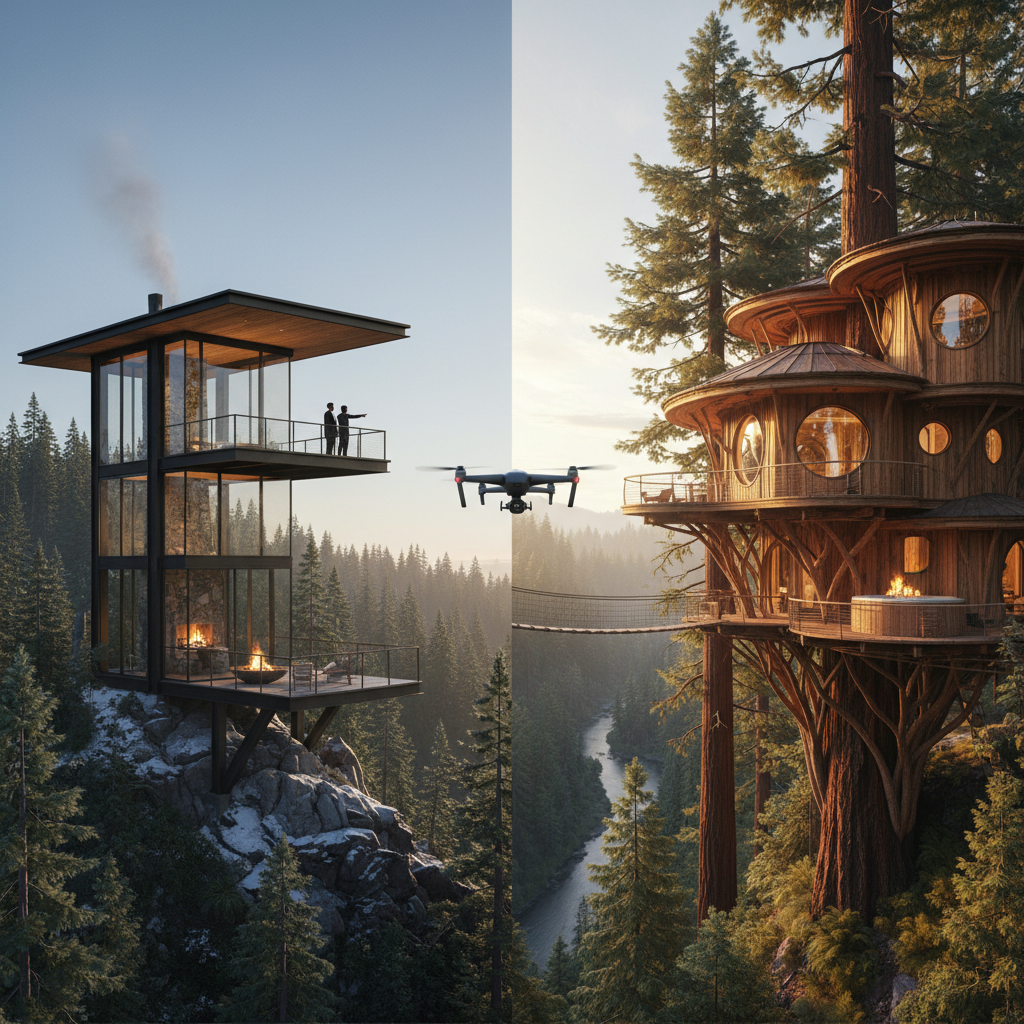
TL;DR — The Bottom Line
The luxury fire tower vs treehouse debate comes down to rarity versus market maturity. Luxury treehouses operate in a proven USD 332.4M global market growing at 5.9% CAGR, while fire towers occupy a scarcer, heritage-rich niche with stronger pricing power and storytelling depth. For investors and design-led hospitality operators, fire towers offer differentiated, high-margin positioning; treehouses offer faster proof of demand. The Lookout Towers blends both — heritage tower architecture with treehouse-grade luxury.
The conversation around elevated luxury stays has shifted dramatically in the last five years. What was once a category dominated by canopy-level timber cabins has expanded into something more architecturally ambitious — and the luxury fire tower vs treehouse comparison now sits at the center of high-end hospitality investment decisions. Affluent travelers want elevation, solitude, and a story. Investors want yield, scarcity, and a brand that can scale. Understanding how these two product typologies differ — and where they converge — is essential before committing capital to either.
This guide breaks down the luxury fire tower vs treehouse question across market size, design language, guest experience, regulatory complexity, and investment economics. Whether you're evaluating a private retreat, a boutique rental portfolio, or a licensed brand platform like The Lookout Towers' investment program, the distinctions below will shape your strategy.
Quick Facts
- Treehouse glamping market (2024): USD 332.4 million
- Projected market value (2030): USD 473.2 million
- CAGR 2025–2030: 5.9%
- Historic U.S. fire towers: 8,000+ (only ~300 still staffed)
- Typical nightly rate, luxury fire tower: USD 450–1,200
- Typical nightly rate, luxury treehouse: USD 350–950
Luxury Fire Tower vs Treehouse: Defining the Two Categories
Before comparing economics, it helps to be precise about what each product actually is. The luxury fire tower vs treehouse distinction isn't just about whether a structure sits in a tree or on stilts — it's about heritage, silhouette, and the emotional promise made to the guest.
A luxury fire tower is either an adaptive reuse of a historic fire lookout or a newly built structure inspired by that vernacular: vertical, often 30–80 feet tall, with a glazed cab at the top offering 360-degree views. The American fire lookout heritage — Kerouac on Desolation Peak, Gary Snyder at Crater Mountain, thousands of rangers scanning ridgelines through the 20th century — gives the typology a literary and historical depth no treehouse can match.
A luxury treehouse, by contrast, is a purpose-built hospitality or residential structure integrated with mature trees or designed to evoke canopy living. Modern luxury treehouses have evolved well past plank-and-rope nostalgia into what one industry analysis describes as "sleek lines, open-concept interiors, and futuristic aesthetics that rival stylish urban homes."
Yes. Fire towers are typically regulated as freestanding elevated structures subject to wind load, egress, and sometimes historic preservation codes. Treehouses are often governed by tree-protection ordinances, arborist sign-offs, and load calculations tied to the host tree's health. The regulatory paths are distinct even when the finished guest experience feels similar.
Market Size and Demand: Where the Money Actually Is
The most measurable side of the luxury fire tower vs treehouse comparison is demand data. According to Grand View Research, the global treehouse glamping market reached USD 332.4 million in 2024 and is projected to hit USD 473.2 million by 2030, growing at a 5.9% CAGR. That's a mature, validated category with established booking platforms, design vendors, and guest expectations.
Fire towers, by contrast, are barely a category in conventional market reports. The U.S. once had over 8,000 staffed fire lookout towers; today fewer than 300 remain in active use, with a small subset converted to vacation rentals through the U.S. Forest Service's recreation rental program or private adaptive reuse projects. That scarcity is precisely the point. In hospitality, an under-supplied product with strong narrative pull commands premium pricing and resists commoditization.
For an investor weighing the luxury fire tower vs treehouse decision, the trade-off is clear:
- Treehouses = proven demand, easier financing, more competition, modest premium over standard glamping.
- Fire towers = scarcer supply, higher perceived exclusivity, stronger editorial and social media pull, more complex permitting.
"Fire towers are not just buildings — they are inherited landscapes. That heritage is the single most defensible moat in luxury elevated hospitality."
Design Language and Guest Experience
Walk into a luxury treehouse and the experience is horizontal: you're surrounded by trunks and leaves, the windows frame branches, and the sound design is dominated by canopy rustle. Walk to the top of a luxury fire tower and the experience is vertical and panoramic: you're above the canopy, scanning ridgelines, with weather visibly moving across the landscape.
That sensory difference drives nearly every downstream design decision in the luxury fire tower vs treehouse comparison.
Fire Tower Interior Cues
- Wraparound glazing and a continuous viewing deck
- Compact, vertically organized layouts (often 200–400 sq ft on the cab level)
- Industrial-rustic materials: steel armature, blackened timber, exposed bracing
- Hero feature: the 360-degree horizon, not the structure itself
Treehouse Interior Cues
- Organic, biomorphic forms hugging existing trees
- Larger horizontal footprints (often 400–900 sq ft)
- Timber-forward, biophilic interiors with handcrafted joinery
- Hero feature: intimacy with the surrounding canopy
Both typologies now share tech-enabled amenities — radiant floors, hidden HVAC, smart lighting, blackout glazing, and premium bedding — but the spatial choreography differs significantly.
Construction, Engineering, and Regulatory Reality
The luxury fire tower vs treehouse question gets genuinely complicated once you move from renderings to permits. Each typology carries its own engineering and regulatory profile, and underestimating either is the most common reason boutique projects stall or blow their budgets.
Fire Tower Construction
New-build luxury fire towers typically use galvanized steel or engineered timber frames designed to handle significant wind loads at height. Foundations are concrete piers or helical piles. Vertical circulation — usually a switchback stair — drives a meaningful portion of the cost. Expect USD 350,000 to USD 1.2 million for a turnkey luxury tower, depending on height, site access, and finish level.
Treehouse Construction
Modern luxury treehouses rarely rely on a single tree for support. Most use a hybrid of tree-attached brackets (TABs) and ground-anchored posts, allowing the tree to flex without transferring damaging loads. Arborist sign-offs are mandatory in most jurisdictions. Costs range from USD 200,000 to USD 900,000 for true luxury builds.
Investment Economics: ROI in the Luxury Fire Tower vs Treehouse Debate
From a pure investment standpoint, the luxury fire tower vs treehouse decision reduces to four numbers: build cost, average daily rate (ADR), occupancy, and brand premium. Here's a realistic comparison based on stabilized year-two performance for well-designed units in scenic markets.
| Metric | Luxury Fire Tower | Luxury Treehouse |
|---|---|---|
| Build cost (turnkey) | $450K–$1.2M | $250K–$900K |
| Average daily rate | $550–$1,100 | $425–$850 |
| Stabilized occupancy | 62–75% | 65–78% |
| Annual gross revenue | $165K–$280K | $130K–$220K |
| Editorial / PR pull | Very high | Moderate–high |
| Time to stabilization | 9–14 months | 6–12 months |
Fire towers tend to win on ADR and editorial leverage. Treehouses win on speed-to-market and broader family appeal. A portfolio approach — running both typologies under one brand umbrella — is increasingly the strategy adopted by sophisticated operators. Learn more about portfolio modeling on the Lookout Towers portfolio page.
Fire towers generally hold stronger resale value because they read as architecturally significant freestanding structures, whereas treehouses are often viewed as accessory improvements tied to specific tree health. A well-built tower on a scenic parcel can appraise as a primary architectural asset; a treehouse usually appraises closer to a high-end outbuilding.
Guest Psychographics: Who Books Which?
The luxury fire tower vs treehouse comparison also splits along guest demographics, and matching the product to the right audience is critical for occupancy and review scores.
Fire Tower Guest Profile
- Couples aged 32–58, often without children
- Architecture, design, and literary enthusiasts
- Solitude-seekers, writers, photographers
- Higher willingness to pay for rarity and view
- Strong overlap with cabin-core and "slow travel" segments
Treehouse Guest Profile
- Couples and small families with children 6+
- Nostalgia-driven, biophilic-design oriented
- Eco-luxury and sustainability-conscious travelers
- Birthday, anniversary, and milestone bookings
- Higher repeat-visit rates
Neither audience is bigger or better — they're different. Treehouses produce more bookings per available night; fire towers produce higher revenue per booking and dramatically more user-generated content per stay.
Branding, Storytelling, and Long-Term Defensibility
This is where the luxury fire tower vs treehouse decision becomes most strategic. Treehouses, as a category, have been heavily commercialized. The aesthetic vocabulary — Scandinavian timber, black-clad exteriors, panoramic glazing — has been replicated thousands of times across Airbnb and design magazines. Differentiation now requires either extraordinary architecture or extraordinary location.
Fire towers retain a much stronger narrative moat. The cultural memory of the American lookout — solitary rangers, midcentury conservation, literary pilgrimages — provides storytelling depth that compounds over time. For brands building a licensable platform, this matters enormously. A heritage-anchored story scales across destinations without diluting; a generic design language does not.
The Lookout Towers brand was built explicitly around this insight: package the fire tower's heritage and silhouette with treehouse-grade interior luxury, and offer the result as a licensed brand and design system to landowners and developers. The result is a defensible niche rather than a commoditized one.
"In luxury hospitality, the most valuable asset is not the building — it's the story the building lets the guest tell about themselves the next morning."
How to Choose: A Decision Framework
If you're actively evaluating the luxury fire tower vs treehouse decision for your own project, the following step-by-step framework will clarify the right path.
- Audit your site. Does it have mature, healthy trees suitable for canopy integration? Or does it have an exposed ridge, meadow, or clearing with long sightlines? Trees push you toward a treehouse; views push you toward a tower.
- Check the regulatory map. Pull local zoning, tree-protection ordinances, and any historic preservation overlays before committing to a typology.
- Model both pro formas. Run side-by-side 10-year financials using realistic ADR and occupancy for your market.
- Test the story. Write the two-sentence guest-facing description for each option. Which one is more compelling? Which one would a magazine actually publish?
- Decide on scale. A single unit favors whichever story is stronger. A portfolio favors a tower-led brand with treehouse adjuncts for variety.
- Pressure-test financing. Lenders increasingly understand glamping and treehouse cash flow; tower lending may require a more sophisticated capital partner.
Frequently Asked Questions
Which earns more revenue: a luxury fire tower or a luxury treehouse?
On a per-night basis, luxury fire towers typically earn 20–35% higher ADR than comparable treehouses due to rarity and view premium. However, treehouses often achieve slightly higher occupancy. Annual gross revenue tends to favor fire towers in scenic ridge or mountain markets, while treehouses can outperform in forested or family-oriented destinations.
Are luxury fire towers harder to build than luxury treehouses?
Fire towers involve more vertical structural engineering and stricter wind-load calculations, but they avoid the biological uncertainty of tree-attached construction. Treehouses are often faster to design but slower to permit due to arborist sign-offs and tree-protection ordinances. Total project timelines are usually comparable: 12–24 months from concept to opening.
Can I convert a historic fire lookout into a luxury rental?
In some U.S. states, yes — particularly through long-term lease arrangements with the Forest Service or via private acquisition of decommissioned towers. However, historic preservation rules often restrict interior modifications. Many operators now build new towers inspired by the heritage form, which sidesteps preservation constraints while preserving the storytelling value.
What insurance considerations differ between fire towers and treehouses?
Fire towers are usually underwritten as freestanding commercial structures with wind and lightning riders. Treehouses are often underwritten as accessory structures with additional clauses around tree failure and biological risk. Premiums for treehouses can actually run higher per insured dollar because of the host-tree variable. Always secure a specialist hospitality broker before closing on either build.
Is the luxury fire tower vs treehouse market saturated?
The luxury treehouse segment is approaching maturity in North America and Western Europe — differentiation is increasingly difficult. The luxury fire tower segment remains substantially under-supplied, with fewer than a few hundred branded units globally. For investors seeking scarcity-driven returns, fire towers currently offer a meaningfully better supply-demand position.
Conclusion: Choosing Your Position in the Elevated Luxury Market
The luxury fire tower vs treehouse decision is ultimately a question about what kind of asset you want to own and what kind of story you want to tell. Treehouses offer a proven, growing market with established guest expectations and faster financing pathways. Fire towers offer scarcity, heritage, panoramic drama, and a narrative moat that compounds with every guest stay and editorial feature.
For most sophisticated investors and developers, the smartest path is not choosing one over the other — it's building a brand platform anchored in the rarer, more defensible fire tower typology while incorporating treehouse-grade interior craft and the occasional canopy-level adjunct for portfolio variety. That is precisely the model The Lookout Towers has built, and it is the model best positioned to capture both the growth of the treehouse market and the premium economics of the fire tower niche.
If you're ready to explore building, licensing, or investing in an elevated luxury lookout property, connect with The Lookout Towers team to discuss site evaluation, brand licensing, and investment partnership opportunities. The elevated luxury market is still in its early innings — and the operators who define the category now will own it for the next decade.