Luxury Fire Tower Construction Methods: Expert Guide
June 16, 2026 · 13 min read
TL;DR — The Bottom Line
Luxury fire tower construction methods blend historic lookout typologies with modern engineered timber, structural steel, and reinforced concrete foundations to create elevated retreats, residences, and hospitality assets. Today's high-end towers typically stand 40–120 feet tall, use hybrid construction systems, and rely on prefabrication to manage remote-site logistics—delivering iconic 360-degree experiences that command premium nightly rates and strong investor returns.
The market for vertical, nature-immersed accommodations has matured dramatically over the past decade, and nowhere is that more evident than in the rise of sophisticated luxury fire tower construction methods. Once purely utilitarian wildfire-detection structures, fire towers have been reimagined as architectural statements, boutique hospitality assets, and bespoke residential landmarks. For affluent buyers, developers, and investors entering this niche, understanding the engineering, materials, and assembly techniques behind these structures is essential to making confident decisions.
At The Lookout Towers, we've spent years refining the design and delivery of elevated retreats that honor the lookout tradition while meeting modern luxury standards. This guide breaks down the construction methodologies, material systems, and project realities that define today's premium tower builds.
Quick Facts
- Typical Height Range: 40–120 feet (historic USFS benchmark)
- Common Footprint: 400–800 sq ft per level; 800–2,800 sq ft total
- Foundation Type: Reinforced concrete piers or mat slab
- Primary Structure: Hybrid steel + engineered timber
- Kit Assembly Time: 1–2 weeks with a two-person crew + lift equipment
- Typical Build Duration: 6–14 months for custom luxury towers
Why Luxury Fire Tower Construction Methods Matter Now
The demand for unique, experience-driven accommodations has reshaped luxury hospitality. Affluent travelers are no longer satisfied with standardized resorts—they seek architecturally distinctive stays that connect them to landscape and story. Fire towers, with their dramatic verticality and 360-degree vistas, deliver that emotional payoff better than almost any other typology. As a result, the luxury fire tower construction methods used today must satisfy demanding criteria: structural reliability under wind loads, premium interior finishes, energy efficiency, and the ability to be built on remote, often topographically challenging sites.
Historic Forest Service guidance specified tower heights of 60–120 feet to maximize fire-detection sightlines. That same scale benchmark now informs hospitality design, because elevation is what creates the signature "above-the-canopy" experience guests pay premium rates to enjoy. Properties developed with smart investment frameworks are showing nightly rates 2–4x comparable ground-based cabins in the same region.
The Foundation: Engineering for Stability and Permanence
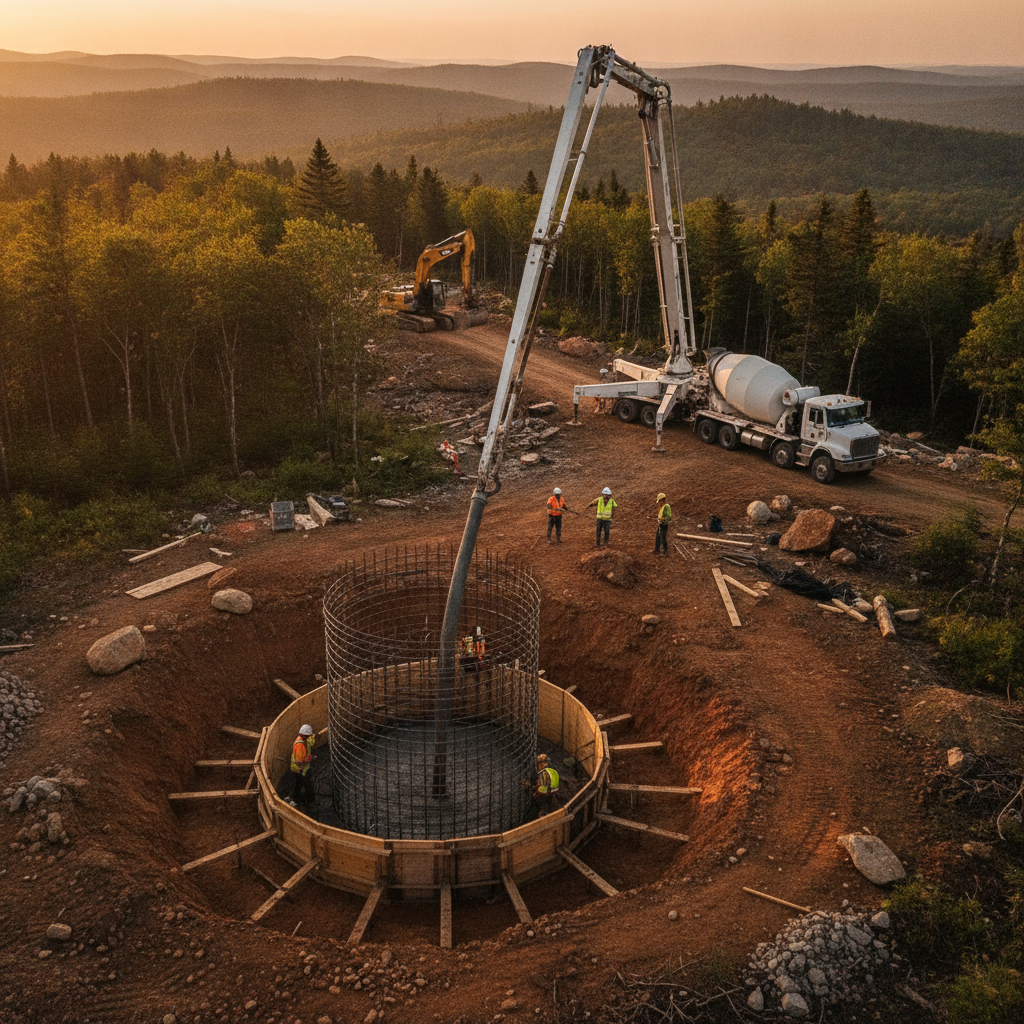
Every successful tower project begins below grade. Because luxury towers are tall, slender, and wind-exposed, the foundation must resist both vertical loads and significant overturning moments. The most common approach in modern luxury fire tower construction methods is a reinforced concrete system, sized to local soil and wind conditions.
Foundation Options
- Reinforced concrete piers: Ideal for rocky or sloped sites; minimizes excavation impact.
- Mat or raft slabs: Used on softer soils where load distribution is critical.
- Helical pile systems: Increasingly used in remote or environmentally sensitive sites where concrete pours are difficult.
- Hybrid pier-and-grade-beam: Common for towers with attached ground-level structures.
Geotechnical investigation is non-negotiable. A proper soils report determines bearing capacity, frost depth, and seismic considerations—all of which dictate foundation geometry. Skipping this step is the single most common error in first-time tower projects.
Structural Systems: Steel, Timber, and Hybrid Frames
The vertical structure is where luxury fire tower construction methods truly diverge from historic lookouts. Where 20th-century fire towers used unadorned galvanized steel angle frames, today's luxury towers blend materials for both performance and aesthetics.
Structural Steel
Steel remains the workhorse for vertical support. It offers high strength-to-weight ratios, predictable engineering behavior, and the ability to span tall sections without intermediate bracing. Modern luxury towers typically use wide-flange columns or HSS (hollow structural section) tubes, often prefabricated off-site and erected in segments. This approach reduces field labor and improves precision—critical on remote sites where skilled welders are expensive to mobilize.
Engineered Timber
Glulam beams, cross-laminated timber (CLT), and mass timber columns have transformed the visible character of luxury towers. Timber delivers the warmth, biophilic appeal, and authentic lookout aesthetic that affluent buyers want. It also sequesters carbon, which matters to ESG-conscious investors. Engineered timber is dimensionally stable, fire-rated when properly sized (mass timber chars predictably), and beautiful when left exposed.
Hybrid Construction
The dominant approach today combines all three materials: concrete below grade, steel for the primary tower skeleton, and engineered timber for floor systems, beams, and the habitable cabin at the top. This hybrid model leverages each material's strengths while controlling cost and construction complexity.
Yes, but it's uncommon above 50 feet. All-timber towers require larger member sizes and more intricate connections to resist wind loads, often increasing cost compared to a steel-timber hybrid. For towers above 60 feet, a hybrid steel-timber system is typically the most cost-effective and structurally efficient approach.
Prefabrication and Kit-of-Parts Assembly
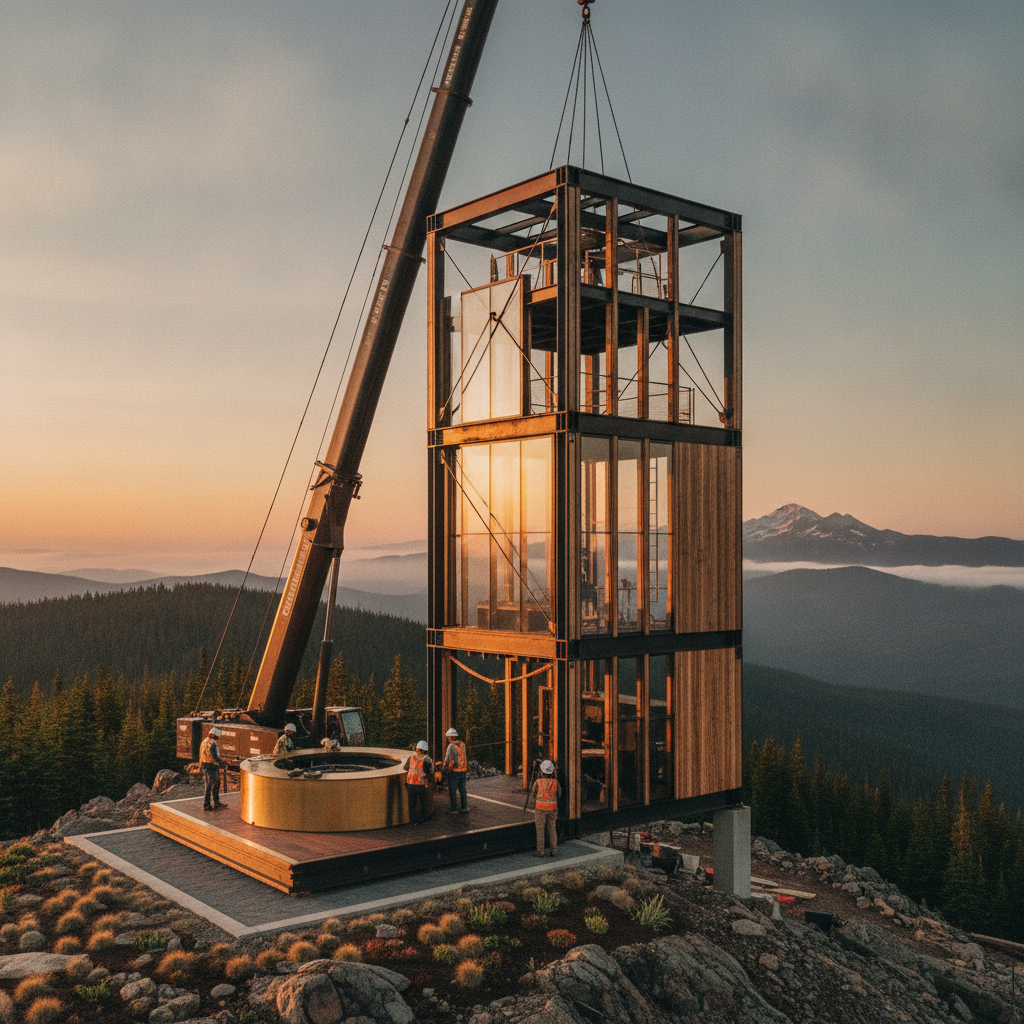
One of the most important shifts in luxury fire tower construction methods is the move toward prefabrication. Remote sites—mountaintops, ridgelines, private wilderness parcels—make traditional stick-built construction slow, expensive, and weather-dependent. Prefabricated components solve those problems.
How Prefabrication Works
- Design and engineering: Every component is engineered and detailed in the office, with full CNC-ready drawings.
- Off-site fabrication: Steel sections, timber members, wall panels, and roof assemblies are built in controlled factory environments.
- Transport: Components are shipped flat-packed or in modular crates to the site.
- On-site erection: A small crew with a crane or telehandler assembles the tower in days or weeks rather than months.
Published design sources note that a two-person crew with lifting equipment can erect an 800-square-foot kit tower in one to two weeks. For larger custom builds—such as a 2,800-square-foot, four-level tower with an elevator—erection typically takes 4–8 weeks, followed by interior finish work.
Building Envelope: Glazing, Insulation, and Weather Performance
The envelope is where luxury fire tower construction methods most clearly serve the guest experience. Buyers expect floor-to-ceiling glazing, wraparound terraces, and seamless indoor-outdoor transitions—but towers must also withstand high winds, driving rain, snow loads, and temperature swings at elevation.
Glazing Strategy
- Triple-pane insulated glazing units (IGUs): Standard for high-altitude or cold-climate projects.
- Low-E coatings: Manage solar heat gain on south and west elevations.
- Structural silicone or aluminum-clad timber mullions: Minimize visible framing for cleaner sightlines.
- Operable corner windows: Deliver the iconic "sky room" feel guests pay for.
Insulation and Air Sealing
Continuous exterior insulation, high-performance air barriers, and careful detailing at floor-to-wall transitions are essential. Towers have a disproportionately high surface-area-to-volume ratio, which means heat loss is amplified compared to ground-level buildings. Spray foam, mineral wool, and rigid exterior insulation are all common; selection depends on climate zone and finish strategy. Many of our design-build packages integrate envelope performance modeling from day one.
Mechanical, Electrical, and Smart Systems
Modern luxury fire tower construction methods incorporate sophisticated MEP systems that would have been unimaginable in historic lookouts. Vertical circulation, off-grid capability, and connectivity are all part of the technical package.
Core Systems Checklist
- Elevators: Increasingly standard in towers above two habitable levels, especially for residential use.
- Mini-split HVAC or radiant floors: Efficient climate control without bulky ductwork.
- Solar PV with battery storage: Common for remote sites; can deliver full off-grid operation.
- Lightning protection systems: Mandatory for tall, exposed structures—UL-listed air terminals, down conductors, and grounding.
- Satellite internet (Starlink-class): Now expected by luxury guests and remote workers.
- Smart-home automation: Lighting, shading, climate, and security integrated via tablet or app.
For a 60–100 ft luxury tower, a properly engineered lightning protection system typically costs $8,000–$25,000 depending on complexity. Given the structure's exposure, it's one of the highest-ROI investments you can make for asset protection and insurance qualification.
Site Logistics and Phased Construction
Remote-site logistics often define project feasibility more than design choices. A documented Maine tower-home project illustrates the typical phased sequence: site access road, foundation excavation and pour, steel tower erection, beam installation, top-level deck and cabin framing, envelope close-in, MEP rough-in, and interior finishes.
Typical Construction Phases
- Site preparation: Access roads, staging areas, utility trenches.
- Foundation: Excavation, rebar, concrete pours, cure time.
- Structural erection: Steel columns, bracing, primary beams.
- Floor and deck framing: Engineered timber systems at each level.
- Envelope: Sheathing, weather barrier, windows, roofing, cladding.
- MEP rough-in: Electrical, plumbing, HVAC, low-voltage.
- Interior finishes: Millwork, flooring, fixtures, furnishings.
- Commissioning: Systems testing, smart-home setup, final inspections.
Cost Drivers and Investment Considerations
Investors evaluating luxury fire tower construction methods should understand where money flows in a typical project. Unlike conventional homes, towers carry unusual cost structures driven by height, remoteness, and engineering intensity.
Primary Cost Drivers
| Cost Category | Typical Share of Budget | Notes |
|---|---|---|
| Foundation & sitework | 15–25% | Higher on rocky or remote sites |
| Structural steel & timber | 20–30% | Hybrid systems optimize this |
| Envelope & glazing | 15–20% | Premium glazing is non-negotiable |
| MEP & smart systems | 15–20% | Off-grid adds 5–8% |
| Interior finishes | 15–20% | Luxury market expectations |
| Logistics & crane | 5–10% | Highly site-dependent |
Properties built with proven luxury fire tower construction methods consistently outperform comparable ground-based cabins on revenue per available room (RevPAR), often by a factor of 2–4x. Explore our consultation process for site-specific feasibility modeling.
Code Compliance and Permitting Realities
Towers used for habitation or hospitality must meet the International Building Code (IBC) or International Residential Code (IRC) depending on use classification, plus local zoning, environmental, and fire codes. Common compliance issues include:
- Egress: Two means of egress are often required above certain occupancy thresholds—typically an interior stair plus an exterior stair or refuge platform.
- Wind load engineering: Stamped structural calculations for exposure category C or D in most rural sites.
- Fire separation and sprinklers: Required for many hospitality classifications.
- ADA accessibility: Triggered for commercial/hospitality use; elevator strategy must account for this.
- Environmental review: Wetlands, viewshed, and habitat protections vary widely by jurisdiction.
Engaging a local civil engineer and land-use attorney early can save months of rework. The most successful projects integrate code strategy into the schematic design phase, not after permit submittal.
Quotable Insight from the Field
"The defining feature of luxury fire tower construction methods isn't height alone—it's the disciplined integration of structural engineering, prefabrication, and biophilic design into a single, repeatable system that performs in remote locations and commands premium returns."
Frequently Asked Questions
How tall can a luxury fire tower legally be built?
Heights vary by jurisdiction, but most residential and hospitality towers fall between 40 and 120 feet. Above ~75 feet, additional engineering, egress, and FAA notification requirements often apply. Historic USFS lookouts were typically 60–120 feet.
What materials are best for luxury fire tower construction?
The dominant approach is a hybrid system: reinforced concrete foundations, structural steel for the primary tower frame, and engineered timber (glulam, CLT) for floors, beams, and the habitable cabin. This balances cost, performance, and aesthetics.
How long does it take to build a luxury fire tower?
Prefabricated kit towers can be erected in 1–2 weeks with a small crew, but complete custom luxury builds—including foundation, finishes, and commissioning—typically take 6–14 months from groundbreaking to occupancy.
Are luxury fire towers a good investment?
For operators in scenic markets, yes. Tower stays consistently command nightly rates 2–4x comparable ground-based cabins, with strong year-round occupancy when paired with professional branding and distribution. ROI depends on land cost, build cost, and operating model.
Can luxury fire towers be built off-grid?
Absolutely. Solar PV with battery storage, propane backup, composting or septic systems, and satellite internet make full off-grid operation realistic. Off-grid systems typically add 5–8% to total build cost but unlock remote, high-value sites.
Bringing Your Tower Vision to Life
Luxury fire tower construction methods have evolved from utility to artistry. Today's towers are engineered hospitality assets and architectural landmarks—structures that anchor brand identity, deliver unforgettable guest experiences, and generate exceptional returns. Whether you're an investor evaluating a hospitality concept, a landowner exploring a signature residence, or an operator seeking to expand a portfolio, understanding the construction realities is the first step toward a successful project.
The team at The Lookout Towers partners with clients across every stage—site evaluation, design, engineering, prefabrication, and operations. If you're ready to explore what a luxury fire tower could mean for your land or your portfolio, reach out for a consultation. The view from the top is worth every step of the climb.