Architectural Glamping Luxury: The Lookout Towers Guide
June 1, 2026 · 13 min read
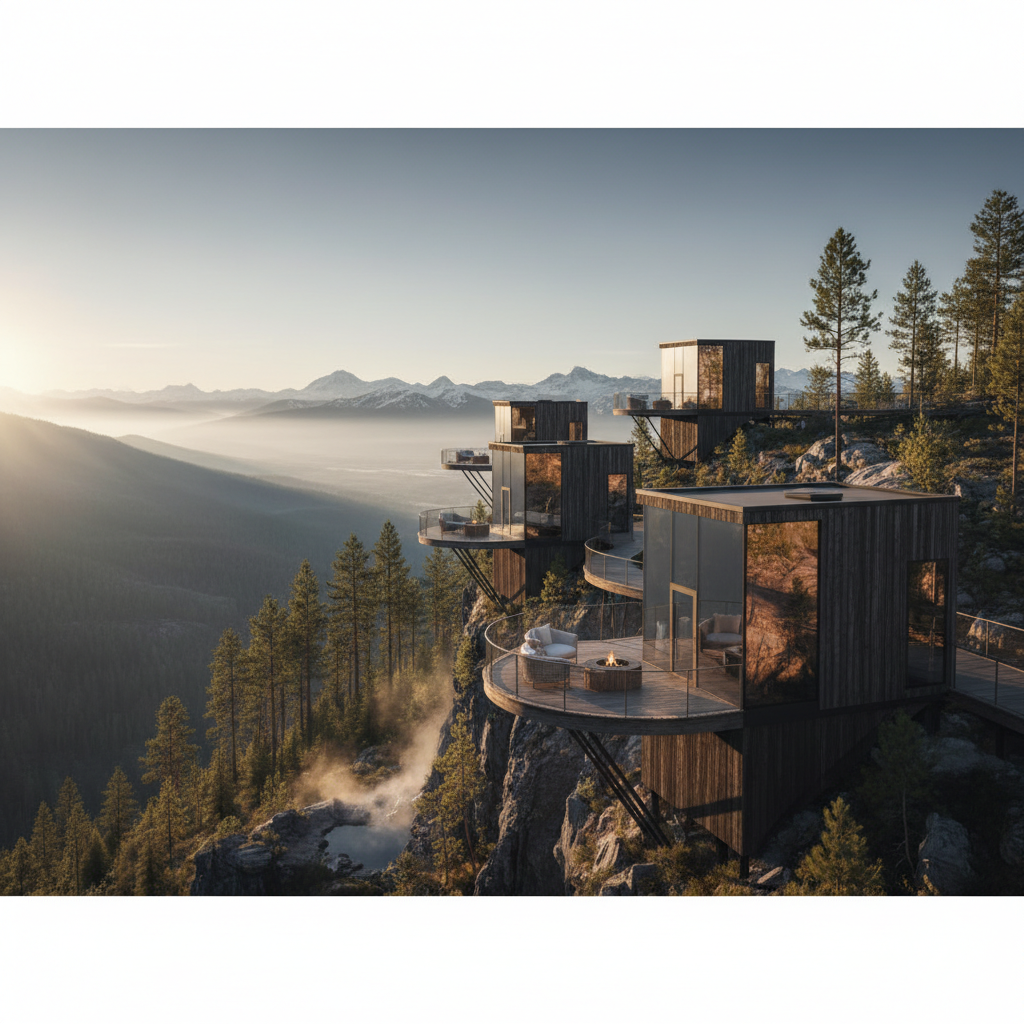
TL;DR — The Bottom Line
Architectural glamping luxury is the fastest-growing segment of experiential hospitality, blending iconic design, deep nature immersion, and wellness into permanent, high-ADR retreats. The global glamping market is projected to reach USD 8.2–9.3 billion by 2032–2034 at roughly 10–11% CAGR, with 66% of guests now preferring permanent cabin-style structures. For investors and discerning travelers, elevated tower typologies — like those pioneered by The Lookout Towers — represent the most defensible position in this category.
The luxury hospitality landscape has shifted decisively. Affluent travelers no longer measure status by thread counts or marble lobbies — they measure it by view, silence, story, and authorship. This is precisely the territory of architectural glamping luxury: design-led, permanent, nature-embedded structures that read as iconic real estate rather than upgraded camping. At The Lookout Towers, we see this convergence every day — guests booking for the architecture, investors underwriting for the yield, and both groups recognizing that elevated, view-maximizing cabins occupy a uniquely defensible niche.
This guide unpacks the market data, design principles, investment economics, and guest psychology shaping the architectural glamping luxury category in 2025 and beyond. Whether you're considering a stay, a second home, or a hospitality investment, the following sections distill what separates enduring architectural icons from novelty stays.
Quick Facts
- Global glamping market (2025): USD ~3.6–4.5 billion
- Projected market (2032–2034): USD 8.2–9.3 billion
- CAGR: 10.3–11.16%
- Guest preference for permanent cabins: 66%
- Asia-Pacific market (2024): USD ~670 million, 10.5% CAGR
- Highest-converting glamping format: permanent, year-round architectural units
Why Architectural Glamping Luxury Is the Defining Hospitality Category
Traditional luxury hotels are commoditizing. A 1,000-room flag in any capital city now competes with hundreds of near-identical peers, all sourcing from the same design libraries and amenity playbooks. Architectural glamping luxury solves this by replacing replicability with singularity: each structure is engineered to its site, its sightlines, and its story. The result is hospitality that cannot be cloned — and pricing power that follows.
Three forces are propelling architectural glamping luxury into the mainstream of affluent travel. First, the experiential economy: ultra-high-net-worth travelers consistently report preferring memorable, photographable, story-rich stays over conventional five-star formats. Second, the wellness imperative: nature exposure, silence, and circadian-aligned design are now table stakes for the affluent traveler. Third, the sustainability mandate: low-density, light-touch developments resonate with both guest values and increasingly strict planning regimes.
For investors, this translates into a category with structural tailwinds, premium ADRs versus build cost, and modular scalability. A single architectural tower can generate ADRs of $600–$1,500+ per night in mature markets, with build costs that pencil far more favorably than a comparable boutique hotel key. Explore the underlying investment thesis for a deeper breakdown of unit economics.
A boutique hotel concentrates rooms in a shared building with communal corridors and central services. Architectural glamping luxury distributes standalone, architect-designed structures across a landscape, giving every guest a private, view-led experience with hotel-grade finishes — typically at higher ADRs and lower per-key construction density.
The Market Case: Data Behind the Architectural Glamping Luxury Boom
Market analysts agree on the trajectory, if not the precise endpoint. The global glamping market sits between USD 3.6 billion and USD 4.5 billion in the mid-2020s, with forecasts converging on USD 8.2–9.3 billion by 2032–2034. That implies a compound annual growth rate of 10.3% to 11.16% — roughly triple the growth rate of traditional hotel categories over the same horizon.
Regional breakdowns are equally instructive. Asia-Pacific alone was valued at approximately USD 670 million in 2024 and is forecast to grow at 10.5% CAGR through 2031, signaling that architectural glamping luxury is no longer a Western niche. Europe leads in design sophistication; North America leads in deployed inventory; APAC leads in growth velocity.
Within the broader glamping category, the architectural sub-segment captures disproportionate value. Permanent, design-led units — towers, treehouses, cabins, pavilions — command 40–80% rate premiums over tents, domes, and pods in comparable locations, and they convert at materially higher rates across direct booking channels.
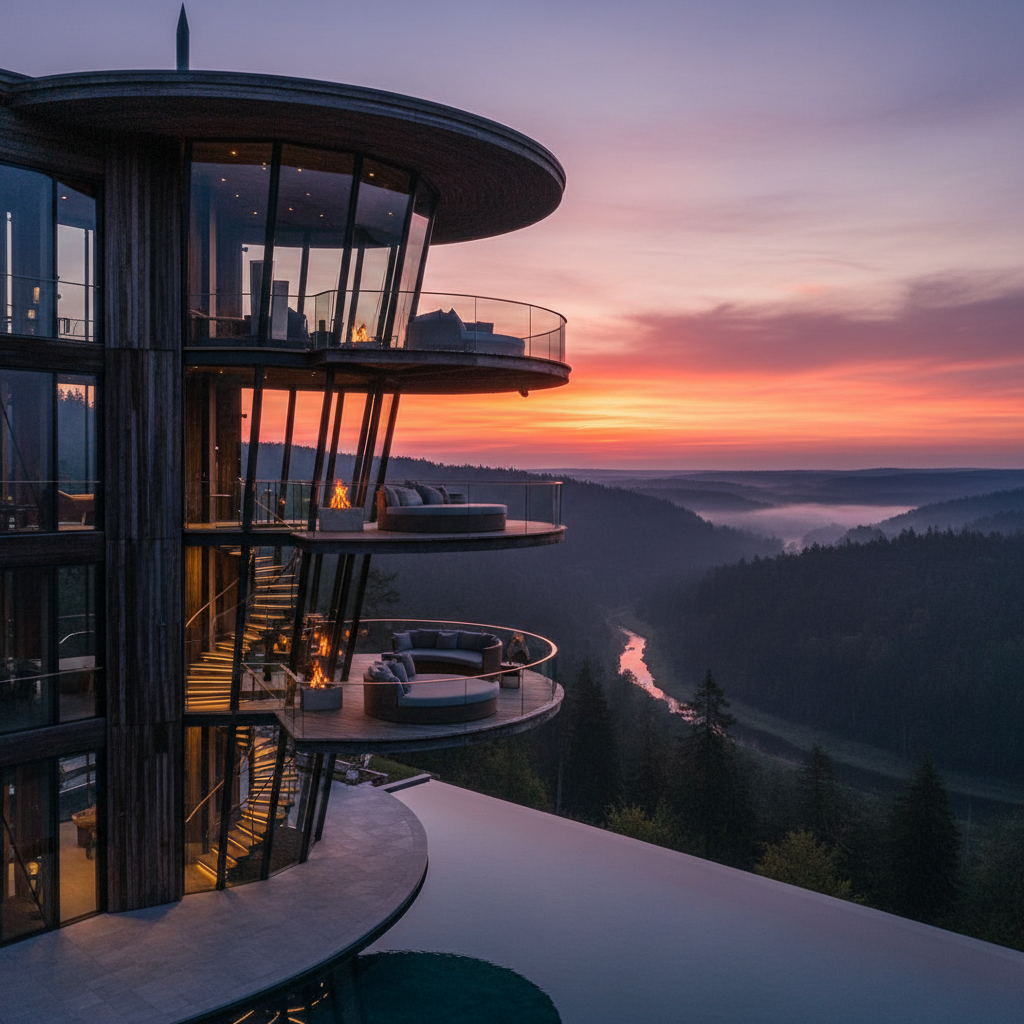
What's Driving Demand?
- Rising discretionary spend among UHNW and HNW travelers seeking experiences over possessions.
- Wellness migration from urban spas to immersive nature retreats with measurable health outcomes.
- Remote-work flexibility extending typical stays from 2 nights to 4–7 nights, lifting RevPAR.
- Social signaling: architecturally distinctive stays generate organic UGC that compounds marketing efficiency.
- Sustainability values: low-impact builds align with the ethics of affluent younger demographics.
What "Luxury" Actually Means in Architectural Glamping Today
The phrase architectural glamping luxury has evolved past the early-2010s definition of "a tent with a chandelier." Today's guests — and underwriters — define luxury through five tangible dimensions: design authorship, site response, material integrity, sensory privacy, and integrated wellness.
Design authorship means a named architect or studio with a clear vocabulary, not a catalog-ordered shell. Site response means orientation calibrated to sunrise, sunset, prevailing wind, and view axes — every degree of rotation matters. Material integrity means honest, tactile, locally sourced finishes: oiled timber, blackened steel, stone, linen. Sensory privacy means acoustic separation, dark-sky lighting, and view lines that never cross another guest's deck. Integrated wellness means in-suite saunas, soaking tubs, cold plunges, and circadian lighting — not a shared spa down the path.
The Vertical Advantage: Why Towers Win
Among architectural typologies, vertical structures — towers, lookouts, elevated cabins — carry distinct advantages. They maximize view yield per square meter of land, minimize wildlife and vegetation disturbance, and create a memorable spatial narrative as guests ascend through living, sleeping, and observation levels. The vertical typology also commands the highest ADR premium in the category, often 25–40% above ground-level equivalents.
This is the architectural thesis behind The Lookout Towers design philosophy: every structure is engineered as a vertical instrument for landscape — its form, glazing, and orientation calibrated to extract maximum experiential value from its site.
Design Principles of Architectural Glamping Luxury
The most successful properties in this category share a coherent design DNA. Understanding these principles helps guests evaluate quality and helps investors evaluate underwriting assumptions.
1. Warm Minimalism
Restrained forms, generous glazing, tactile natural materials. The architecture recedes so the landscape can advance. Color palettes favor charred timber exteriors and pale, neutral interiors that read as a frame around the view.
2. Site-Responsive Orientation
Each structure is sited individually — never on a grid. Orientation accounts for prevailing wind (for ventilation and acoustic comfort), solar gain (for passive thermal performance), view axes (for the headline moment), and privacy lines (so no two decks ever see each other).
3. Climate-Responsive Performance
Triple glazing, hydronic underfloor heating, mechanical heat recovery ventilation, and high-mass interiors deliver year-round comfort. A luxury architectural cabin must perform identically in February and August — seasonality is the enemy of yield.
4. Integrated Wellness Infrastructure
In-suite saunas, cedar soaking tubs, outdoor showers, cold plunges, and yoga decks are now baseline expectations at the top of the architectural glamping luxury market. These features drive both ADR and length of stay.
5. Dark-Sky and Acoustic Discipline
Lighting is warm, low, and downward-facing — preserving star visibility and circadian alignment. Acoustic separation is engineered, not assumed: dense walls, decoupled decks, and generous spacing between units.
The Investment Case for Architectural Glamping Luxury
For investors, architectural glamping luxury offers a rare combination: structural market growth, premium pricing power, modular scalability, and lower capital intensity per key than comparable boutique hotels. The category has matured beyond speculative novelty into a defensible asset class.
Unit Economics at a Glance
| Metric | Boutique Hotel Key | Architectural Tower Unit |
|---|---|---|
| Build cost per key | $450k–$1.2M | $280k–$650k |
| Stabilized ADR | $350–$700 | $600–$1,500 |
| Occupancy (mature) | 65–75% | 60–80% |
| Operating margin | 22–32% | 40–55% |
| Time to stabilization | 24–36 months | 12–18 months |
The operating margin advantage is decisive. Architectural glamping luxury properties carry far less fixed overhead — no large F&B operation, no central lobby staffing, no extensive back-of-house — while charging hotel-equivalent or higher rates. Margins of 40–55% are achievable at mature properties.
Yes. Many properties in this category operate as hybrid use: owners enjoy personal use for 4–8 weeks annually, with the unit placed into a managed rental program for the remainder. Net yields of 5–9% on capital, plus capital appreciation, are typical in well-sited assets. Learn more about ownership opportunities.
Risk Factors to Underwrite
- Planning and zoning: elevated structures in sensitive landscapes face increasing scrutiny.
- Climate exposure: wildfire, storm, and flood risk must be priced into both construction and insurance.
- Operational complexity: distributed units require skilled hospitality management.
- Brand differentiation: as the category grows, generic offerings will compress; architectural distinction becomes the moat.
How to Choose an Architectural Glamping Luxury Property
For affluent travelers evaluating where to book — or where to invest — the following criteria separate enduring properties from novelty stays.
- Architect of record: Is the structure attributed to a named studio with a portfolio you can verify?
- Site density: How many units share the property? Below 1 unit per 2 acres is a strong indicator of true privacy.
- View authorship: Does the headline view feel curated and exclusive, or generic?
- Wellness specification: Are sauna, plunge, and bath features in-unit or shared?
- Year-round performance: Is the property genuinely four-season, or does it close for shoulder months?
- Operator track record: Does management have hospitality pedigree, or is this a passion project?
- Sustainability credentials: Are claims certified (e.g., Passivhaus, LEED, BREEAM) or marketing copy?
A property that scores strongly on five or more of these criteria is highly likely to deliver both guest satisfaction and investment durability.
The Wellness Layer: Where Architectural Glamping Luxury Is Heading
The next frontier for architectural glamping luxury is deep integration with wellness — not as an amenity bolt-on, but as the organizing logic of the architecture itself. Properties leading this evolution are designing for biophilic exposure, circadian alignment, vagal-nerve activation (via cold and heat protocols), and silence as a measurable wellness asset.
Expect to see the following in top-tier architectural glamping luxury properties over the next 36 months: in-unit infrared and traditional saunas, contrast hydrotherapy circuits, biometric sleep optimization (mattress, lighting, air), in-room cold plunges, dedicated meditation lofts, and forest-bathing trail networks designed into the masterplan from day one.
This wellness layer materially expands the addressable market. A property that is both architecturally iconic and clinically wellness-credible competes for the longevity-travel and medical-wellness budgets — where ADRs of $1,500–$4,000+ are commonplace.
"The defining luxury of the next decade is not what you can buy, but what you can step away from. Architectural glamping luxury is the built form of that idea."
Sustainability as a Premium, Not a Compromise
Affluent travelers — particularly under 50 — increasingly require that their luxury choices align with environmental values. Architectural glamping luxury is uniquely positioned to deliver this: low site coverage, light-touch foundations, off-grid energy potential, and material palettes that age into the landscape rather than against it.
The most credible properties are pursuing measurable certifications (Passivhaus performance, net-positive energy operation, FSC-certified timber sourcing) and publishing transparent impact reports. This isn't greenwashing — it's the new entry ticket for the top quartile of the market. Properties without verifiable sustainability credentials will increasingly be priced out of UHNW consideration.
Frequently Asked Questions
What exactly is architectural glamping luxury?
Architectural glamping luxury refers to permanent, architect-designed accommodation structures — typically towers, treehouses, cabins, or pavilions — that combine high-design authorship, deep nature immersion, hotel-grade finishes, and integrated wellness amenities. It is distinct from tent-based glamping and from traditional hotels in both format and pricing.
How much does an architectural glamping luxury stay typically cost?
ADRs in the category typically range from $600 to $1,500 per night for established properties, with ultra-luxury wellness-led properties reaching $2,000–$4,000. Pricing reflects design authorship, site exclusivity, wellness specification, and operator pedigree.
Is architectural glamping luxury a good investment?
The category offers structural market growth (10–11% CAGR), premium ADRs versus build cost, operating margins of 40–55% at mature properties, and shorter stabilization windows than boutique hotels. Net yields of 5–9% on invested capital are typical in well-sited, well-operated assets, plus capital appreciation potential.
What makes The Lookout Towers different from other glamping operators?
The Lookout Towers focuses exclusively on vertical, view-maximizing architectural structures engineered as instruments for landscape. Every tower is site-specifically designed, four-season specified, and integrated with in-unit wellness infrastructure — positioning the brand at the intersection of iconic architecture and serious wellness rather than novelty glamping.
How sustainable is architectural glamping luxury compared to traditional hotels?
Properly designed architectural glamping luxury properties have materially lower environmental impact than traditional hotels — smaller footprints, lighter foundations, off-grid energy potential, and locally sourced materials. Credible operators pursue certifications such as Passivhaus, LEED, or BREEAM and publish transparent impact reports.
Conclusion: The Future Belongs to Architectural Glamping Luxury
The convergence of experiential travel demand, wellness imperatives, sustainability values, and design-led differentiation has created a hospitality category that is structurally advantaged for the next decade. Architectural glamping luxury is no longer an emerging niche — it is the leading edge of how affluent travelers and sophisticated investors are redefining what luxury accommodation means.
For guests, the proposition is simple: a stay that cannot be replicated, in a structure authored for its site, surrounded by silence and view. For investors, the proposition is equally clear: premium ADRs, superior operating margins, structural market growth, and a defensible moat built from architectural authorship rather than commoditized amenities.
The Lookout Towers exists at this intersection — pioneering vertical, view-maximizing architectural glamping luxury that performs as both an unforgettable guest experience and a high-yield real estate asset. Whether you're planning your next escape or evaluating your next investment, we invite you to begin a conversation about what is possible when architecture, nature, and wellness are designed as a single instrument.