Beyond the Headlines: Spot Media Bias in Reporting
May 25, 2026 · 13 min read

TL;DR — The Bottom Line
Beyond the Headlines: Practical Ways to Spot Media Bias in Everyday Reporting means looking past whether facts are technically true and examining how stories are chosen, framed, sourced, and worded. Check who gets quoted, what's omitted, the loaded language used, and who owns or funds the outlet. With a few quick habits, any reader can decode bias in under 60 seconds.
You scroll your feed. A headline screams. A push notification buzzes. Within ten seconds, you've absorbed a framing, a villain, a hero, and a vague sense of outrage—without ever questioning the story behind the story. Welcome to modern news consumption, where the loudest voice usually wins and nuance dies in the algorithm. This is exactly why Beyond the Headlines: Practical Ways to Spot Media Bias in Everyday Reporting matters more than ever. Bias isn't always a lie. More often, it's a choice—about what to cover, who to quote, and which words to use.
At The DONUT, we believe readers deserve fast, witty, impartial news without jargon or drama. That mission starts with empowering you—the reader—to spot spin on your own. This guide gives you a practical toolkit for decoding bias in everyday reporting, whether you're reading a hometown paper, a cable transcript, or a viral tweet thread.
Quick Facts
- Most common bias type: Framing and source selection, not outright falsehood
- Biggest invisible bias: Omission—what the story leaves out
- Trust in U.S. mass media: Just 32% trust it "a great deal" or "fair amount" (Gallup, 2023)
- Time needed for a bias check: Under 60 seconds per article
- Top warning sign: Loaded language paired with anonymous sources
- Best defense: Reading laterally across 2–3 outlets
Why Going Beyond the Headlines Matters Now
Headlines are designed to make you click, not to inform you. A 2016 Columbia University and French National Institute study found that roughly 59% of links shared on social media are never actually clicked—meaning most people share stories based on the headline alone. That's a perfect environment for bias to thrive, because the headline is where editors compress (and often distort) the entire story.
Beyond the Headlines: Practical Ways to Spot Media Bias in Everyday Reporting isn't about becoming cynical. It's about becoming literate. The difference matters. A cynic dismisses everything. A literate reader knows how to extract signal from noise—and how to tell the difference between a reporter doing their job and a publisher pushing an agenda.
Trust in media has been falling for two decades. According to Gallup's 2023 polling, only 32% of Americans say they trust mass media "a great deal" or "a fair amount." That collapse isn't just about politics—it's about a generation of readers who've been burned by spin and don't know which tools to use to push back.
Step One: Identify What You're Actually Reading
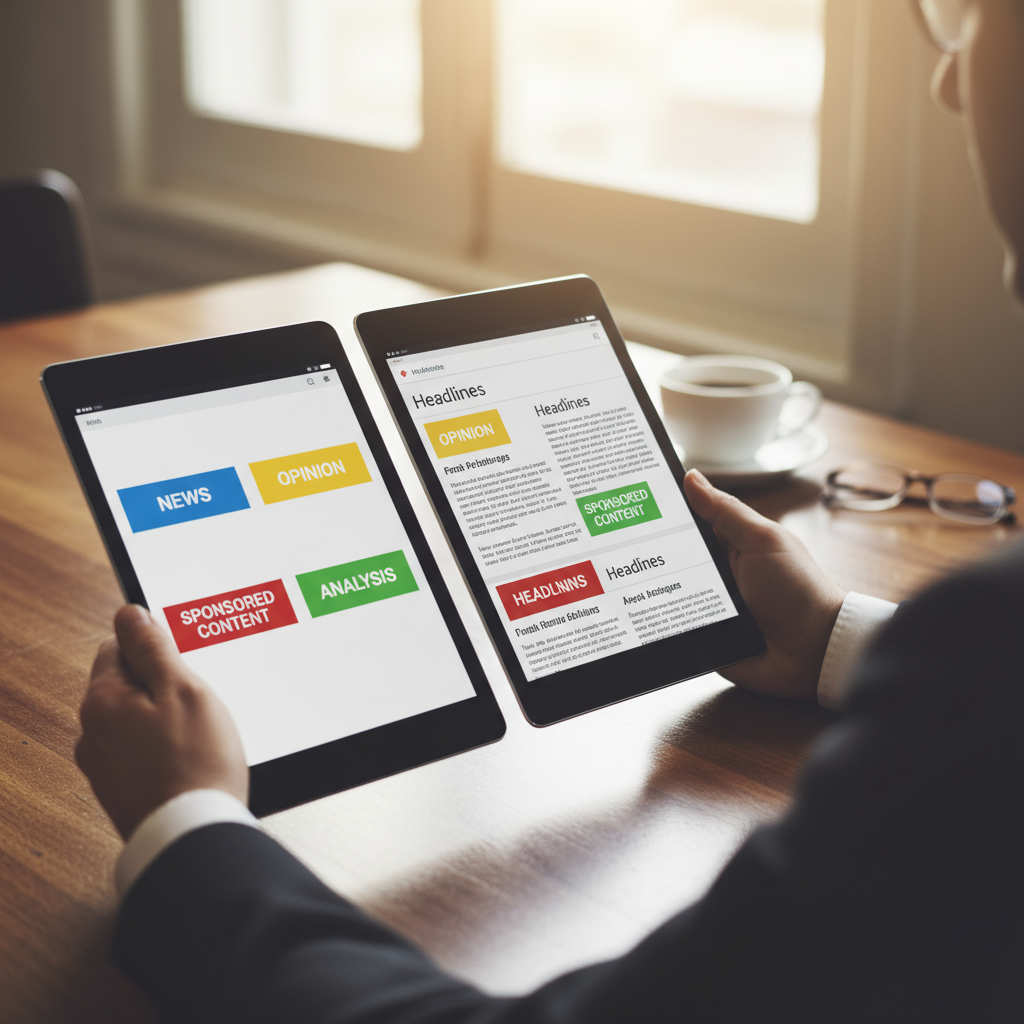
The first question to ask is deceptively simple: what type of content is this? Outlets routinely blur the lines between news, opinion, analysis, and sponsored content. A well-written opinion piece can feel like reportage. A native ad can mimic a news article almost perfectly.
The Four Content Types
- News: Verified facts, multiple sources, attempts at neutrality.
- Analysis: A reporter connects dots and offers interpretation, but should still be evidence-based.
- Opinion/Editorial: An argument. One person's view. Should be clearly labeled.
- Sponsored content: Paid by a brand or interest group. Required disclosure but often buried.
If a piece isn't clearly labeled, that ambiguity is itself a red flag. Reputable outlets—including the kind of impartial sources we link to at The DONUT's source page—make labels obvious. When you can't tell whether you're reading reporting or argument, assume argument until proven otherwise.
Step Two: Ask Who Gets to Speak
Source selection is one of the most powerful—and most overlooked—forms of media bias. Reporters rarely lie about who said what. But they choose who to call, who to quote, and whose voice leads the article. That choice shapes everything.
Three Questions About Sources
- Whose voices appear most? If a story about a labor dispute quotes three executives and zero workers, that's a top-down bias—even if every quote is accurate.
- Is there genuine diversity of perspective? Diversity isn't just demographic. It includes ideological range, geographic spread, and lived experience. A piece about rural broadband that only quotes urban policy analysts has a blind spot.
- Why is anonymity granted? Anonymous sources are legitimate when there's risk—whistleblowers, vulnerable communities. But the article should explain why anonymity was granted. Unexplained, repeated anonymity often signals spin.
No. Anonymous sources are essential for stories involving genuine risk to the source—think Watergate or modern whistleblower reporting. The red flag is when anonymity is used frequently, without justification, and to deliver opinions or attacks rather than verifiable facts.
Step Three: Follow the Money and the Ownership
Ownership shapes coverage—not always through direct interference, but through hiring, framing, and quiet editorial pressure. Knowing who owns and funds an outlet is foundational to Beyond the Headlines: Practical Ways to Spot Media Bias in Everyday Reporting.
Key Funding Models to Recognize
- Billionaire- or hedge fund-owned: Watch for soft coverage of the owner's other businesses or political interests.
- Ad-driven: Often rewards attention-grabbing, divisive, or emotionally heated coverage because clicks pay the bills.
- Nonprofit or member-supported: Tends to lean into mission-aligned beats (climate, democracy, social justice, etc.). Less commercial pressure but a different kind of editorial slant.
- State-funded: Can produce excellent journalism (BBC, NPR) but requires extra scrutiny on stories involving the funding state.
Practical move: when you notice a pattern—"this outlet never criticizes Big Tech," "this channel always sides with police unions"—check the ownership and funding. The blind spot usually has a paycheck behind it.
Step Four: Decode Framing and Loaded Language
Two journalists can report the same event with completely accurate quotes and still produce wildly different stories. The difference is framing—the deliberate choice of what to emphasize, what to lead with, and what verbs to use.
The Framing Test
Ask yourself: how is this event being categorized? A street protest can be described as:
- A "demonstration" (neutral, civic)
- An "uprising" (heroic, justified)
- "Unrest" (worrying, ambiguous)
- A "riot" (criminal, chaotic)
Each word implies a judgment. The facts can be identical, but the reader's takeaway is completely different. Beyond the Headlines: Practical Ways to Spot Media Bias in Everyday Reporting requires noticing these framing choices in real time.
The Loaded-Language Swap
Rewrite charged sentences in your head with neutral terms. If the emotional charge disappears, the original language was doing political work. Examples of buzzwords that carry heavy ideological baggage:
- "Thug," "terrorist," "radical," "extremist"
- "Woke," "snowflake," "elites," "globalist"
- "Crime wave," "invasion," "crisis," "chaos"
- "Patriots," "freedom fighters," "resistance"
None of these words are inherently wrong. But a piece that leans on labels instead of specifics—numbers, dates, direct quotes—is doing rhetoric, not reporting.
"If you rewrite a charged sentence in neutral terms and the story falls apart, the language was the story."
Step Five: Hunt for What's Missing
Omission is the most powerful and most invisible form of bias. You can't notice what isn't there—unless you train yourself to look.
Three Questions to Surface Omissions
- What's the obvious question this piece doesn't answer? If a story celebrates a new factory but never mentions environmental review or wages, those omissions are the story.
- Which stakeholders are missing? Workers, residents, opposition voices, independent scientists, affected communities.
- Are only favorable data points cited? A propaganda hallmark is presenting only the numbers that support a conclusion while ignoring inconvenient ones.
Ask yourself before reading: "If I were affected by this story, what would I want to know?" Then check whether the article answers those questions. Compare the same story across two or three different outlets—gaps become obvious instantly. Tools like The DONUT's cross-outlet comparison guide can speed this up.
Step Six: Read Laterally, Not Vertically
Stanford History Education Group researchers studying digital literacy found that professional fact-checkers don't evaluate sources by reading them top to bottom ("vertical reading"). Instead, they open multiple tabs and compare—a practice called lateral reading.
The 60-Second Lateral Read
- Open the original article.
- Open one ideologically opposite outlet covering the same story.
- Open one wire service (AP, Reuters) for a baseline.
- Compare: which facts appear in all three? Which only in one?
Facts that appear across the ideological spectrum are usually solid. Facts that appear in only one outlet—or are framed dramatically differently—deserve a second look. This is the single most effective habit in any reader's toolkit for Beyond the Headlines: Practical Ways to Spot Media Bias in Everyday Reporting.
Step Seven: Audit Your Own Algorithm
The most powerful bias filter in your life isn't an editor. It's your feed. Social platforms learn what you click, share, and linger on—and then they show you more of it. Over time, you're not reading the news. You're reading your own confirmation bias reflected back as news.
Three Habits to Audit Your Feed
- Diversify your follows. Add at least three outlets whose perspectives you disagree with. You don't have to share them—just see them.
- Use chronological feeds when possible. Algorithmic feeds amplify outrage. Chronological feeds at least show you what's actually new.
- Subscribe to neutral digests. Brand-driven, impartial summaries like The DONUT's daily digest deliberately strip out outrage and give you the day's news in plain English.
A Quick Comparison: Bias Signals at a Glance
| Bias Signal | Low Risk | High Risk |
|---|---|---|
| Labels | Clear "News," "Opinion," "Sponsored" | Unlabeled or buried disclosures |
| Sources | Diverse voices, named, explained | One-sided, anonymous, unexplained |
| Language | Specific facts, neutral verbs | Loaded buzzwords, emotional labels |
| Framing | Multiple angles acknowledged | Single villain/hero narrative |
| Omissions | Acknowledges counterpoints | Only favorable data, no critics quoted |
| Ownership | Transparent funding, editorial firewall | Hidden ownership, conflicts of interest |
Putting It All Together: Your 60-Second Bias Check
You don't need a journalism degree to apply Beyond the Headlines: Practical Ways to Spot Media Bias in Everyday Reporting. You need a checklist and sixty seconds. Here it is:
- 10 seconds: Is this news, opinion, analysis, or sponsored? If unclear, treat as opinion.
- 15 seconds: Who's quoted? Whose voice is missing? Any unexplained anonymous sources?
- 10 seconds: Spot any loaded words. Mentally swap them for neutral terms. Does the story survive?
- 15 seconds: What obvious question isn't answered?
- 10 seconds: Open one other outlet covering the same story. Compare.
That's it. A minute of friction between you and the headline is the difference between being informed and being manipulated.
"Bias rarely arrives as a lie. It arrives as a choice—about who speaks, what's emphasized, and what's quietly left out."
Frequently Asked Questions
What is the most common form of media bias in everyday reporting?
The most common form is bias by selection and omission—choosing which stories to cover, which sources to quote, and which facts to include or leave out. Outright falsehoods are rare in mainstream outlets; selective framing is the norm. Beyond the Headlines: Practical Ways to Spot Media Bias in Everyday Reporting always starts with asking what's missing, not just what's there.
How can I tell if a news article is biased in under a minute?
Run a 60-second check: identify the content type, scan who's quoted, mentally swap loaded language for neutral terms, ask what question the piece doesn't answer, and compare it briefly against one other outlet. If the story collapses without its emotional vocabulary, you're reading rhetoric, not reporting.
Are all news outlets biased?
Every outlet has a perspective, but bias and dishonesty are not the same thing. A well-run outlet labels its opinion content, sources transparently, and acknowledges counterpoints. The goal isn't finding a "bias-free" outlet—it's developing the skills to recognize slant wherever you find it.
What is lateral reading and why does it help spot bias?
Lateral reading is the practice of evaluating a source by opening multiple tabs and comparing how different outlets cover the same story, rather than reading one article top to bottom. Stanford researchers found that professional fact-checkers rely on it because cross-comparison surfaces omissions and framing differences almost instantly.
Does media bias only come from political ideology?
No. Commercial pressure, ownership interests, ad revenue models, access journalism, and even reporter convenience can all create bias independent of politics. A story can be slanted toward advertisers, toward official sources, or toward whatever is easiest to report—none of which fit neatly on a left-right spectrum.
Conclusion: Be the Editor of Your Own Feed
The news isn't broken. The relationship between readers and the news is broken—and rebuilding it starts with you. Beyond the Headlines: Practical Ways to Spot Media Bias in Everyday Reporting is ultimately about reclaiming agency. You don't have to accept what's pushed at you. You can interrogate it, compare it, and decide what to do with it.
The habits in this guide—labeling content, auditing sources, decoding language, spotting omissions, reading laterally, and watching your own algorithm—take less than a minute per article. Multiply that by the dozens of headlines you see each day, and you'll quickly become harder to manipulate than 95% of news consumers.
That's the whole point of The DONUT: fast, witty, impartial news without jargon or drama, written for readers who'd rather think than be told what to think. If this guide helped you, subscribe to our daily digest, share it with a friend who only reads headlines, and keep going beyond them. Your democracy—and your blood pressure—will thank you.
Subscribe to The DONUT's daily digest →