Slow Streets San Francisco Community Coffee Culture
May 14, 2026 · 13 min read
TL;DR — The Bottom Line
Slow Street Coffee is a hyper-local, family-run coffee business founded by NoPa resident Zaid Zayouna that transforms San Francisco's pedestrian-friendly Slow Streets into vibrant community gathering spaces. Operating as a mobile "coffee shop on two wheels," it delivers small-batch, Berkeley-roasted beans via e-bike and hosts pop-up events that spark neighborhood connections, playdates, and local commerce. If you care about slow streets San Francisco community coffee culture and want to support a grassroots business that puts people over cars, this is the story you need to read.
Quick Facts
- Founder: Zaid Zayouna, electrical engineer and NoPa resident
- Founded: Formally launched as Slow Street Coffee in 2023
- Roasting Location: Small-batch roasting in Berkeley, CA
- Delivery Method: E-bike and BART across San Francisco
- Primary Pop-Up Locations: Golden Gate & Baker, Page & Baker (NoPa/Haight)
- SF Slow Streets Scale: 23+ designated slow streets serving approximately 150,000 residents as of 2026
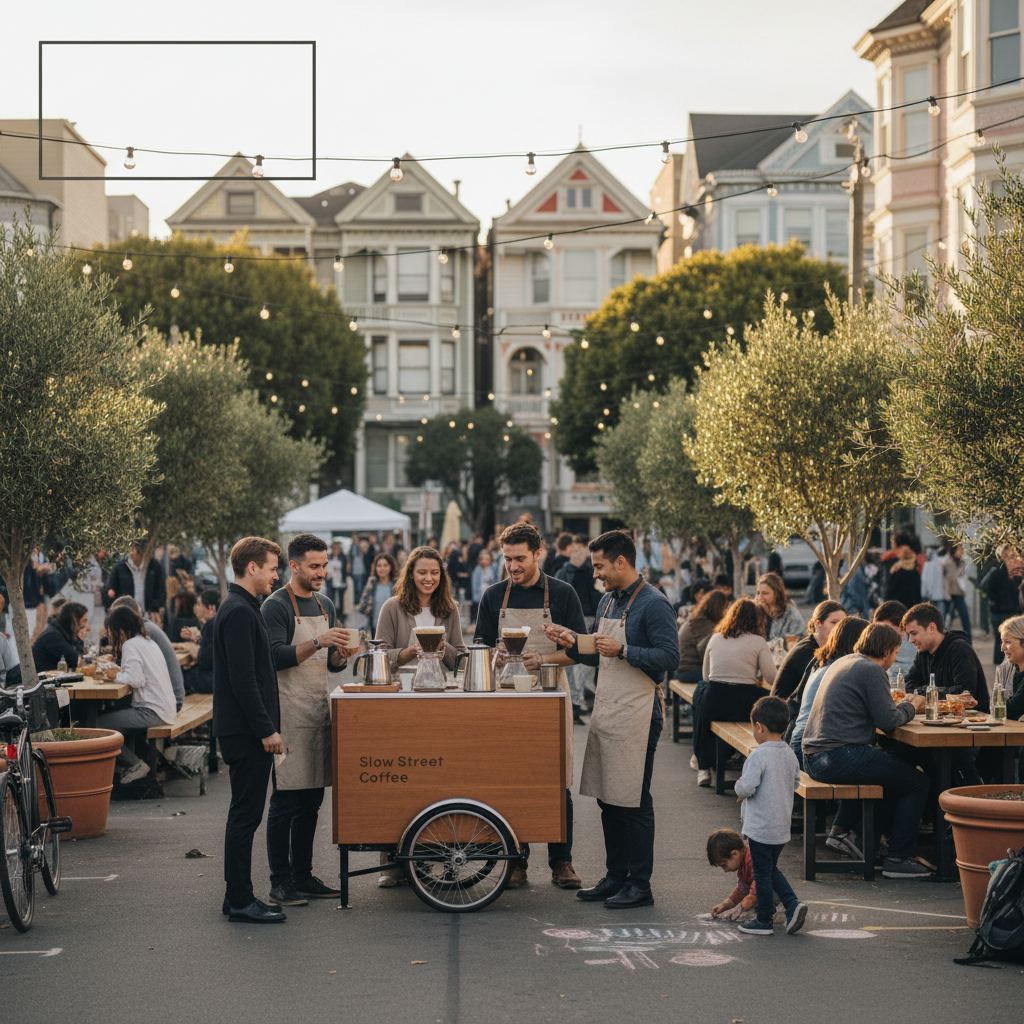
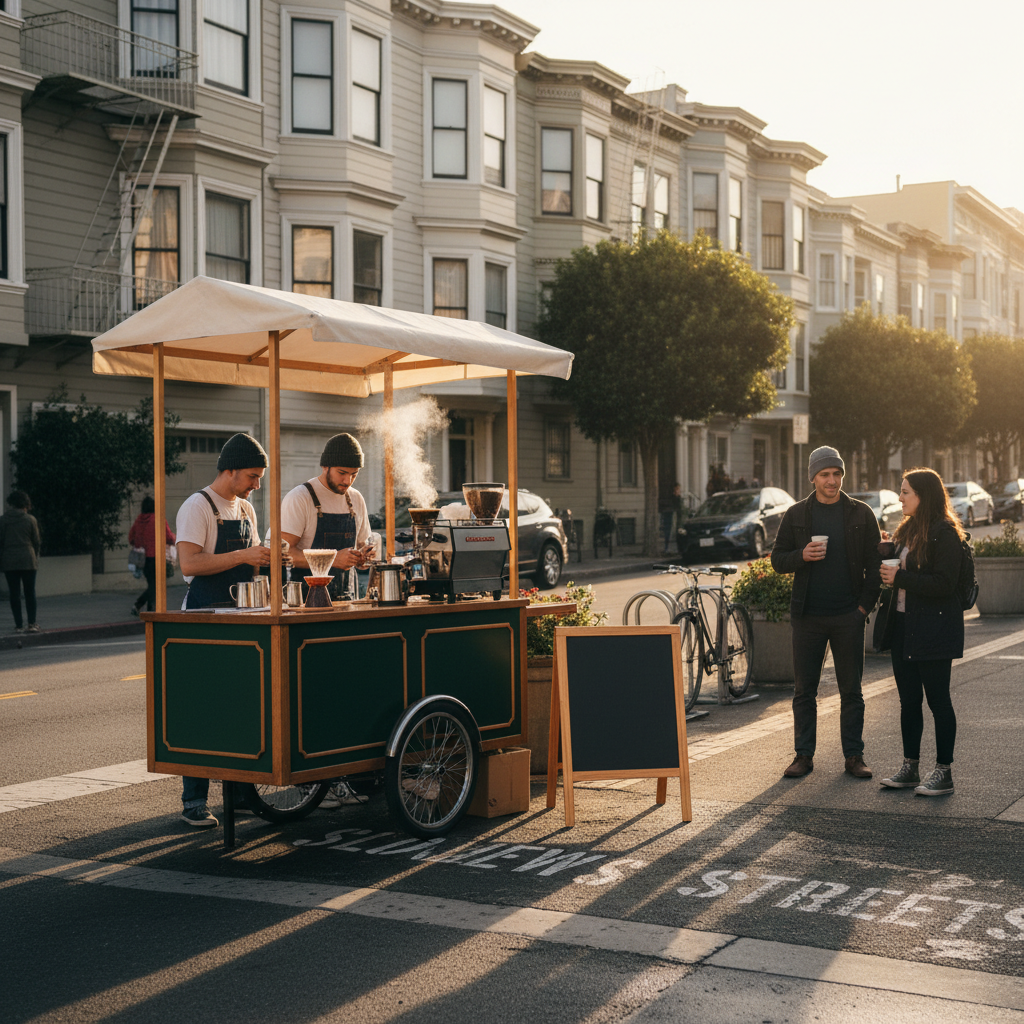
There is something quietly revolutionary happening on the residential streets of San Francisco's NoPa and Haight neighborhoods. On weekend mornings, where cars once dominated and neighbors rushed past one another, you can now find families gathered around a two-wheeled coffee cart, sipping freshly brewed cups, swapping stories, and discovering that the street outside their front door is actually a community living room. This is the world of slow streets San Francisco community coffee — and at the heart of it is a small business called Slow Street Coffee that is redefining what a neighborhood coffee experience can look like.
Founded by Zaid Zayouna, a working electrical engineer and father of two young daughters, Slow Street Coffee began as a pandemic hobby and blossomed into one of San Francisco's most compelling grassroots business stories. It is not just about the coffee — though the coffee is exceptional. It is about what happens when a cup of something warm is handed across a folding table on a car-free street, and suddenly a neighborhood comes alive.
The Origin Story: From Home Roaster to Community Hub
Every great local business has an origin story rooted in passion, and the slow streets San Francisco community coffee movement around Slow Street Coffee is no exception. Zaid Zayouna did not set out to disrupt the coffee industry. Long before the pandemic, he was simply a curious home roaster experimenting with green beans in his NoPa kitchen, chasing the perfect roast the way engineers chase elegant solutions — methodically, obsessively, and with deep attention to detail.
When San Francisco's shelter-in-place orders took hold in 2020, something unexpected happened. The city launched its Slow Streets program, closing residential roads to through-traffic and opening them as public space. Neighbors who had never spoken began lingering outside. Zayouna, watching this transformation unfold on his own block, saw an opportunity not just for commerce but for connection. He became what he jokingly calls a "milkman for coffee" — loading up freshly roasted beans and hand-delivered brews for neighbors who had nowhere to go and every reason to stay home.
By 2021, word had spread organically through NoPa. By 2023, the informal deliveries had evolved into something with a name, a brand, and a mission: Slow Street Coffee. Zayouna formalized his pop-up operations at key Slow Streets intersections — most notably Golden Gate & Baker and Page & Baker — showing up with his mobile setup, his two daughters often by his side, and a genuine commitment to the idea that coffee could be a catalyst for community.
The founder's approach is worth examining closely, because it reflects a philosophy that separates Slow Street Coffee from virtually every other coffee business in the city. He does not aspire to own a brick-and-mortar café. He does not seek venture funding or franchise arrangements. His vision is purposefully intimate: small-batch roasting for quality, e-bike delivery for sustainability, and street-level pop-ups for human connection. In a city saturated with coffee options, that intentionality is its own competitive advantage.
What Makes Slow Streets San Francisco Community Coffee Different
San Francisco is not short on excellent coffee. The city hosts world-class roasters, meticulously designed cafés, and a consumer base that takes specialty coffee seriously. So why has slow streets San Francisco community coffee — and Slow Street Coffee specifically — captured so much attention and genuine affection from residents and media alike?
The answer lies in what the business is not doing as much as what it is. It is not optimizing for throughput. It is not chasing efficiency with automated espresso machines. It is not building a loyalty app or opening a second location in SoMa. Instead, Slow Street Coffee is optimizing for something harder to quantify: joy.
Zayouna has spoken publicly about how the pop-up functions as a social infrastructure node — a place where playdates get organized, local artists set up tables, musicians show up with instruments, and entrepreneurs like local bagel maker Nick Cheung use the gathered crowd to trial their own side hustles. The coffee cart becomes a gravitational center around which community life orbits.
Slow Street Coffee offers small-batch roasted whole beans and fresh brews at pop-up events. Beans are roasted in Berkeley with careful attention to quality, emphasizing freshness and craft over volume. You can explore their current offerings and sourcing philosophy at slowstreetcoffee.com.
This approach also taps into something deeper about San Francisco's cultural identity. The city has long wrestled with the tension between its progressive, people-first values and the practical dominance of automobiles in daily life. The Slow Streets program — and businesses like Slow Street Coffee that animate those streets — represent a tangible, felt resolution to that tension. When you sip a cup of freshly roasted coffee on a car-free Page Street on a Sunday morning, surrounded by children on bikes and neighbors you actually know by name, the abstract promise of urban livability becomes concrete and personal.
For readers interested in the broader landscape of quality-focused local roasters, our guide to sustainable coffee brands in San Francisco offers helpful context on how Slow Street Coffee fits into the city's growing ecosystem of values-driven coffee businesses.
The Slow Streets Program: A Platform for Local Business
To fully appreciate the slow streets San Francisco community coffee story, it helps to understand the policy ecosystem that makes it possible. San Francisco's Slow Streets program launched in April 2020 as an emergency pandemic measure, converting selected residential streets into low-traffic corridors where pedestrians and cyclists could move safely with appropriate physical distancing. What began as a temporary health intervention quickly revealed itself as something with far broader civic value.
By 2026, the program had expanded to more than 23 designated streets serving an estimated 150,000 residents across neighborhoods including NoPa, Haight-Ashbury, the Outer Sunset, and newly added corridors announced in May 2026. The expansion was accompanied by physical enhancements — parklet installations, neighborhood murals (including a new Lyon Street mural in NoPa and a forthcoming Page Street mural in the Haight), and organized activation events that drew hundreds of residents at a time.
For Zaid Zayouna, this expanding program is not just backdrop — it is infrastructure. Each new Slow Street is a potential venue, each activation event a natural gathering point for his mobile coffee operation. The SFMTA's own podcast, "Taken for Transportation," featured Zayouna in 2025 specifically because his story illustrates the program's most aspirational outcome: streets that generate economic activity, social bonds, and neighborhood identity rather than simply moving vehicles from point A to point B.
The business model is elegantly suited to this environment. With no rent overhead from a fixed location, Slow Street Coffee can be present where the people are — following activations, responding to neighborhood demand, and building a loyal following that is tied to place rather than to a specific address. This is, in a very real sense, the coffee shop model of the future: decentralized, community-embedded, and mobile by design.
How to Find and Support Slow Street Coffee
One of the most common questions from residents newly discovering the slow streets San Francisco community coffee scene is simply: where and when can I find them? Unlike a café with fixed hours and a Google Maps pin, Slow Street Coffee operates on a schedule shaped by neighborhood events, seasonal rhythms, and the evolving Slow Streets activation calendar.
Here is a practical guide to connecting with Slow Street Coffee:
- Check the official website: Visit slowstreetcoffee.com for the most current schedule of pop-up locations, upcoming events, and bean availability. The site reflects Zayouna's own updates and is the most reliable source for real-time information.
- Follow Slow Streets activation events: The SFMTA and neighborhood associations regularly announce activation events on Slow Streets corridors. Slow Street Coffee frequently appears at these gatherings in NoPa and Haight. Watch for events on Page Street, Lyon Street, and Golden Gate Avenue in particular.
- Look for the coffee cart on weekends: The pop-up at Golden Gate & Baker and Page & Baker tends to be most active on weekend mornings — prime time for families, cyclists, and neighbors taking their morning walk.
- Order beans for home delivery: Zayouna's e-bike delivery model means you can receive freshly roasted beans without leaving your home. This is an especially appealing option for those who want to support the business consistently between in-person pop-up visits. For tips on how to brew those beans at their peak, our guide to coffee brewing methods at home for beginners is an excellent starting point.
- Spread the word locally: The best support for a micro-business like Slow Street Coffee is genuine community word-of-mouth. Tell a neighbor, bring a friend, show up with your kids. The energy that makes the pop-up work is generated by the people who show up for it.
Yes. Zaid Zayouna delivers freshly roasted beans via e-bike (and via BART for neighborhoods slightly farther afield), continuing the "milkman for coffee" model that started the business. This keeps beans fresher than retail and supports a zero-emissions local supply chain. Details and ordering information are available at slowstreetcoffee.com.
Community Impact: More Than a Cup of Coffee
It would be easy to tell the slow streets San Francisco community coffee story purely as a charming small-business narrative — a feel-good tale of a hobbyist going pro. But the actual community impact of what Slow Street Coffee does is more substantive and worth examining carefully.
Research on urban planning and public space consistently demonstrates that the quality of neighborhood social ties — often called "social capital" — is strongly correlated with physical environments that encourage spontaneous interaction. Streets dominated by moving cars are, by design, hostile to lingering. They push people indoors, into cars, into isolation. Slow Streets, by contrast, create the conditions for what urban theorists call "third places" — spaces that are neither home nor work but where community life happens organically.
Slow Street Coffee functions as a portable third place. The coffee cart is almost incidental to what it generates: the playdate that gets scheduled between two parents who meet for the first time, the local artist who sets up next to the cart and finds their first buyers, the bagel entrepreneur who discovers there is real demand for their product in the neighborhood, the child who learns that the street outside their home is a place of joy rather than danger. Zayouna has spoken about this dynamic with evident pride, noting that the pop-up creates "energy" that outlasts the morning coffee rush and ripples through the neighborhood for days afterward.
This community function also gives Slow Street Coffee a resilience that purely transactional businesses lack. Customers are not just buying coffee — they are participating in a neighborhood institution. That emotional investment creates loyalty that no loyalty app can replicate. In an industry where chains compete ruthlessly on convenience and price, this depth of community attachment is Slow Street Coffee's most durable competitive advantage.
The media has recognized this. Streetsblog SF's February 2025 profile highlighted Zayouna's growth and the broader community buzz his operation generates. SFMTA's podcast brought him on as a case study in what Slow Streets can become. YouTube shorts on channels like Spokes and Folks have captured the e-bike deliveries and pop-up scenes, spreading the story beyond NoPa to a city-wide and even national audience interested in car-free urban life.
The Competitive Landscape: Why Hyper-Local Wins
San Francisco's coffee market is formidable. Starbucks maintains a commanding presence, Dunkin' serves the value-conscious commuter, and premium roasters like Blue Bottle (now Nestlé-owned) compete for the craft-coffee consumer. Newer entrants like Blank Street use automation and small formats to squeeze margins further. The U.S. coffee shop industry is estimated at $74.3 billion in 2025, and competition for consumer attention is intense.
Yet within this crowded landscape, slow streets San Francisco community coffee represents a category of one. No chain can replicate what Slow Street Coffee does, because what it does is fundamentally about human presence, neighborhood identity, and trust built over time on specific streets with specific people. Starbucks can open a pickup-only micro-format in NoPa. It cannot show up at a Lyon Street mural unveiling with a cart, two kids, and a genuine relationship with every family on the block.
This is the strategic insight that independent coffee businesses everywhere can learn from Slow Street Coffee's model: hyper-local specificity is a moat. The more deeply embedded a business is in a particular neighborhood's identity and rhythms, the less relevant the competitive advantages of scale become. Chains win on convenience and consistency. Slow Street Coffee wins on meaning.
| Business Type | Key Advantage | What Slow Street Coffee Offers Instead |
|---|---|---|
| Starbucks / Dunkin' | Scale, loyalty apps, drive-through convenience | Human connection, zero-car ethos, neighborhood belonging |
| Blue Bottle / Intelligentsia | Premium café experience, polished interiors | Accessible pop-up intimacy, street-level community activation |
| Blank Street | Automation-driven low prices, urban efficiency | Craft roasting, personal story, values-aligned consumption |
| Other SF pop-ups | Flexibility, low overhead | Slow Streets integration, family-run identity, media visibility |
The Future of Slow Streets and Community-Driven Coffee
The trajectory for both the Slow Streets program and the slow streets San Francisco community coffee ecosystem around businesses like Slow Street Coffee looks genuinely promising as of 2026. The program's May 2026 expansion to new neighborhoods signals that San Francisco's commitment to pedestrian-first street design is deepening rather than retreating — a significant contrast to some other cities that rolled back pandemic-era street interventions under pressure from drivers and business associations that feared reduced vehicle access.
For Zaid Zayouna, the expansion is opportunity. Each new Slow Street is a potential new community to serve, a new set of neighbors who might one day become regulars. He has stated publicly that there is no fixed endpoint — the business is "continuing to evolve" in direct response to the expanding network of slow streets and the neighborhood activation events that populate them. He is, by his own account, leaning more intentionally into the activation model: showing up not just to sell coffee but to be a consistent, recognizable presence at the events that bring his neighborhood to life.
There is also a broader cultural shift at work that benefits this model. Urban residents — particularly in cities like San Francisco with strong environmental and social justice values — are increasingly seeking out consumption choices that align with their beliefs. Buying coffee from Slow Street Coffee is not just a caffeine transaction. It is a statement about the kind of city you want to live in: one where streets belong to people, where local entrepreneurs can thrive without corporate infrastructure, and where a morning cup of coffee connects you to your neighbors rather than isolating you in a drive-through queue.
Research suggests that consumer preference for local, community-embedded businesses has grown substantially in the post-pandemic period, with surveys indicating that a significant portion of urban consumers actively seek out businesses that contribute to neighborhood social cohesion. Slow Street Coffee is positioned precisely at the intersection of these values: local, sustainable, community-generating, and — critically — genuinely excellent on the product itself.
"The best slow streets San Francisco community coffee experience isn't just about what's in the cup — it's about who you meet while you're drinking it."
What is Slow Street Coffee and where is it based?
Slow Street Coffee is a hyper-local, mobile coffee business founded by Zaid Zayouna, a NoPa resident and electrical engineer in San Francisco. The business roasts small-batch coffee in Berkeley, delivers via e-bike, and operates pop-up sales events on San Francisco's designated Slow Streets — primarily in the NoPa and Haight neighborhoods at locations like Golden Gate & Baker and Page & Baker.
Where can I find Slow Street Coffee pop-ups in San Francisco?
Slow Street Coffee most commonly appears at pop-up events on Golden Gate Avenue at Baker Street and Page Street at Baker Street in the NoPa and Haight neighborhoods. The schedule follows Slow Streets activation events and weekend mornings. Check the current schedule at slowstreetcoffee.com for the most up-to-date locations and times.
Does Slow Street Coffee deliver beans to homes in San Francisco?
Yes. Founder Zaid Zayouna delivers freshly roasted coffee beans to San Francisco homes via e-bike, continuing the "milkman for coffee" model that started the business during the pandemic. Delivery is available across NoPa and surrounding neighborhoods, with BART-assisted delivery extending reach further into the city.
How does Slow Street Coffee fit into San Francisco's Slow Streets program?
Slow Street Coffee was born directly out of San Francisco's Slow Streets program, which launched in 2020 to restrict through-traffic on residential streets and create pedestrian- and cyclist-friendly community corridors. Zaid Zayouna operates his mobile coffee pop-ups specifically on these slow streets, using the car-free environment to foster neighborhood gatherings, playdates, and local commerce. As the program expanded to 23+ streets by 2026, so did the visibility and reach of Slow Street Coffee.
What makes Slow Street Coffee's coffee different from major chains?
Slow Street Coffee uses small-batch roasting in Berkeley to maximize freshness and flavor quality, delivering directly to consumers with minimal time between roast and cup. Unlike major chains that prioritize volume and consistency at scale, Slow Street Coffee prioritizes craft, freshness, and a personal relationship with customers. The result is coffee that is often significantly fresher and more carefully sourced than what is available at high-volume retail chains.
Conclusion: Why Slow Streets San Francisco Community Coffee Matters
The story of slow streets San Francisco community coffee — and of Slow Street Coffee specifically — is ultimately a story about what cities are for. At its best, a city is not just an efficient machine for moving people and goods. It is a place where strangers become neighbors, where children learn to trust the world outside their front door, where a shared cup of something warm is sufficient reason to stop, linger, and connect.
Zaid Zayouna did not set out to make a philosophical statement about urban life. He set out to share coffee he loved with people he wanted to know better. But in doing so, on the car-free streets of NoPa and the Haight, he built something that resonates far beyond his own neighborhood: proof that a single person with a good product, genuine values, and a willingness to show up consistently can generate the kind of community energy that no chain, no app, and no amount of marketing budget can manufacture.
If you live in San Francisco — especially in or near the neighborhoods where Slow Streets run — seek out Slow Street Coffee on your next weekend morning walk or bike ride. Bring your kids. Linger a little. Buy a bag of beans to take home. And if you want to understand what specialty-grade coffee actually is and why it matters, our deep-dive on what makes coffee specialty grade will give you the vocabulary to appreciate every cup more fully.
The streets of San Francisco are slowly, beautifully becoming something more than roads. And at the corner of Golden Gate and Baker, on a Sunday morning, a small coffee cart is helping lead the way.
Ready to experience slow streets San Francisco community coffee for yourself? Visit slowstreetcoffee.com to find the next pop-up near you, order freshly roasted beans for home delivery, and become part of the neighborhood movement that is making San Francisco's streets worth lingering on.