How to Fold Fitted Sheets Neatly: A Step-by-Step Guide
September 3, 2026 · 13 min read
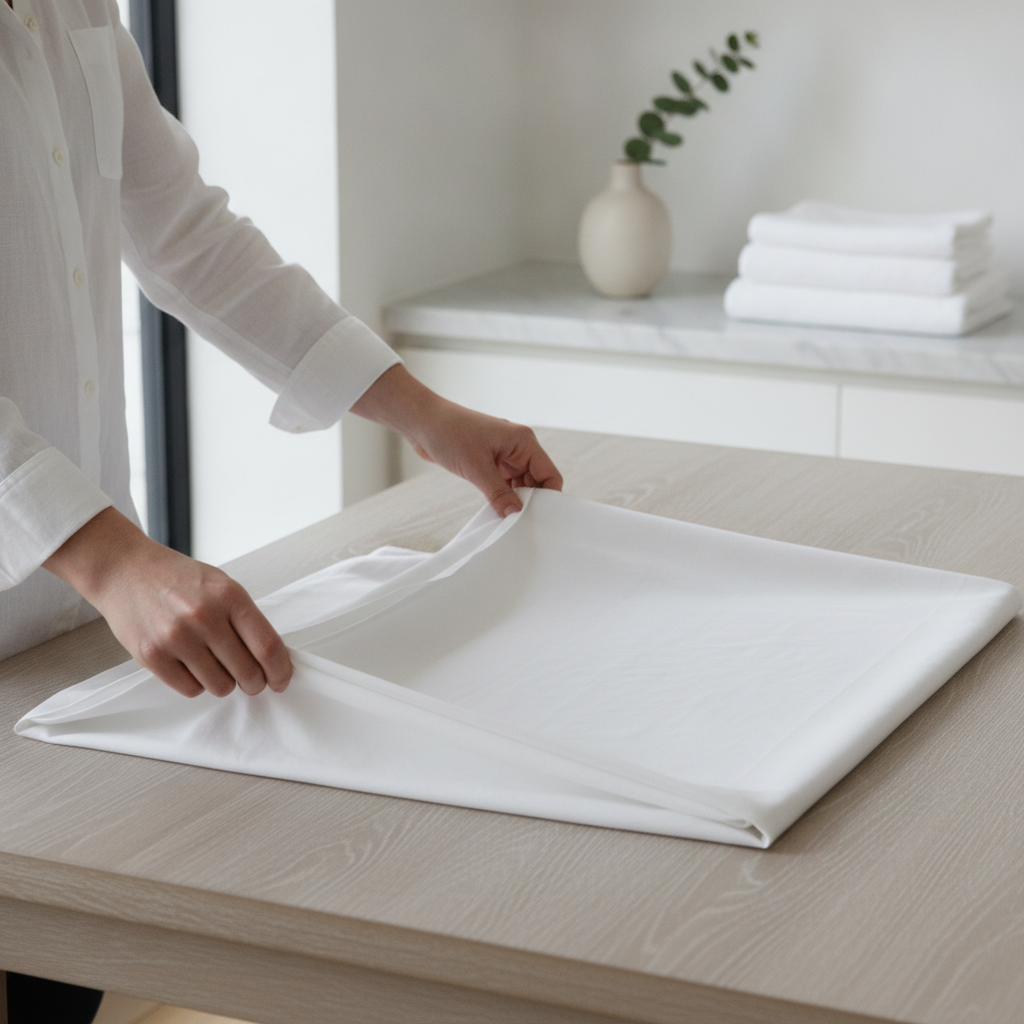
If you've ever shoved a wrinkled, lumpy fitted sheet into your linen closet and prayed the door would still close, you already know the problem. Learning how to fold fitted sheets neatly is one of those small household skills that pays off every single day, in a tidier closet, faster bed-making, and sheets that actually look as good as they feel. At Sierra Dreams, we spend our days engineering bedding that resists shifting and bunching on the bed itself, so it only makes sense to help you master the folding side of the equation too.
This guide breaks down exactly how to fold fitted sheets neatly using the same nesting-and-thirds technique favored by professional organizers, plus two alternative methods, common mistakes to avoid, and how your sheet's design can make the whole process easier or harder.
TL;DR, The Bottom Line
The fastest way to fold fitted sheets neatly is to turn the sheet inside out, nest all four elastic corners into one another, lay the sheet flat, smooth it into a rectangle, and fold it lengthwise and widthwise into thirds. This six-step method takes under two minutes once practiced and produces a compact, stackable bundle instead of a lumpy ball. Deep-pocket or heavily elasticized sheets can complicate the process, which is why sheet design matters as much as technique.
Quick Facts
- Core technique: Nest 4 corners, then fold into thirds lengthwise and widthwise
- Average time to master: 45–90 seconds once practiced, according to home organization experts
- Best starting position: Sheet turned inside out, elastic facing you
- Most common mistake: Skipping the flat-surface smoothing step, leaving rounded corners
- Alternative methods: Half-fold method and the KonMari-style rolling method
- Storage benefit: A properly folded fitted sheet can take up to 30% less shelf space than a bunched one
The Step-by-Step Method: How to Fold Fitted Sheets Neatly in 6 Steps
Nearly every modern home-organization guide, from lifestyle publications to professional closet organizers, converges on the same core sequence for how to fold fitted sheets neatly: nest the corners, square off the shape, and fold in thirds. Here's the full breakdown.
Step 1: Turn the sheet inside out
Flip the fitted sheet so the seams and elastic face outward toward you. This matters more than it seems, the elastic band is what creates all the awkward curves, and working with it visible lets you control it instead of fighting it.
Step 2: Hold two corners like mittens
Pick up the sheet by one long side, placing one hand inside each of the two corners along that edge, similar to slipping on oven mitts.
Step 3: Nest the first pair of corners
Bring your hands together and fold the right corner over the left, tucking one elastic pocket fully inside the other so they sit flat. A gentle shake here helps the fabric settle and prevents twisting.
Step 4: Find and nest the remaining two corners
Slide your hand down the elastic edge to locate the third corner, tuck it into the nested pair, then repeat for the fourth corner. At this point all four corners should be stacked together in one hand.
Step 5: Lay flat and square off the shape
Place the sheet on a bed or table with the nested corners at one end. Smooth the fabric with your palms, pulling the elastic edges into straight lines rather than curves, until you have a clean rectangle instead of a lopsided blob.
Step 6: Fold into thirds, then thirds again
Fold the rectangle lengthwise into three sections, smoothing after each fold. Rotate and fold widthwise into thirds again to finish with a small, uniform rectangle. Flip it so the smooth side faces out before placing it on the shelf.
Answer: Nesting all four corners together before you attempt any folds. Skipping this step is the number-one reason fitted sheets end up as a wrinkled ball instead of a flat rectangle.

Why Fitted Sheets Are So Hard to Fold Neatly
Before mastering how to fold fitted sheets neatly, it helps to understand why they're so much trickier than flat sheets or pillowcases in the first place. Fitted sheets are cut with elasticized corners designed to hug a mattress, which means the fabric is inherently three-dimensional. Flat sheets and duvet covers, by contrast, are simple rectangles that fold along straight lines.
That elastic also varies in width, tension, and placement depending on the brand and price point. Thicker elastic, common in budget sheets, tends to hold its curved shape stubbornly, making it harder to flatten into straight lines during the folding process. Deep-pocket sheets, designed for thicker mattresses, have even more excess fabric bunched around each corner, adding another layer of difficulty.

Two Alternative Folding Methods Worth Trying
The thirds method above is the most widely recommended approach for how to fold fitted sheets neatly, but it isn't the only one. Depending on your storage style and patience level, one of these variations might suit you better.
The half-fold method
After nesting the four corners and squaring the sheet into a rectangle, simply fold it in half, then in half again, rather than into thirds. This produces a slightly larger, thicker square, but it's faster and more forgiving for beginners still learning how to fold fitted sheets neatly without overthinking each crease.
The rolling method (KonMari-inspired)
Popularized by organizing expert Marie Kondo, this method starts the same way, nest the corners and fold lengthwise into thirds, but instead of folding again, you roll the sheet tightly from one end like a yoga mat. Rolled sheets stand upright in a drawer or basket, making every sheet visible at a glance instead of hidden in a stack.
| Method | Best For | Time Required | Storage Style |
|---|---|---|---|
| Thirds Fold | Linen closets, stacked shelves | 60–90 seconds | Flat stacks |
| Half Fold | Beginners, quick tidying | 30–45 seconds | Flat stacks (bulkier) |
| Rolling Method | Drawers, baskets, small spaces | 60 seconds | Upright rolls |
Answer: Both work well. Folding into thirds is better for stacked linen closets, while rolling is ideal for drawers or baskets where you want to see every sheet at a glance without unstacking a pile.
Common Mistakes That Ruin a Neat Fold
Even people who know the general steps of how to fold fitted sheets neatly often undermine themselves with a few avoidable habits. Watch for these:
- Folding right-side out. This traps the seams and elastic on the outside, making it much harder to see and control the corners.
- Skipping the flat-surface step. Trying to fold while holding the sheet in midair almost always produces a lumpy result. Always lay it flat first.
- Not smoothing between folds. Air pockets and wrinkles compound with every fold if you don't flatten as you go.
- Ignoring the elastic tension. Sheets with very tight or very thick elastic need extra smoothing to coax the curves into straight lines before folding.
- Storing sheets loose in a pile. Even a perfectly folded sheet can come undone if it's tossed unsecured onto a shelf. Stack folded sheets with the open edge facing inward, or store the matching flat sheet and pillowcases inside the folded fitted sheet as a bundle.
How Sheet Design Affects How Easily You Can Fold Fitted Sheets Neatly
Here's something most folding tutorials skip entirely: the sheet itself matters as much as your technique. Cheaper sheets often use thick, high-tension elastic around the entire perimeter, which fights every attempt to flatten it into straight lines. Higher-quality sheets, by contrast, typically use elastic only at the corners or along partial sides, leaving more flat fabric that's naturally easier to smooth and fold.

This is one of the reasons Sierra Dreams designs its fitted sheets with corner-focused elastic and precision-cut deep pockets, not just to keep them secure on the mattress, but to make everyday handling, washing, and folding simpler too. If you're tired of fighting stiff, over-elasticized sheets every laundry day, exploring bedding built with both fit and foldability in mind is worth the switch. You can browse Sierra Dreams' current bedding collection at Sierra Dreams to see how thoughtful construction changes the daily experience of making, and folding, your bed.
Answer: Generally, yes. Sheets with corner-only elastic and consistent fabric weight hold a flatter shape once nested, while all-around, high-tension elastic bands tend to curl and resist folding into a clean rectangle.
Storage Tips to Keep Your Folded Sheets Looking Neat
Knowing how to fold fitted sheets neatly is only half the equation, keeping them that way in storage is the other half. A few small habits go a long way:
- Bundle full sets together. Fold your flat sheet and pillowcases, then tuck them inside the folded fitted sheet like an envelope so a full set stays together and doesn't get separated on the shelf.
- Stack by size. Group sheets by bed size (twin, queen, king) so you're not unfolding several sets just to find the right one.
- Store flat, not vertical, on deep shelves. Vertical stacking works well in shallow drawers, but deep linen closet shelves usually hold flat stacks more securely without toppling.
- Refold after every wash. Sheets naturally lose their crease in the dryer; a quick refold while still warm produces the crispest, flattest result.
- Use labeled bins for guest linens. If you manage multiple bed sizes across a household, labeling helps everyone maintain the same neat folding habit.
According to organizing resources like The Spruce, professional organizers consistently recommend the corner-nesting approach over ad-hoc folding precisely because it standardizes the result regardless of who is doing the folding, a small detail that keeps shared linen closets consistently tidy.
Frequently Asked Questions
What is the easiest way to fold a fitted sheet neatly?
The easiest way is the nesting method: turn the sheet inside out, tuck all four elastic corners into one another, lay it flat, smooth it into a rectangle, and fold it into thirds. This is widely considered the standard technique for how to fold fitted sheets neatly because it works regardless of sheet size or elastic thickness.
Why does my fitted sheet always end up as a lumpy ball instead of neat and flat?
This usually happens when the four corners aren't nested together before folding, or when the sheet is folded while right-side out. Both issues leave the elastic curves exposed and uncontrolled, which prevents the fabric from lying flat during subsequent folds.
Should I fold a fitted sheet inside out or right-side out?
Inside out. Turning the sheet inside out exposes the seams and elastic pockets, making it much easier to see and nest the corners. Most modern guides recommend starting inside out for this reason, and it's a core part of learning how to fold fitted sheets neatly and consistently.
Is there a faster alternative to folding fitted sheets into thirds?
Yes. The half-fold method, where you fold the squared rectangle in half twice instead of into thirds, is faster and more beginner-friendly, though it produces a slightly bulkier square. The rolling method is another quick alternative, especially for drawer storage.
Do deep-pocket fitted sheets fold differently than standard sheets?
Deep-pocket sheets have more excess fabric bunched at each corner, so they require extra smoothing on a flat surface before folding to avoid uneven bulk. The core nesting-and-thirds technique still applies, but expect to spend a few extra seconds flattening the corners.
Mastering how to fold fitted sheets neatly is a small skill with an outsized payoff: a calmer linen closet, faster bed-making, and sheets that look as put-together as the rest of your home. But no folding technique can fully compensate for a sheet that fights you at every turn, thick, uneven elastic and poor-quality fabric will always be harder to smooth and fold, no matter how practiced your hands become.
If your current sheets never seem to cooperate, whether on the bed or in the closet, it may be time for an upgrade. Sierra Dreams designs fitted sheets with precision-engineered elastic and premium natural fabrics specifically to make everyday handling, from bed-making to folding to storage, noticeably easier. Explore the full collection at Sierra Dreams and discover bedding built for both comfort and everyday practicality.