How to Identify Biased Sports Reporting: Fan's Guide
June 19, 2026 · 13 min read
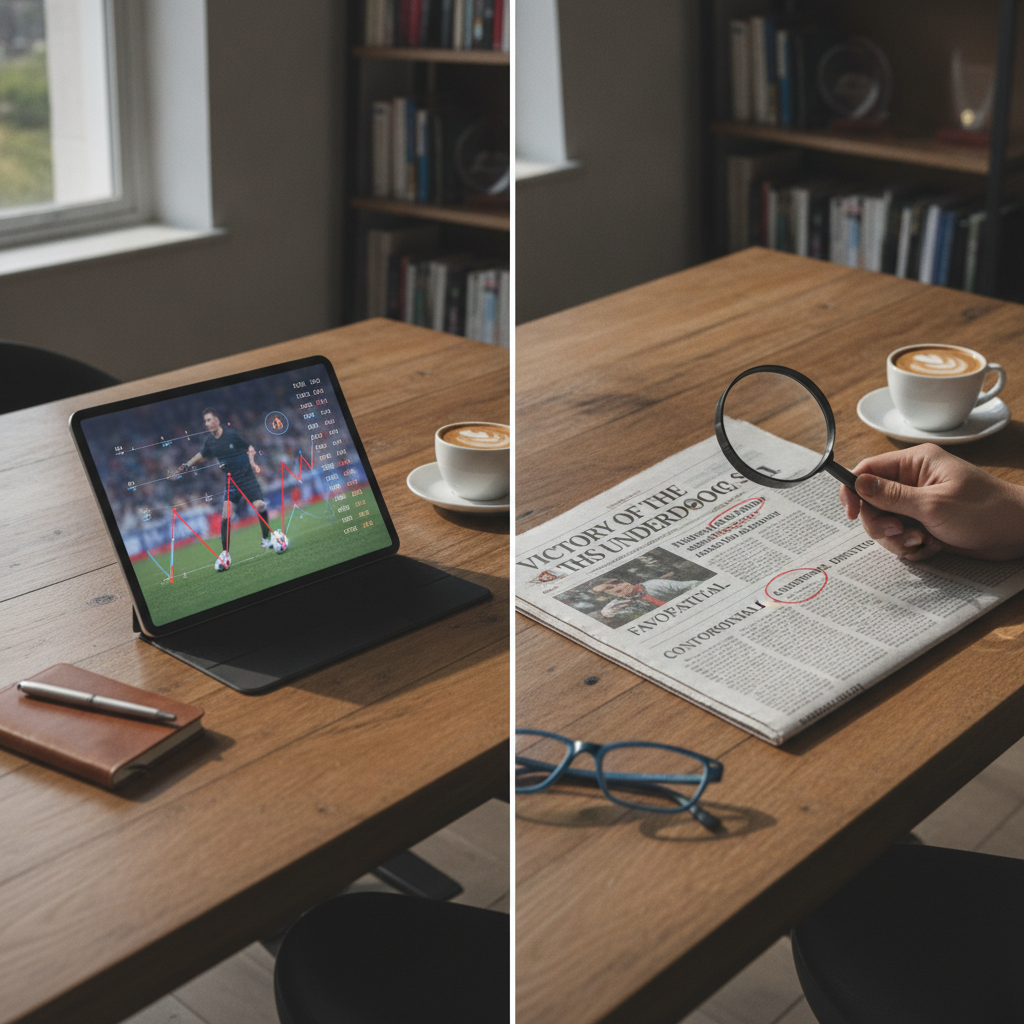
TL;DR — The Bottom Line
Learning how to identify biased sports reporting comes down to four fast checks: notice what's omitted, scrutinize loaded language, audit whose voices are quoted, and compare coverage consistency across teams, genders, and races. Bias hides in story selection, placement, framing, and source choice — not just hot takes. Use the checklist in this guide to read smarter in under 60 seconds per article.
Every sports fan has felt it: a headline that seems to celebrate one team's win while burying another's, a feature story that focuses on a female athlete's outfit instead of her stat line, or a controversy framed completely differently depending on which network covers it. Learning how to identify biased sports reporting is no longer a niche media-literacy skill — it's essential armor for anyone who consumes sports news in 2025. With outlets fighting for clicks, leagues owning their own media arms, and social platforms amplifying tribal narratives, the line between reporting and storytelling has never been blurrier.
At Press Sports, we believe fans deserve sharp, fair, fluff-free coverage — and the tools to spot when other outlets fall short. This guide breaks down exactly how to identify biased sports reporting in real time, with concrete examples, a quick mental checklist, and a definition of bias that goes far beyond "the announcer hates my team."
Quick Facts
- Primary bias types: Selection, placement, framing, source choice, identity-based
- Coverage gap: Women's sports historically receive a fraction of the airtime of men's sports despite rising viewership
- Fastest red flag: Loaded adjectives and missing context in the first two paragraphs
- Most common blind spot: Confusing opinion columns with straight reporting
- Reader checklist: Who, voice, omission, consistency — in under 60 seconds
What Bias in Sports Reporting Actually Looks Like
Before you can learn how to identify biased sports reporting, you need a working definition that goes beyond "the commentator was mean to my quarterback." Bias in journalism is systematic — it shows up as patterns, not one-off opinions. According to media-literacy frameworks adapted from organizations like the News Literacy Project, bias generally appears in five recurring forms within sports coverage.
1. Bias by Story Selection and Omission
The stories an outlet chooses to cover — and the ones it ignores — shape what fans believe matters. If a network spends an hour debating an NFL backup quarterback's tweet while a WNBA championship game gets a 30-second mention, that's selection bias in action. Women's sports remain the textbook case: despite record-breaking 2024 viewership for the WNBA Finals and NCAA Women's Tournament, daily coverage volume still lags dramatically behind comparable men's events.
2. Bias by Placement and Prominence
Where a story lives signals how important it is. A headline at the top of the homepage carries different weight than a sidebar link or a scrolling ticker mention. Track an outlet for a week and you'll see clear patterns about which leagues, genders, and franchises get "hero" placement versus which get buried below the fold.
3. Framing and Language Bias
The same play, performance, or controversy can be framed radically differently depending on who's involved. Research on sports media has long documented that female athletes are disproportionately described through appearance, family roles ("wife of," "mother of"), or emotional reactions, while male athletes are described through performance metrics. Racial coding also persists — Black athletes more often described as "naturally gifted" or "physical," white athletes as "cerebral" or "hardworking."
4. Source and Voice Bias
Whose quotes appear in the story? Whose don't? Coverage that leans exclusively on league executives, head coaches, and superstars while ignoring role players, women's league spokespeople, or affected fan communities tells a one-sided story by default.
5. Commercial and Tribal Bias
Outlets owned by leagues, teams, or major sponsors face built-in conflicts of interest. They're unlikely to aggressively investigate the hand that feeds them. Meanwhile, fan-run sites are openly tribal — which is fine, as long as readers know they're consuming a partisan perspective rather than neutral reporting.

How to Identify Biased Sports Reporting in Under 60 Seconds
You don't have time to write a media-studies thesis on every article you read. Here's a fast, repeatable mental checklist that works for any sports story — whether it's a transfer rumor, a controversy, or a postgame analysis. This is the core framework for how to identify biased sports reporting on the fly.
- Check the label. Is this tagged as news, analysis, opinion, or column? Opinion pieces are supposed to be biased — that's the genre. Trouble starts when opinion is packaged to look like straight reporting.
- Read the byline and outlet. Who wrote it? Who owns the outlet? A team-owned media channel covering its own franchise is structurally compromised, even if the writer is talented.
- Scan the quotes. Count whose voices appear. Are the people most affected by the story actually quoted, or just the powerful and famous?
- Hunt for omissions. What context, stats, or counterpoints would change your interpretation if included? Missing rule explanations, replay angles, or prior precedent are common red flags.
- Compare coverage. Pull up the same story from a rival outlet. Differences in tone, headline, and what gets emphasized expose framing choices.
No. Columns and analysis pieces are openly subjective by design — that's not the same as bias hiding inside a straight news report. The problem arises when outlets blur the line, presenting takes as neutral coverage. Always check the article label before judging.
Loaded Language: The Single Biggest Red Flag
If you only have time for one bias check, make it the language audit. The adjectives, verbs, and metaphors a writer chooses reveal their angle faster than any other element. When figuring out how to identify biased sports reporting, training your ear for loaded language is the single highest-ROI skill you can build.
Watch for Asymmetric Adjectives
Notice when two comparable athletes get described in fundamentally different ways. One quarterback is "gritty" and "a field general"; another with identical stats is "a game manager" or "limited." One coach is "passionate"; another doing the exact same thing is "out of control." These patterns aren't accidents — they reflect the writer's frame.
Spot Emotional Verbs in Headlines
Headlines that use verbs like "slams," "destroys," "embarrasses," or "silences" are signaling drama, not reporting it. Compare "Team A beats Team B 24-17" with "Team A demolishes hapless Team B." Both can be technically accurate, but the second is editorializing in the headline.
Identify Coded Descriptions
Decades of research show that descriptors like "natural athlete," "high motor," "cerebral," "coachable," or "raw" are not evenly distributed across racial and gender lines. When you notice a pattern in which athletes earn which adjectives across a publication, you've found systemic framing bias.
Who Gets a Voice? Auditing Sources and Quotes
One of the most overlooked dimensions of how to identify biased sports reporting is the source audit. The voices a story amplifies — and the voices it leaves silent — quietly determine the entire narrative. A story can be technically accurate and still be deeply slanted simply because of who was (and wasn't) asked.
Count the Quote Distribution
In any feature or news report, take 15 seconds to tally who speaks. Coaches? Players? Executives? Fans? Independent experts? Affected community members? A story about a stadium relocation that only quotes the team owner and the mayor — but never the residents being displaced — is missing half the picture.
Watch for Anonymous Source Patterns
"Sources close to the situation say..." is sometimes legitimate journalism and sometimes lazy speculation. Responsible outlets explain why a source is anonymous (fear of retaliation, contract restrictions) and how the information was verified. Anonymous quotes used to attack a player's character — without explanation — should raise immediate suspicion.
Look for Missing Stakeholders
In a pay equity story, are women athletes actually quoted, or only male executives discussing them? In a racism controversy, are players of color given meaningful voice, or are their experiences narrated by others? Missing stakeholders are a tell.
Bias by Omission: The Hardest Type to Spot
The trickiest skill in learning how to identify biased sports reporting is recognizing what isn't there. Bias by omission doesn't leave fingerprints in the text — you have to know enough context to notice the gap. Here's how to train that instinct.
Read the Full Context, Not Just the Highlight
A story might report that a player was suspended without mentioning that comparable infractions by other players received lighter penalties. A controversial call gets covered without referencing the league's own published rulebook clarification from the previous week. These omissions don't lie — they just leave out the facts that would complicate the narrative.
Cross-Reference With Primary Sources
When a story summarizes a league statement, a press conference, or a study, take 30 seconds to check the original. You'll be surprised how often the headline framing diverges from what was actually said. For curated, source-linked reporting that respects your time, our team at Press Sports news prioritizes context over clickbait.
Notice What Never Gets Asked
If every postgame interview avoids a topic that fans are clearly discussing, that's editorial choice. If an outlet covers a league for years without ever questioning its labor practices, ownership structure, or commercial conflicts, the omissions tell their own story.
Check whether the outlet holds broadcast rights, ownership stakes, or major sponsorship deals with the league it covers. Then look at whether their coverage of league controversies (labor disputes, officiating scandals, ownership issues) is as aggressive as their game coverage. Soft coverage of the business hand that feeds them is a telltale sign.
Identity-Based Bias: Gender, Race, and Beyond
Among the most documented forms of bias in sports media are those tied to identity — particularly gender and race. Recognizing these patterns is a critical part of how to identify biased sports reporting in a meaningful way, because they reflect industry-wide blind spots, not just individual writer choices.
Gender Bias Patterns
Common patterns documented across decades of research include: lower overall coverage volume for women's sports, less prominent placement, framing through appearance or relationships rather than performance, fewer action photos and more posed portraits, and reduced use of athletic titles (calling a female athlete by first name while male peers get "Mr." or surname treatment).
Racial Coding in Descriptors
Audit the adjectives applied to athletes across an outlet over time. Are Black athletes consistently described as "athletic," "explosive," or "naturally gifted" while white athletes with similar profiles are "smart," "hardworking," or "high-IQ"? These patterns persist even when individual writers don't intend them.
Whose Stories Get the Long-Form Treatment
Look at who gets the 5,000-word feature, the documentary, the redemption arc. Long-form storytelling is a powerful form of recognition, and its distribution reveals editorial priorities. Outlets that consistently invest in stories from women's sports and underrepresented athletes signal a different set of values than those that don't.
Building Your Own Personal Media Diet
The final step in mastering how to identify biased sports reporting is moving from analysis to action. Once you can spot bias, you can build a media diet that gives you a fuller, fairer picture of the sports world.
Diversify Your Sources
Don't rely on a single outlet for any major story. Compare how three or four different publications — including at least one outside the mainstream — cover the same event. The differences will teach you more about media bias than any guide.
Mix Reporting Styles
Combine straight news (for the facts), analysis (for context), opinion (for perspective you can argue with), and longform (for depth). Knowing which mode you're consuming protects you from being manipulated by genre confusion.
Follow Journalists, Not Just Outlets
Individual reporters often have stronger records of fair coverage than the brands they write for. Build a roster of journalists you trust across beats — and pay attention when they disagree with their own outlet's house framing.
For fans who want their sports news distilled, fair, and fluff-free, you can explore our analysis hub where we apply these same principles to our own work.
Frequently Asked Questions
What is the fastest way to identify biased sports reporting?
The fastest method is a 60-second checklist: identify the article type (news vs. opinion), scan for loaded adjectives in the first two paragraphs, count whose voices are quoted, and check what context might be missing. If three of those four checks raise flags, you're likely reading slanted coverage.
Is criticism of my favorite team automatically biased reporting?
No. Critical coverage can be entirely accurate and fair. True bias is a systematic pattern of unequal treatment across comparable subjects — not a single unflattering article. Fan loyalty often interprets fair criticism as bias, which is itself a cognitive bias to watch for.
How do I spot gender bias in sports coverage?
Look for differences in coverage volume between men's and women's events, framing that emphasizes appearance or relationships over performance, use of first names versus surnames, and the prominence of placement on homepages. Comparing how the same accomplishment is covered across genders is the clearest test.
Are team-owned media outlets reliable sources of news?
Team- and league-owned outlets produce high-quality content but face structural conflicts of interest. They rarely break critical stories about their parent organization. Use them for access-driven features and official information, but pair them with independent outlets for accountability journalism.
What's the difference between opinion and biased reporting?
Opinion is openly subjective and labeled as such — it's a legitimate journalism genre. Biased reporting is slanted coverage presented as neutral news. The problem isn't strong takes; it's takes disguised as objective reporting without proper labeling.
Conclusion: Read Smarter, Cheer Harder
Learning how to identify biased sports reporting doesn't mean becoming cynical about everything you read — it means becoming a sharper, more empowered fan. The five-part framework in this guide (selection, placement, framing, sources, omission) plus the 60-second checklist will let you evaluate any sports story in real time. You'll catch loaded language faster, notice missing voices, and stop confusing opinion with reporting.
At Press Sports, our mission is to deliver the insightful, fluff-free coverage that busy fans deserve — built on transparency about what we're reporting, who we're quoting, and what we're choosing to cover. If you're ready to upgrade your sports media diet, visit Press Sports and subscribe to our newsletter for fair, fast, fan-first reporting every week. Read smarter. Cheer harder. And never let a headline tell you what to think again.