How Green Light Therapy Works for Migraines: Guide
June 20, 2026 · 13 min read
TL;DR — The Bottom Line
Understanding how green light therapy works for migraines comes down to one key insight: a narrow band of low-intensity green light (around 520 nm) calms hyperactive visual pathways, reduces neuroinflammation, and triggers the body's natural pain-relieving endorphins. Clinical trials show it can cut migraine days by up to 60% in episodic sufferers and 58% in chronic migraine patients, with no significant side effects reported. It's a promising, drug-free complementary therapy — though still considered experimental and not FDA-approved.
If you live with migraines, you already know that light can be both an enemy and, surprisingly, a potential ally. Understanding how green light therapy works for migraines has become one of the most exciting frontiers in non-pharmacologic headache care. Backed by research from Harvard Medical School and the University of Arizona, this gentle, drug-free approach is helping people reduce headache frequency, ease photophobia, and reclaim hours — sometimes entire days — from migraine.
In this comprehensive guide, we'll break down exactly how green light therapy works for migraines at the biological level, what the clinical data shows, who it helps most, and how to use it safely at home. Whether you're new to phototherapy or evaluating devices like the MyGreen Lamp, you'll leave with a clear, science-backed picture of what to expect.
Quick Facts
- Optimal wavelength: ~520 nm (narrow-band green)
- Episodic migraine reduction: 7.9 → 2.4 headache days/month
- Chronic migraine reduction: 22.3 → 9.4 headache days/month
- Pain intensity drop: ~20% at low intensities (Harvard study)
- Reported adverse events: None in published trials
- Typical session length: 1–2 hours daily, eyes open in a dark room
How Green Light Therapy Works for Migraines: The Science
To grasp how green light therapy works for migraines, you first need to understand why migraine brains are so reactive to light in the first place. During an attack, the visual cortex becomes hyperexcitable. Cells in the retina — particularly intrinsically photosensitive retinal ganglion cells (ipRGCs) — fire abnormally strong signals when exposed to white, blue, amber, or red wavelengths. Those signals travel directly to thalamic pain pathways, intensifying head pain and creating the crushing light sensitivity (photophobia) most migraine sufferers know well.
Green light is different. In landmark research led by Dr. Rami Burstein at Harvard Medical School, a narrow band of green light at around 520 nm produced significantly smaller electrical signals in both the retina and visual cortex compared to every other color tested. At low intensities, it didn't just fail to provoke pain — it actually reduced headache intensity by about 20% in participants.
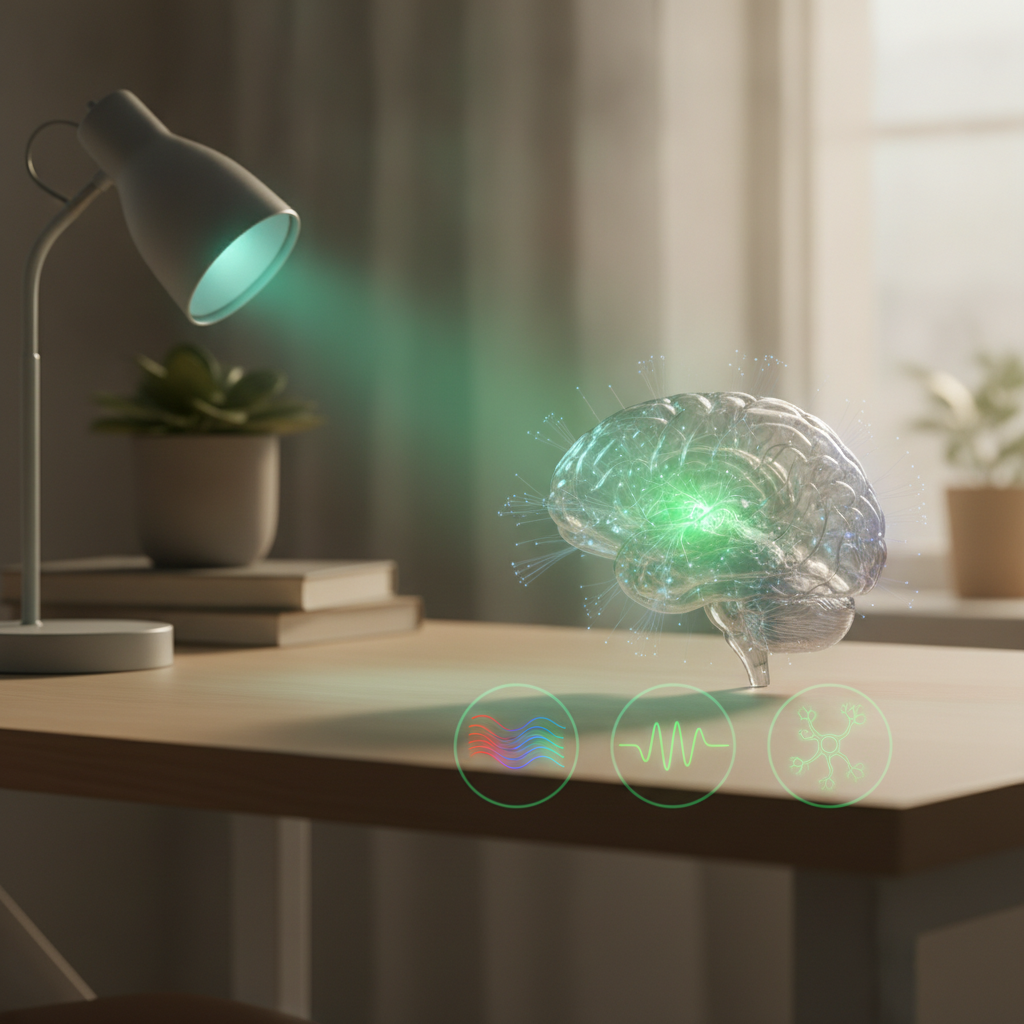
So when we ask how green light therapy works for migraines, the answer involves four overlapping mechanisms:
- Reduced cortical activation: Narrow-band green light generates the smallest electrical response in the visual pathway of any color, meaning less pain provocation.
- Pain network modulation: University of Arizona research shows green light, delivered through the eyes, alters how brain regions perceive and control pain signals.
- Endorphin release: Animal studies demonstrate increased beta-endorphins — the body's natural opioid-like painkillers — after green light exposure.
- Lower neuroinflammation: Green light has been shown to decrease activation of immune cells in the nervous system, dampening a known migraine driver.
Together, these mechanisms explain why patients often report not just less pain, but improved mood, better sleep, and reduced sensory overload after consistent use.
Why 520 nm Is the Migraine Sweet Spot
Not all green light is created equal. The reason the specific wavelength matters so much when discussing how green light therapy works for migraines comes down to retinal biology. Cone cells in the human eye peak in sensitivity around 530 nm, but the therapeutic "sweet spot" for migraine research has consistently been a tight band centered at 520 nm ± 10 nm.
Outside that band — even within the broader green range — light begins activating melanopsin-containing ipRGCs more strongly, which can re-trigger pain pathways. This is why generic green LEDs from a hardware store, or even some "green" therapy lamps with spectral spill into blue or yellow, often fail to deliver consistent results. Precision-engineered devices like the MyGreen Lamp clinical-grade lamp are designed to keep the output tightly within that 510–530 nm therapeutic window.
No. Standard green bulbs emit a broad spectrum that includes blue and yellow wavelengths known to trigger migraine. Effective therapy requires a narrow-band lamp engineered to peak at ~520 nm with minimal spectral spill.
What the Clinical Evidence Actually Shows
The most compelling data on how green light therapy works for migraines comes from a 2020 clinical trial (NCT03677206) led by Dr. Mohab Ibrahim at the University of Arizona. Adults with both episodic migraine (EM) and chronic migraine (CM) used green light-emitting diodes (GLEDs) at home for 1–2 hours per day in a darkened room, for ten weeks.
Headline Results
| Group | Headache Days/Month Before | Headache Days/Month After | Reduction |
|---|---|---|---|
| Episodic Migraine | 7.9 ± 1.6 | 2.4 ± 1.1 | ~70% |
| Chronic Migraine | 22.3 ± 1.2 | 9.4 ± 1.6 | ~58% |
| White Light Control | Baseline | Little change | Minimal |
Beyond raw headache counts, patients reported significant improvements on the Headache Impact Test-6 (HIT-6), McGill Pain Questionnaire, and EQ-5D-5L quality-of-life scale. Critically, zero adverse events were reported across the entire study cohort — a remarkable safety profile compared to many migraine medications.
A separate Harvard study confirmed that, of all visible wavelengths tested, narrow-band green light worsened active migraines least and, at low intensities, actively reduced pain and photophobia. These findings have been replicated in animal models showing reduced thermal and mechanical pain sensitivity after green light exposure.
You can read more about emerging clinical applications on our research and education hub.
How to Use Green Light Therapy at Home
Now that you understand how green light therapy works for migraines biologically, here's the practical protocol used in clinical studies and recommended by phototherapy specialists:
- Choose a clinically appropriate lamp. Look for narrow-band output centered at 520 nm with minimal spectral spill outside 510–530 nm.
- Set up a dark room. Eliminate other light sources. The therapeutic effect depends on green being the dominant or sole wavelength reaching your eyes.
- Position the lamp 1–2 meters away. Don't stare directly into the bulb; let the ambient green light fill the room and reflect off surfaces.
- Keep eyes open, but relaxed. You can read a book (under the green light only), listen to a podcast, meditate, or rest. Avoid screens, which emit competing wavelengths.
- Aim for 1–2 hours daily. Clinical trials used roughly 2 hours/day. Many users see benefits at 60–90 minutes.
- Be consistent for 8–10 weeks. Benefits compound over time. The Arizona trial measured outcomes at 10 weeks of daily use.
- Track your headache days and intensity. Use a simple migraine diary to objectively assess whether the therapy is working for you.
Yes — many users find it soothing during attacks because the eye and brain process narrow-band green light with minimal pain provocation. However, the strongest evidence supports daily preventive use rather than acute rescue.
Common Myths About Green Light Therapy for Migraines
Who Benefits Most from Green Light Therapy?
Based on the published evidence, green light therapy appears especially well-suited for:
- People with frequent episodic or chronic migraine who want to reduce monthly headache days without adding another medication.
- Individuals with severe photophobia or sensory overload who struggle to tolerate normal indoor lighting.
- Patients with medication-overuse headache seeking to taper acute drug use safely.
- People with comorbid anxiety, fibromyalgia, or post-concussion syndrome, where light sensitivity overlaps with broader sensory processing issues.
- Pregnant or breastfeeding individuals who need drug-free options (always consult your physician first).
It may be less helpful — or simply unstudied — for cluster headaches, tension-type headaches without photophobia, or trigeminal autonomic cephalalgias. The science is most robust for classic migraine.
"Narrow-band green light at 520 nm is the only color shown to reduce, rather than provoke, migraine pain — making it a uniquely promising drug-free therapy."
Is Green Light Therapy Safe? What to Know
One of the most reassuring aspects of how green light therapy works for migraines is its safety profile. Across published human trials, no significant adverse events have been reported. Green light at therapeutic intensities is non-ionizing, non-UV, and does not damage the retina at the recommended distances and durations.
Still, a few sensible precautions apply:
- Don't stare directly into the bulb at close range for prolonged periods.
- If you have a pre-existing retinal condition, epilepsy with photosensitivity, or take photosensitizing medications, consult an ophthalmologist before starting.
- Discontinue if you experience eye strain, dizziness, or worsening symptoms.
- Choose devices with verified spectral output. You can explore safety-tested options through MyGreen Lamp's product specifications.
Importantly, green light therapy is not currently FDA-approved as a medical treatment for migraine — it remains a wellness/complementary therapy. That means evidence is promising but still emerging, and results vary between individuals.
Comparing Green Light Therapy to Other Migraine Tools
| Therapy | Mechanism | Evidence Strength | Side Effects |
|---|---|---|---|
| Green Light Therapy (520 nm) | Calms visual pathway, boosts endorphins | Emerging clinical trials | None reported |
| Triptans | Serotonin receptor agonism | Strong (acute) | Chest tightness, rebound |
| CGRP Inhibitors | Blocks pain peptide | Strong (preventive) | Constipation, injection site |
| FL-41 Tinted Glasses | Filters trigger wavelengths | Moderate | None significant |
| Botox | Blocks neuromuscular signaling | Strong (chronic) | Neck pain, drooping |
Green light therapy isn't a replacement for proven pharmacologic treatments, but it's one of the few non-drug options with growing clinical support and an exceptional safety record.
Frequently Asked Questions
How long does it take for green light therapy to work for migraines?
Most clinical trials measured outcomes after 8–10 weeks of daily 1–2 hour sessions. Some users notice reduced light sensitivity within days, but meaningful drops in headache frequency typically require consistent use over two to three months.
How green light therapy works for migraines compared to other colors?
Harvard research found that narrow-band green light (~520 nm) produces the smallest electrical signal in the retina and visual cortex of any color, while white, blue, amber, and red light all worsened migraine pain. Green is uniquely tolerated — and at low intensities, it actually reduces pain.
Can children use green light therapy for migraines?
While the published trials focused on adults, the therapy's non-pharmacologic nature and excellent safety profile make it an appealing option for pediatric migraine. Always consult a pediatric neurologist before starting any new therapy with children.
Is green light therapy covered by insurance?
Currently, no. Because it's not FDA-approved as a medical device for migraine, green light lamps are typically out-of-pocket purchases. Some users qualify for HSA/FSA reimbursement with a doctor's letter of medical necessity.
Can I use green light therapy alongside my migraine medication?
Yes. Green light therapy is designed as a complementary approach and has no known drug interactions. Many neurologists are open to patients trying it alongside preventive medications, triptans, or CGRP inhibitors.
Conclusion: A Gentle, Science-Backed Tool for Migraine Relief
Understanding how green light therapy works for migraines reveals something genuinely remarkable: a single, precisely-tuned wavelength of light can calm overactive pain pathways, trigger natural endorphin release, and reduce neuroinflammation — all without a single pill or side effect. Clinical trials show dramatic reductions in headache days for both episodic and chronic migraine sufferers, and the safety profile is virtually unmatched in headache medicine.
Of course, green light therapy isn't a miracle cure, and it's not a replacement for the care of your neurologist. But for the millions of people seeking drug-free relief, fewer headache days, and a way to take back control of their sensory environment, it represents one of the most exciting developments in migraine wellness in a generation.
Ready to experience clinical-grade narrow-band green light at home? Explore the MyGreen Lamp collection — engineered specifically for the 520 nm therapeutic window backed by peer-reviewed research. Your migraine relief journey starts with the right light.