Best Green Light Therapy Lamp for Home Use: 2025 Guide
June 24, 2026 · 13 min read
Finding the best green light therapy lamp for home use can feel overwhelming, especially when you're already dealing with migraines, photophobia, or sensory overload. The wrong lamp can actually worsen symptoms, while the right one—engineered with a precise narrowband wavelength, low flicker, and eye-safe brightness—can offer meaningful, drug-free relief in as little as 10 minutes per session.
TL;DR — The Bottom Line
The best green light therapy lamp for home use delivers a narrow 520–530 nm wavelength, is UV-free, flicker-free, and offers adjustable brightness. For migraine and light-sensitivity sufferers, look for clinically referenced wavelengths (525 nm is the gold standard from Harvard-affiliated research), IEC 62471 photobiological safety certification, and tunable intensity. MyGreen Lamp's dual-wavelength design (525 nm + 545 nm) is engineered specifically for this use case, with users reporting relief in approximately 10 minutes.
Quick Facts
- Optimal Wavelength: 520–530 nm (narrowband green)
- Clinical Study Result: 5–13 fewer headache days per month
- Typical Session Length: 10–120 minutes
- Time to Relief (MyGreen Lamp): ~10 minutes
- Safety Certification to Look For: IEC 62471, CE, UV-free
- Adverse Events in Clinical Trials: None reported
Why Green Light Therapy Works for Migraines and Light Sensitivity
Green light occupies a unique position in the visible spectrum. Research from Harvard Medical School and the University of Arizona has shown that a narrow band of green wavelengths around 525 nm appears to reduce migraine pain intensity and frequency, while other colors of light—including white, blue, amber, and red—tend to aggravate symptoms in people with photophobia.
For migraine sufferers, this matters enormously. Roughly 80–90% of people experiencing a migraine attack report light sensitivity as a core symptom. Most ambient lighting—LED office bulbs, fluorescent tubes, even smartphones—emits broad-spectrum light that triggers or worsens attacks. A purpose-built green light therapy lamp does the opposite: it bathes the room in a soothing, narrowband green glow that's actually neurologically calming.
The seminal 2021 clinical study published in Cephalalgia used 525 nm green LEDs in a controlled setting and found participants experienced reductions of 5 to 13 headache days per month—results comparable to some prescription preventive medications, but with zero adverse events. That's why choosing the best green light therapy lamp for home use isn't just a wellness decision; for many, it's a legitimate symptom-management strategy.
What Makes a Green Light Therapy Lamp Effective?
Not every lamp marketed as "green" delivers therapeutic value. Many decorative LEDs labeled green actually emit a broad spectrum with a green-tinted appearance, which won't produce the neurological effects documented in clinical studies. When evaluating the best green light therapy lamp for home use, focus on these five engineering criteria:
1. Narrowband Wavelength (520–530 nm)
The therapeutic effect is wavelength-specific. A true green migraine lamp emits a tight band around 525 nm with minimal spectral bleed into blue or yellow. Lamps that include 545 nm as a secondary option, like MyGreen Lamp, allow users to tune to their individual response—some people find slightly different wavelengths more comfortable.
2. Flicker-Free Operation
Flicker, even imperceptible flicker above 60 Hz, is a known migraine trigger. The best lamps use DC-driven LEDs or high-frequency modulation to eliminate flicker entirely.
3. Adjustable Brightness
During an active migraine, even therapeutic green light should be dimmable. During preventive use, brighter exposure may be desired. Look for continuous dimming, not just two or three preset levels.
4. UV-Free and Eye-Safe
Reputable manufacturers test against IEC 62471, the international photobiological safety standard. This certification confirms the lamp poses no risk of UV exposure, retinal blue-light hazard, or thermal injury during normal use.
5. Eyes-Open vs. Eyes-Closed Design
Some protocols (like the Allay Lamp) require eyes-open exposure for 1–2 hours. Newer designs, including MyGreen Lamp, are tuned for eyes-closed sessions of about 10 minutes—a major usability win when you're mid-attack.
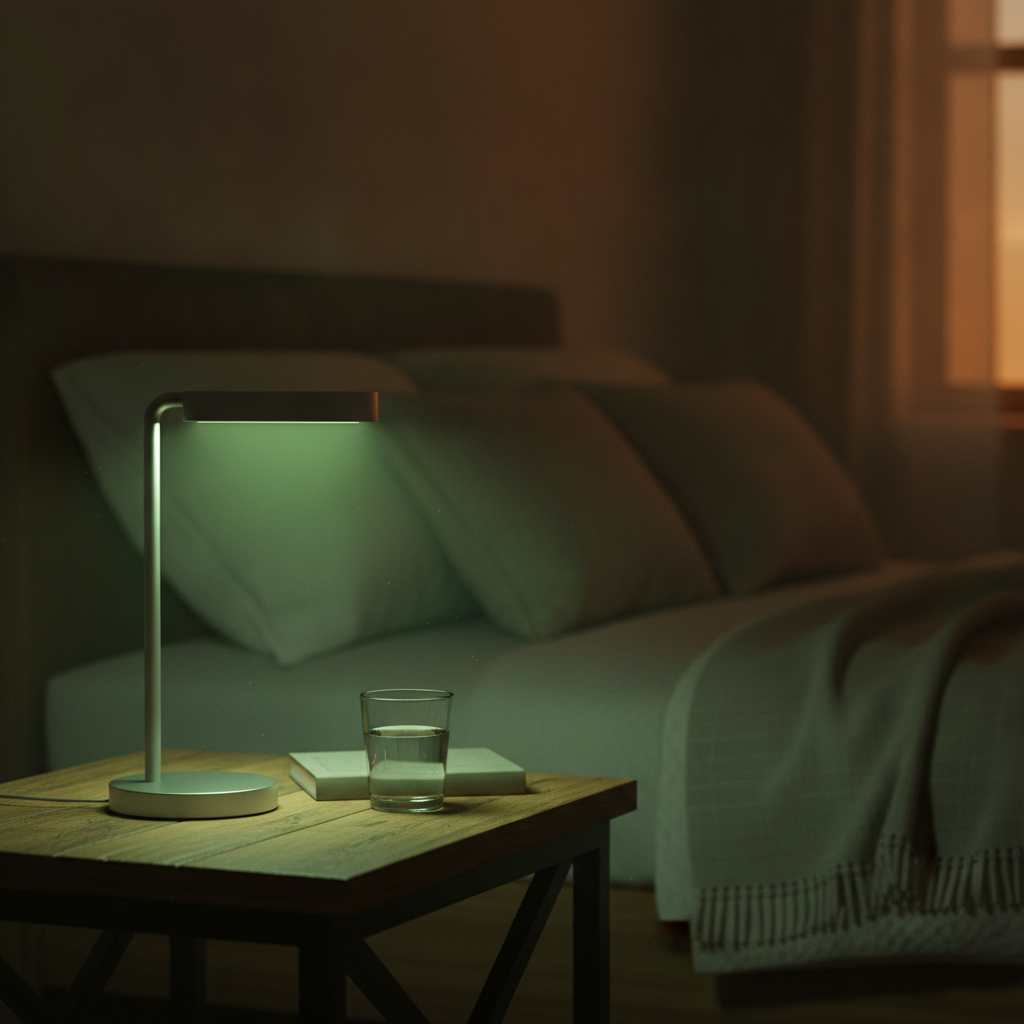
How to Choose the Best Green Light Therapy Lamp for Home Use
Selecting the best green light therapy lamp for home use comes down to matching the device to your symptom profile and lifestyle. Here's a structured approach.
- Identify your primary use case. Are you treating acute migraine attacks, preventing them, managing daily light sensitivity, or addressing sensory overload from autism, concussion, or post-viral fatigue?
- Verify the wavelength specification. Demand a spec sheet. "Green light" is meaningless; "525 nm peak with ±5 nm bandwidth" is meaningful.
- Confirm safety certifications. CE marking is a regulatory baseline; IEC 62471 is the photobiological gold standard.
- Evaluate session ergonomics. A lamp requiring 2 hours of eyes-open exposure may be impractical during an attack. Shorter eyes-closed protocols are more livable.
- Check the return policy. Individual response varies. A 30-day money-back guarantee is reasonable.
- Read user reviews from migraine communities, not just generic e-commerce stars.
Technically yes, but most consumer green bulbs emit a broad spectrum that only appears green—they're not narrowband. For genuine therapeutic effect, you need a lamp engineered to emit a tight 520–530 nm band, with verified spectral output and flicker control.
Comparing the Top Green Light Therapy Lamps in 2025
The market for green light migraine devices is small but growing. Below is a comparison of the leading options to help you identify the best green light therapy lamp for home use for your needs.
| Product | Wavelength | Session Style | Typical Session Time | Approx. Price |
|---|---|---|---|---|
| MyGreen Lamp | 525 nm + 545 nm (tunable) | Eyes-closed | ~10 minutes | $$$ Premium |
| Allay Lamp | ~520 nm narrowband | Eyes-open, ambient | 60–120 minutes | $$$ Premium |
| NorbRELIEF Bulb | Narrowband green | Eyes-open, ambient | 30–60 minutes | $$ Mid |
| Hooga Green Bulb | ~520 nm (variable) | Eyes-open, ambient | 30–90 minutes | $ Budget |
| Green-tinted Glasses | Variable (filter-based) | Wear during exposure | As needed | $–$$ |
The standout differentiator for MyGreen Lamp is the dual-wavelength tunability and the eyes-closed, 10-minute protocol. For someone in the throes of an attack, the ability to lie down, close your eyes, and feel relief in minutes is fundamentally different from sitting in a green-lit room for two hours.
How to Use a Green Light Therapy Lamp at Home
Owning the best green light therapy lamp for home use is only half the equation. Consistent, correct usage drives results. Here's a practical protocol synthesized from clinical research and manufacturer guidance.
For Acute Migraine Attacks
- At the first sign of an attack, retreat to a quiet, low-light room.
- Turn off all other light sources—including phone screens and white-light bulbs.
- Position the lamp 2–4 feet from your face.
- Set brightness to a comfortable level (start low if you're highly photophobic).
- Close your eyes (for eyes-closed devices) or rest your gaze comfortably in the green field (for eyes-open lamps).
- Remain in the green light for 10 minutes (eyes-closed) or up to 60–120 minutes (eyes-open).
- Reassess symptoms. Many users report meaningful relief within the session.
For Migraine Prevention
The 2021 clinical study had participants use green light for 1–2 hours daily over 10 weeks. For prevention, consistency matters more than session length. Many users incorporate green light during evening wind-down—reading, meditating, or simply relaxing.
For Sensory Overload and Light Sensitivity
People with concussion recovery, autism, long COVID, or general sensory sensitivities often find a green-lit room dramatically more tolerable than standard lighting. Use the lamp as ambient lighting during periods of high stimulation.
Individual response varies. In the 2021 clinical trial, benefits accumulated over weeks. With MyGreen Lamp's tunable narrowband design, many users report acute relief within 10 minutes of a session, though preventive benefits build over consistent daily use.
Common Myths About Green Light Therapy
Safety, Side Effects, and Who Should Be Cautious
Green light therapy has an exceptional safety profile. The 2021 clinical trial reported zero adverse events across the study population. The light is non-ionizing, UV-free (in properly engineered products), and operates at intensities well within the eye-safe range when IEC 62471 certified.
That said, a few considerations:
- Photosensitive epilepsy: Anyone with a seizure disorder should consult a neurologist before starting any light-based therapy, even flicker-free devices.
- Retinal conditions: Patients with macular degeneration or active retinal disease should consult an ophthalmologist.
- Medications: Certain photosensitizing medications (some antibiotics, retinoids) warrant a brief conversation with your prescriber.
- Children: Pediatric use should be supervised and ideally discussed with a pediatric neurologist.
For most adults with migraine, photophobia, or sensory sensitivities, a quality green light therapy lamp is one of the safest interventions available. You can learn more about the clinical background on the MyGreen Lamp research page.
Why MyGreen Lamp Stands Out
Among the available options, MyGreen Lamp is engineered specifically around the published clinical research. Its distinguishing features include:
- Dual narrowband wavelengths (525 nm and 545 nm), individually adjustable so users can tune to personal response
- Eyes-closed protocol designed for ~10 minute sessions, making it usable during active attacks
- Flicker-free DC drive for migraine-safe operation
- UV-free, eye-safe certified output
- Compact, bedside-friendly form factor rather than a wall-sized lamp
- Companion goggles with four wavelengths for portable use
The combination of clinically anchored wavelengths, short session times, and home-friendly ergonomics positions it as a strong candidate for the best green light therapy lamp for home use in 2025—particularly for users who need relief that fits into a real-life routine.
"For migraine sufferers, choosing the right green light therapy lamp isn't a wellness purchase—it's a clinical decision. Wavelength precision, flicker control, and session ergonomics determine whether a device delivers relief or just decoration."
Frequently Asked Questions
What is the best green light therapy lamp for home use in 2025?
The best green light therapy lamp for home use is one that emits a narrowband 520–530 nm wavelength, is flicker-free, UV-free, and IEC 62471 certified. MyGreen Lamp, Allay Lamp, and NorbRELIEF are leading purpose-built options. MyGreen Lamp differentiates with dual tunable wavelengths and a 10-minute eyes-closed protocol.
How long does it take for green light therapy to work for migraines?
Acute relief can occur within a single 10-minute session for many users. Preventive benefits, as documented in a 2021 Cephalalgia study, accumulate over 10 weeks of daily 1–2 hour exposure, with participants experiencing 5–13 fewer headache days per month.
Is green light therapy safe for daily use at home?
Yes. Clinical trials have reported no adverse events. Provided the lamp is UV-free and IEC 62471 certified, daily use is considered safe for most adults. People with photosensitive epilepsy, retinal disease, or those taking photosensitizing medications should consult a clinician first.
Can I use a regular green LED bulb instead of a dedicated green light therapy lamp?
It's not recommended. Most consumer green LED bulbs emit a broad spectrum that only appears green, lacking the narrow 525 nm peak shown effective in research. They may also flicker. A purpose-built green light therapy lamp is engineered to clinical wavelength and safety specifications.
Does green light therapy help with sensory overload or autism-related light sensitivity?
Many users with sensory processing sensitivities, autism, concussion recovery, or long COVID report that green-lit environments are dramatically more tolerable than standard lighting. While robust clinical trials in these populations are still emerging, the mechanism—reduced cortical activation from green light—suggests broad applicability for light-sensitive individuals.
Conclusion: Choosing the Right Green Light for You
Migraines and chronic light sensitivity are isolating conditions, but the science behind green light therapy offers a rare combination: meaningful relief, no medication, no side effects, and a research foundation from institutions like Harvard and the University of Arizona. The best green light therapy lamp for home use is one that respects this science—narrowband wavelength, flicker-free operation, eye-safe certification—while fitting into the reality of your daily life.
If you're ready to try a clinically anchored, dual-wavelength, eyes-closed solution designed specifically for migraine and light sensitivity, explore the MyGreen Lamp collection and see why it's becoming a trusted choice for drug-free relief. Your next 10 minutes could be the start of a calmer, clearer day.