What to Look For in a Tampa Bay Walkable Neighborhood
June 20, 2026 · 13 min read
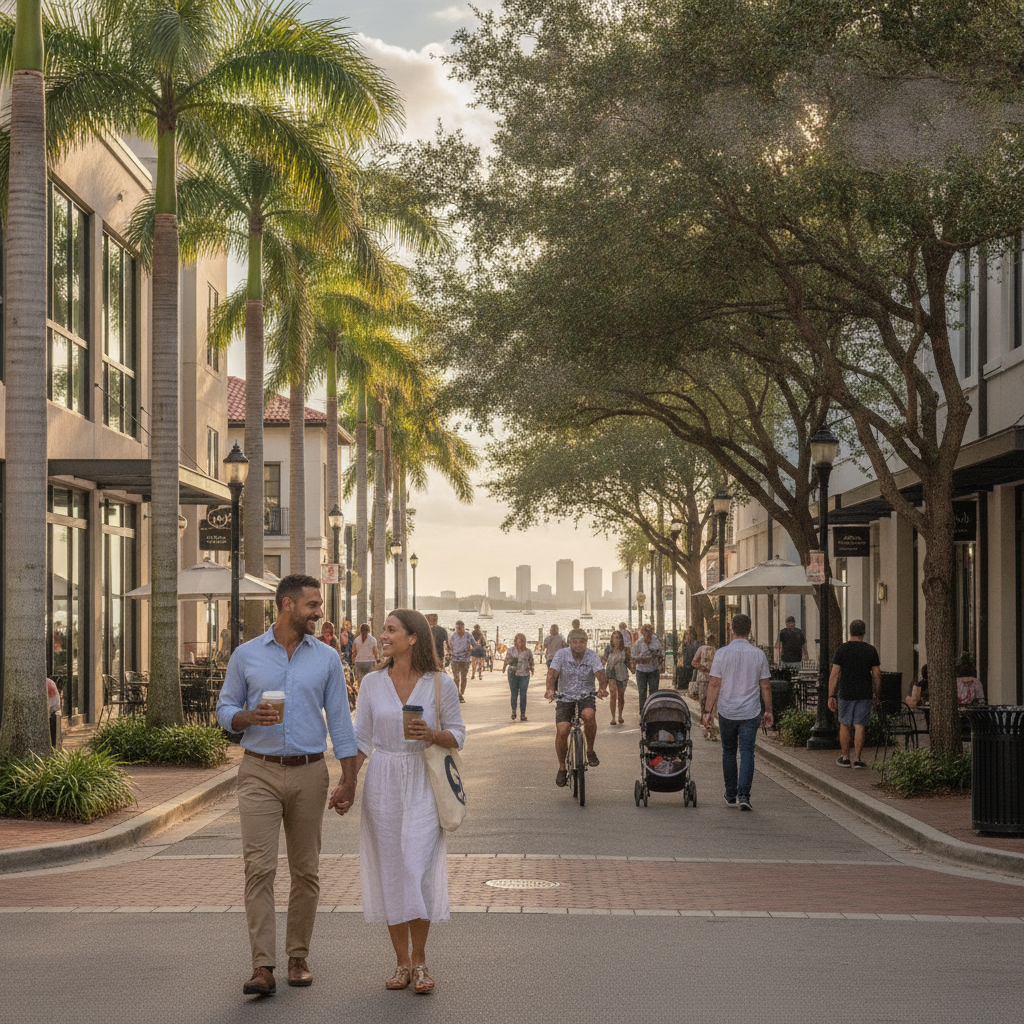
TL;DR — The Bottom Line
When deciding what to look for in a Tampa Bay walkable neighborhood, focus on four things you can reach on foot from your front door: groceries, coffee, dinner, and a park or waterfront. Tampa's most walkable neighborhoods — Hyde Park, Courier City–Oscawana, Uptown, Channel District/Water Street, and Downtown St. Pete — combine high Walk Scores (77–89) with continuous sidewalks, slow streets, and dense amenities. Decide early whether you want a true walkable region (Hyde Park, Old Northeast) or a suburban walkable village center (Westchase) — they live very differently.
If you're house hunting in Tampa Bay right now, the single biggest lifestyle decision isn't square footage or pool versus no pool — it's how much of your daily life you can do without your car. Knowing what to look for in a Tampa Bay walkable neighborhood can be the difference between loving where you live in year three and quietly resenting your commute. As a Tampa Bay real estate specialist, I walk buyers through this framework on almost every consultation, because Tampa's walkability is uneven, hyperlocal, and often misunderstood by national portals.
This guide breaks down exactly what to look for in a Tampa Bay walkable neighborhood — from Walk Score benchmarks and sidewalk quality to school access, flood considerations, and resale value. Whether you're a first-time buyer eyeing a Hyde Park bungalow or a relocating professional weighing Downtown St. Pete versus Water Street, you'll leave with a practical checklist you can use this weekend.
Quick Facts
- Tampa Citywide Walk Score: ~50 (somewhat walkable)
- Most walkable Tampa neighborhood: Uptown Tampa, Walk Score 89
- Top South Tampa walkable areas: Courier City–Oscawana (87), North Hyde Park (79), Palma Ceia West (77)
- Key walkable corridor: Tampa Riverwalk — 2.6 miles linking downtown parks, museums, and Water Street
- Walkable St. Pete benchmark: Downtown St. Pete & Old Northeast — among the highest pedestrian density in the region
- Bike-friendliness: Tampa rated "somewhat bikeable" with strong pockets in South Tampa and along the Riverwalk
How Walkability Is Actually Measured in Tampa Bay
Before you can evaluate what to look for in a Tampa Bay walkable neighborhood, you need to understand how the metrics work — and where they fall short. Walk Score, the industry standard, ranks neighborhoods from 0 to 100 based on the distance to nearby amenities like grocery stores, restaurants, schools, and parks. Anything 70+ is considered "very walkable," and 90+ is a "walker's paradise."
Here's how Tampa stacks up by neighborhood:
| Neighborhood | Walk Score | Character |
|---|---|---|
| Uptown Tampa | 89 | Dense, urban, mixed-use |
| Courier City–Oscawana | 87 | South Tampa urban village |
| North Hyde Park | 79 | Historic, tree-lined |
| Palma Ceia West | 77 | Walkable to SoHo & Bayshore |
| Channel District / Water Street | 70s–80s | New urban core |
| Tampa (citywide average) | ~50 | Car-dependent overall |
But raw scores miss something critical: the Tampa Riverwalk and Bayshore Boulevard functionally extend walkability far beyond what algorithms capture. A Channel District condo with a Walk Score of 78 may, in practice, give you better foot access to parks, museums, and waterfront than a higher-scored neighborhood elsewhere — because the Riverwalk acts as a 2.6-mile pedestrian spine.
This is why understanding what to look for in a Tampa Bay walkable neighborhood requires more than a score. It requires asking: walkable to what, and along what kind of street?
Walkable Region vs. Walkable Inside: The Tampa Bay Distinction
One of the most useful frameworks I share with buyers is the difference between a walkable region and a walkable inside. This distinction matters more in Tampa Bay than almost anywhere else in Florida, because we have both in abundance.
Walkable Region
You can walk for miles between cafes, shops, restaurants, and parks without ever leaving an urban fabric. The streets connect. The sidewalks continue. People are out. Examples include:
- Hyde Park & SoHo — Tampa's gold standard for walkable urban living
- Downtown St. Pete & Old Northeast — arguably the most walkable region in all of Tampa Bay
- Channel District / Water Street / Riverwalk — newest, most amenity-rich
Walkable Inside
The community has a charming, walkable center — but everything beyond it requires a car. Westchase and parts of Wesley Chapel fit here. You can stroll to the village green, the coffee shop, and the playground inside the community, but grocery runs and commutes still mean driving on arterial roads.
For many families, yes. Walkable village centers like Westchase deliver community, kid-friendly streets, and after-dinner strolls — even though weekday life still requires a car. The right answer depends on whether walkability is a lifestyle choice or a car-replacement strategy.
The Four-Door Test: What to Look For in a Tampa Bay Walkable Neighborhood
When I tour homes with buyers, I use a simple four-door test to evaluate what to look for in a Tampa Bay walkable neighborhood. Stand at the front door and ask: can I walk to each of these in 15 minutes or less?
- Groceries or a pharmacy — the single biggest predictor of true car-free days
- A coffee shop — proxy for morning walkability and street life
- A sit-down dinner restaurant — proxy for evening safety and density
- A park, waterfront, or trail — proxy for weekend lifestyle
If you can hit all four, you're in a genuinely walkable Tampa Bay neighborhood. Three out of four is excellent. Two or fewer, and you're really buying a quiet residential street that happens to be near walkable amenities — which is fine, but be honest about it. For more neighborhood-by-neighborhood breakdowns, see our Tampa Bay neighborhood guide.
Where the Four-Door Test Passes Easily
- Hyde Park Village area
- SoHo (South Howard Avenue)
- Channel District / Water Street
- Downtown St. Pete (Beach Drive corridor)
- Old Northeast (St. Pete)
- Parts of Seminole Heights along Florida Avenue
Sidewalks, Streets, and Shade: The Physical Infrastructure
Knowing what to look for in a Tampa Bay walkable neighborhood means looking down as much as around. The physical infrastructure determines whether walking is pleasant or a chore — especially in our summer heat.
Sidewalk Continuity
Historic neighborhoods like Hyde Park, Palma Ceia, Davis Islands, and Old Northeast were platted with continuous sidewalks on both sides of the street. Newer suburban developments often have sidewalks only on one side, or none at all on interior streets. Walk the block at the time of day you'd actually be out — morning commute, school pickup, post-dinner — and check for breaks, overgrown vegetation, and curb cuts.
Tree Canopy and Shade
In Tampa Bay, shade isn't a luxury — it's the difference between walking and not walking from June through September. Seminole Heights, Hyde Park, and Old Northeast all have mature oak canopies that make summer walks tolerable. New construction neighborhoods often lack this for a decade or more.
Traffic Calming
Look for narrow streets, on-street parking (which slows cars), four-way stops, and short blocks. Avoid neighborhoods cut off from amenities by six-lane arterials like Dale Mabry, Hillsborough Avenue, or 4th Street North — even a high Walk Score can't overcome a hostile crossing.
Lifestyle Anchors: Riverwalk, Bayshore, and Beach Drive
Tampa Bay has three pedestrian "superhighways" that dramatically amplify walkability for nearby homes. If you're evaluating what to look for in a Tampa Bay walkable neighborhood, proximity to one of these is a major value-add.
The Tampa Riverwalk
A 2.6-mile waterfront path connecting Curtis Hixon Park, the Tampa Museum of Art, the Florida Aquarium, Amalie Arena, and Water Street. Condos in the Channel District and downtown effectively gain a giant linear park as their front yard.
Bayshore Boulevard
The world's longest continuous sidewalk — 4.5 miles of waterfront promenade along Hillsborough Bay. Homes in Hyde Park, Palma Ceia, and Bayshore Beautiful command premium pricing largely because of it.
Beach Drive (St. Pete)
The pedestrian heart of Downtown St. Pete, with waterfront parks, museums (including The Dalí), and a dense restaurant row. Old Northeast and Downtown condos all funnel into this corridor.
Generally, yes. Hyde Park, Palma Ceia, Old Northeast, and Downtown St. Pete have consistently outperformed Tampa Bay's average appreciation over the last decade, in part because walkable inventory is fixed and demand keeps rising. Walkability is a durable, scarce amenity.
Schools, Families, and Walkability
For families, what to look for in a Tampa Bay walkable neighborhood expands to include schools, playgrounds, and safe routes for kids. The good news: several of Tampa Bay's most walkable neighborhoods are also zoned for strong schools.
- South Tampa — Mitchell Elementary, Wilson Middle, Plant High School zone is highly sought after and overlaps with Hyde Park, Palma Ceia, and Bayshore Beautiful
- Davis Islands — small-town feel inside the city, with its own elementary, beach, and airport
- Old Northeast (St. Pete) — proximity to North Shore Elementary and several magnet options
Walk the route to school during morning drop-off. Look for crossing guards, low-traffic side streets, and continuous sidewalks. A great Walk Score means nothing if your seven-year-old has to cross Kennedy Boulevard. For more on family-friendly buying, browse our Tampa Bay buyers guide.
Flood Zones, Insurance, and Walkable Waterfront Living
This is the conversation national portals never have. Many of Tampa Bay's most walkable neighborhoods are also the most flood-exposed. Davis Islands, Channel District, parts of Hyde Park, Old Northeast, and Downtown St. Pete all have homes in FEMA Special Flood Hazard Areas.
Before you fall in love with a walkable bungalow, get clear on:
- The property's exact FEMA flood zone (AE, X, VE)
- The base flood elevation versus the home's finished floor elevation
- Estimated annual flood insurance under the current NFIP rating
- Elevation certificate availability
Walkability premiums plus flood insurance premiums can quickly reshape your monthly budget. A great agent will run these numbers before you write an offer, not after inspection.
How to Tour a Walkable Neighborhood Like a Pro
Here's the step-by-step process I walk clients through when evaluating what to look for in a Tampa Bay walkable neighborhood:
- Check the Walk Score and Bike Score for the exact address, not the neighborhood
- Run the Four-Door Test on foot — literally walk to groceries, coffee, dinner, and a park
- Visit at three times of day — weekday morning, weekday evening, weekend midday
- Walk to the nearest arterial and ask whether you'd cross it with a stroller
- Check the flood zone and insurance estimate through your agent or insurer
- Map the school walk if you have or plan to have kids
- Drive the commute once during rush hour to confirm the trade-off math
Spending one Saturday doing this can save you years of buyer's remorse. If you'd like a guided neighborhood tour with this framework, you can reach out to schedule a walkability tour.
Resale Considerations: Why Walkability Protects Your Investment
Buyers often ask whether walkability is worth the premium. In Tampa Bay, the answer has been an emphatic yes for the past decade. Walkable inventory is essentially fixed — you cannot build more Hyde Park bungalows, more Old Northeast streetscapes, or more Bayshore frontage. As remote work, retiree relocation, and lifestyle-driven buying continue to grow, scarce walkable inventory commands durable premiums.
When you sell, a walkable address sells itself. Listing photos can capture a Bayshore sunset or a Beach Drive cafe. Buyers tour at 5 PM on a Friday and feel the energy. That emotional pull is hard to manufacture in a car-dependent subdivision — and it compresses days on market.
"Walkability isn't a feature — it's an entire lifestyle infrastructure that you either inherit with the address or you don't. In Tampa Bay, it's also one of the most scarce and durable forms of real estate value."
Frequently Asked Questions
What is the most walkable neighborhood in Tampa?
Uptown Tampa currently has the highest Walk Score in the city at 89, followed by Courier City–Oscawana at 87. For a true walkable-region lifestyle, Hyde Park and the Channel District/Water Street area are the most popular choices among buyers, while Downtown St. Pete and Old Northeast lead the region overall.
What should I look for in a Tampa Bay walkable neighborhood as a first-time buyer?
Use the Four-Door Test: can you walk to groceries, coffee, dinner, and a park or waterfront in 15 minutes? Then check sidewalk continuity, shade, traffic calming on local streets, flood zone, and school walk routes. First-time buyers should also confirm flood insurance estimates before falling in love with a waterfront walkable address.
Is Downtown St. Pete more walkable than Downtown Tampa?
For pure pedestrian density and lifestyle, Downtown St. Pete — especially the Beach Drive corridor and Old Northeast — is generally considered the most walkable region in all of Tampa Bay. Downtown Tampa is rapidly catching up thanks to Water Street and the Riverwalk, but St. Pete still leads on continuous street life and waterfront pedestrian space.
Do walkable Tampa Bay neighborhoods cost more?
Yes, typically. Walkable neighborhoods like Hyde Park, Palma Ceia, Davis Islands, Old Northeast, and Downtown St. Pete carry a premium of 15–40% per square foot over comparable car-dependent areas. However, they also tend to appreciate faster and resell more quickly, which often justifies the premium for long-term owners.
Are walkable Tampa Bay neighborhoods family-friendly?
Many are. Hyde Park, Palma Ceia, Davis Islands, and Old Northeast all combine walkability with strong school zones, parks, and quiet residential streets. Westchase offers a walkable-inside village center that families particularly love. The key is matching the walkable type to your family's daily rhythms.
Conclusion: Your Next Step
Knowing what to look for in a Tampa Bay walkable neighborhood comes down to one honest question: how do you actually want to spend your days? If you crave morning coffee on foot, after-work walks along the water, and dinner without parking, target a true walkable region — Hyde Park, Palma Ceia, Channel District, Downtown St. Pete, or Old Northeast. If you want community charm with a suburban anchor, a walkable-inside neighborhood like Westchase may fit better.
Either way, the framework is the same: run the Four-Door Test, evaluate the physical infrastructure, weigh flood and insurance realities, and choose a walkable type that matches your real life — not the one in the brochure.
If you'd like a personalized walkability tour or a shortlist of homes matching your Four-Door criteria, I'd love to help. Contact Kyle Hollister today to start your Tampa Bay home search with a walkability-first strategy.