Tampa Bay Investment Property Taxes: What to Know in 2026
September 15, 2026 · 13 min read

If you're buying rental property or a second home in the Tampa Bay area, Tampa Bay investment property taxes will hit your bottom line differently than the taxes on a primary residence. Florida's property tax system treats owner-occupied homesteads and non-homestead investment properties very differently, and understanding that gap is essential before you underwrite a deal in Hillsborough, Pinellas, or Pasco County. This guide breaks down exactly how Tampa Bay investment property taxes work, what caps and exemptions apply (and don't apply) to you, and how to plan for them as part of your long-term investment strategy.
TL;DR — The Bottom Line
Tampa Bay investment property taxes typically run 1.6%–1.9% of taxable value annually because rental and second-home properties don't qualify for Florida's homestead exemption. Instead, non-homestead property gets a 10% annual cap on assessment increases for non-school taxes, meaning your assessed value can still climb steadily even without a sale. Investors should budget for higher starting tax bills than owner-occupants, watch for reassessment triggers, and factor county-specific millage rates into their cap rate math before closing.
Quick Facts
- Typical effective tax rate: 1.6%–1.9% of taxable value for non-homestead investment property in Tampa Bay
- Annual assessment cap: 10% maximum increase per year for non-school taxes on non-homestead property
- Homestead exemption available to investors: None — homestead exemptions apply only to owner-occupied primary residences
- Counties covered: Hillsborough, Pinellas, and Pasco, each with distinct millage rates
- School tax cap: None — school board millage applies to full, uncapped assessed value
- Cap reset triggers: Change of ownership, new homestead designation, parcel splits, and qualifying improvements
Understanding Tampa Bay Investment Property Taxes: The Basics
Florida's property tax code was built around protecting the primary homeowner, not the investor. That distinction is the single most important thing to understand about Tampa Bay investment property taxes. When you buy a home to live in, you can file for a homestead exemption that shields a portion of your assessed value from taxation and slows future increases through the Save Our Homes cap. When you buy a rental property, a second home, or a small multifamily building as an investment, none of that applies.
Instead, investment and rental properties are classified as "non-homestead" for tax purposes. That means the property is taxed on its full just (market) value each year, with only one meaningful protection: a 10% cap on how much the assessed value can increase annually for county, city, and special-district taxes. There is no exemption reducing the taxable base, and school district taxes are calculated on the uncapped value. For an investor comparing a primary-residence purchase to a rental purchase in the same neighborhood, this difference alone can mean a materially higher first-year tax bill.
In practical terms, most Tampa Bay investors should expect an effective property tax burden somewhere in the 1.6% to 1.9% range of taxable value, depending on the county, city, and special taxing districts involved. That's before insurance, HOA fees, or maintenance reserves — all of which also factor into your net yield calculations.
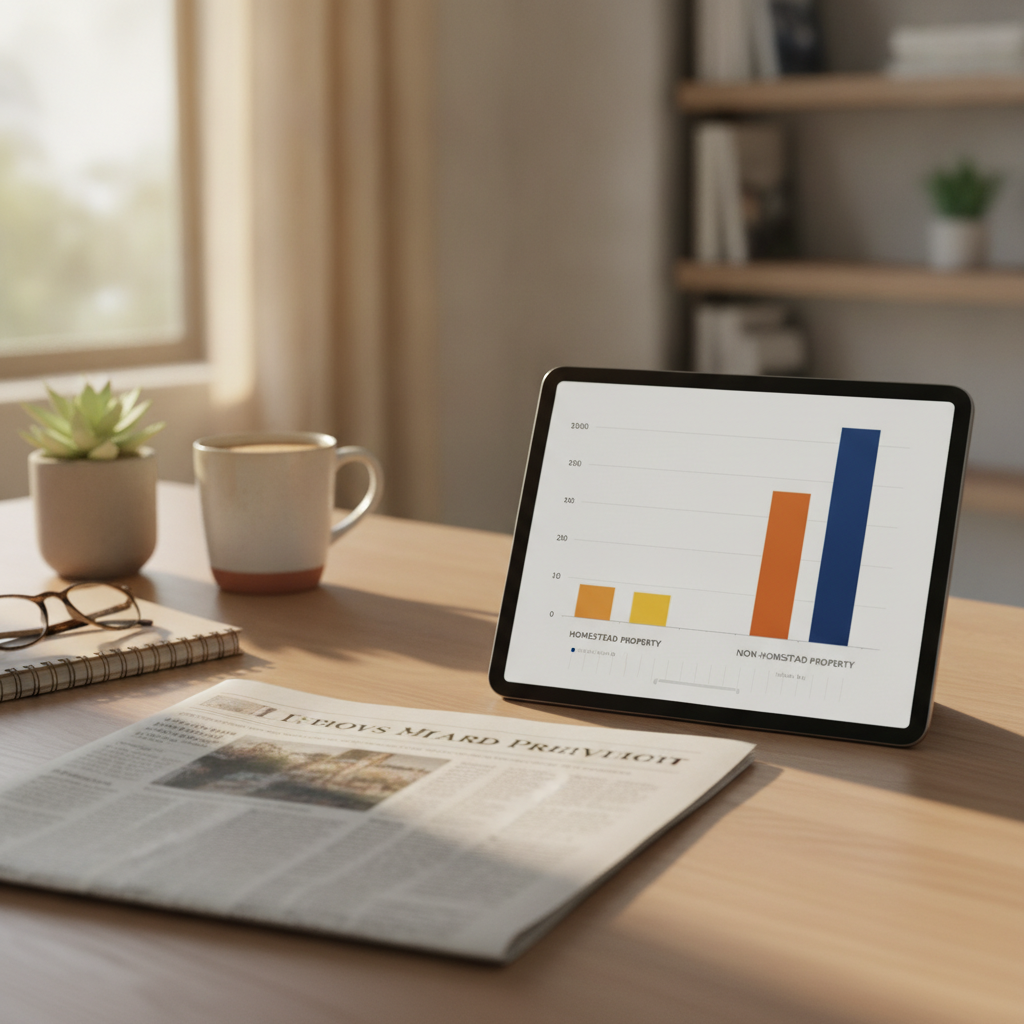
Homestead vs. Non-Homestead: Why Investment Properties Are Taxed Differently
To understand Tampa Bay investment property taxes, it helps to see the homestead system side by side with the non-homestead system that governs most rental and second-home purchases.
| Feature | Homestead Property | Non-Homestead (Investment) Property |
|---|---|---|
| Exemption on assessed value | Up to $50,000 combined exemption | None |
| Annual assessment growth cap | 3% or CPI, whichever is lower (Save Our Homes) | 10% for non-school taxes only |
| School tax treatment | Subject to capped assessed value in most cases | Full uncapped just value |
| Portability of tax benefit | Up to $500,000 transferable to new homestead | Not available |
| Application required | Yes, filed with county property appraiser | No — cap applies automatically |
A homesteaded owner who has lived in a home for a decade might be paying taxes on an assessed value far below current market value, thanks to the Save Our Homes cap. An investor buying a comparable property today, with no homestead exemption, starts at full just value on day one. That's why two nearly identical houses on the same street can carry dramatically different tax bills — one reflects years of capped growth under homestead protection, and the other reflects current market value adjusted only by the 10% non-homestead cap going forward.
No. Florida homestead exemptions require the owner to occupy the property as their permanent residence as of January 1 of the tax year. A property used exclusively as a rental or held as a pure investment does not qualify, regardless of how long you've owned it.
The 10% Assessment Cap: How It Works for Tampa Bay Investors
The good news for investors is that Florida does offer some protection against runaway tax increases, even without a homestead exemption. The 10% non-homestead assessment cap limits how much your property's assessed value can rise each year for county, municipal, and special-district taxes — regardless of how fast market values are climbing.
Here's what that means in practice for Tampa Bay investment property taxes:
- The cap is automatic. You don't need to file paperwork; the property appraiser applies it as long as the property doesn't change ownership or gain a homestead exemption.
- It only limits the non-school portion. School board millage — often a third or more of your total bill — is calculated on the full, uncapped just value every year.
- It resets on sale. When you buy an investment property, the assessed value typically resets to the current just value in the following tax year, meaning the prior owner's capped assessment doesn't transfer to you.
- It applies broadly. Rental houses, condos held as investments, vacation homes, and most commercial and small multifamily properties under 10 units all qualify, but agricultural land, conservation parcels, and tangible personal property do not.
County-by-County Breakdown: Hillsborough, Pinellas, and Pasco Tax Rates
One of the most overlooked factors in underwriting a deal is that Tampa Bay investment property taxes vary meaningfully by county and even by municipality within a county. Millage rates — the rate per $1,000 of taxable value — are set independently by county commissions, city councils, school boards, and special districts.
| County | General Tax Character | What Investors Should Watch |
|---|---|---|
| Hillsborough | Includes Tampa city millage layered on top of county and school rates in urban areas | Properties inside Tampa city limits often carry higher combined millage than unincorporated areas |
| Pinellas | Dense, largely built-out county with numerous municipal millage rates (Clearwater, St. Petersburg, etc.) | Coastal and barrier island properties may also carry additional special assessments for infrastructure or stormwater |
| Pasco | Faster-growing county with newer special taxing districts (CDDs) common in newer developments | Community Development District fees can add significantly to the effective tax burden beyond standard millage |
Because these differences compound over a holding period, it's worth running the actual millage rate for the specific parcel — not a countywide average — before finalizing your purchase price or projected cap rate. A local advisor who tracks Tampa Bay investment property taxes across all three counties can help you compare apples to apples when you're weighing a Tampa duplex against a Pinellas beach condo or a Pasco new-construction rental.
How Tampa Bay Investment Property Taxes Impact Cash Flow and Underwriting
Every dollar spent on Tampa Bay investment property taxes is a dollar that doesn't reach your net operating income. That makes accurate tax estimation one of the most important — and most frequently underestimated — steps in evaluating a rental purchase.
A common investor mistake is using the seller's current tax bill as a proxy for what they'll pay after closing. But because the assessed value typically resets closer to the purchase price after a sale, buyers often see a meaningful jump in their first full year of ownership compared to what the seller was paying — especially if the seller held the property for many years under the 10% cap or, in rarer cases, previously had it homesteaded.
To model Tampa Bay investment property taxes accurately for underwriting purposes:
- Pull the current just value from the county property appraiser's site, not the seller's tax bill alone.
- Apply the relevant combined millage rate for the property's specific municipality and taxing districts.
- Add any CDD or special assessment fees that appear separately from ad valorem taxes.
- Project forward using the 10% cap for non-school portions and a reasonable annual increase for school millage.
- Build a 3-5 year tax escalation line into your pro forma rather than assuming a flat number.
This usually happens because the assessed value resets closer to your purchase price in the year following the sale, eliminating any benefit the previous owner had accumulated under the 10% cap. It's a normal part of how Tampa Bay investment property taxes work and should be anticipated in your first-year budget.
Common Triggers That Reset Your Tax Assessment
Beyond the ordinary annual cap, certain events can cause your Tampa Bay investment property taxes to jump more significantly than the standard 10% limit. Investors should watch for these triggers when planning renovations, refinances, or portfolio restructuring:
- Change in ownership: Selling or transferring title generally resets the assessed value to current just value the following tax year.
- Granting a homestead exemption: If you convert an investment property into your primary residence and file for homestead, any previously untaxed value under the 10% cap becomes taxable in that transition year.
- Parcel splits or combinations: Subdividing a lot or combining parcels can trigger reassessment outside the normal cap.
- Substantial improvements: Major renovations or new construction on the parcel can add assessed value beyond the annual cap limit.
Investors who plan to convert a rental into a future primary residence, or who are considering splitting a larger parcel for redevelopment, should model these triggers carefully — they can meaningfully change the timing and size of your Tampa Bay investment property taxes in the year the event occurs.
Tax Planning Strategies for Tampa Bay Investors
While investors can't access homestead benefits, there are still practical ways to manage and plan around Tampa Bay investment property taxes:
- Verify the county's assessed value early. Before making an offer, check the property appraiser's current just value and any pending reassessment to avoid surprises after closing.
- Factor in CDD and special district fees separately. In parts of Pasco and newer Hillsborough developments, these can add hundreds or thousands of dollars annually beyond standard millage.
- Appeal an inflated assessment. If you believe your just value assessment is higher than comparable properties support, you can file a petition with the county's Value Adjustment Board within the statutory window each year.
- Model a multi-year tax escalation. Since the 10% cap allows steady increases even without a sale, build a rising tax line into 5- and 10-year holding period projections rather than a flat annual figure.
- Work with advisors who track county-specific data. Because Hillsborough, Pinellas, and Pasco each set their own millage rates and special assessments, generic statewide averages can distort your underwriting.
Kyle Hollister works with Tampa Bay investors to model these numbers before an offer is written, not after closing, so buyers understand the real, county-specific impact of Tampa Bay investment property taxes on their expected returns. If you're evaluating a purchase, our team at Hollister Real Estate can walk through the current assessed value, applicable millage, and projected tax trajectory for any property you're considering.
Frequently Asked Questions
Do rental properties get any property tax exemption in Florida?
No. The homestead exemption is reserved for owner-occupied primary residences. Rental and investment properties are classified as non-homestead and taxed on full just value, subject only to the 10% annual assessment cap on non-school taxes.
How much are typical Tampa Bay investment property taxes?
Most investors should budget an effective rate of roughly 1.6% to 1.9% of taxable value annually, though the exact figure depends on the specific county, municipality, and any special taxing districts like CDDs that apply to the parcel.
Can my investment property's assessed value increase by more than 10% in a year?
The 10% cap only applies to non-school portions of the tax bill. School board millage is calculated on the full uncapped just value, so your total tax bill can still rise by more than 10% in a given year even though the non-school assessed value itself is capped.
What happens to my tax assessment when I buy an investment property from a long-time owner?
The assessed value typically resets closer to the purchase price the year after the sale, which often means a higher tax bill than what the previous owner was paying, especially if they held the property for many years under the capped assessment system.
Which Tampa Bay county has the highest investment property taxes?
There's no single answer county-wide, since millage varies by municipality and special district. Properties inside city limits (such as Tampa, St. Petersburg, or Clearwater) often carry higher combined millage than unincorporated areas, and Pasco's newer developments frequently add CDD fees on top of standard rates.
Planning Your Next Tampa Bay Investment Purchase
Understanding Tampa Bay investment property taxes before you buy — not after your first tax bill arrives — is one of the clearest ways to protect your projected returns. Because non-homestead property carries no exemption and resets closer to market value at sale, the numbers on a listing sheet rarely tell the full story. Pairing accurate assessed-value research with county-specific millage data gives you a realistic picture of what a property will actually cost to hold over a 5- or 10-year period.
Whether you're evaluating your first Tampa Bay rental or expanding a growing portfolio across Hillsborough, Pinellas, and Pasco, getting ahead of your Tampa Bay investment property taxes early in the underwriting process helps you negotiate smarter, budget more accurately, and avoid unpleasant surprises down the road. Reach out to Kyle Hollister to review the tax profile of a specific property or discuss how Tampa Bay investment property taxes should factor into your next purchase decision.