What Is an Application Energy Dashboard? Dev Guide
May 17, 2026 · 13 min read

TL;DR — The Bottom Line
An application energy dashboard is a software interface that collects, aggregates, and visualizes energy-related data — consumption, cost, emissions, and equipment performance — in real time. For developers building B2B SaaS products, it functions as a specialized analytics UI plus API layer that sits on top of meters, IoT devices, and building management systems. Understanding what is an application energy dashboard is the first step toward building smarter, greener, and more cost-efficient software platforms.
Quick Facts
- Primary data sources: BMS/BAS platforms, smart meters, IoT sensors, utility APIs, weather feeds
- Core output formats: Interactive charts, PDF/CSV reports, REST API endpoints
- Common commodities tracked: Electricity, natural gas, water, steam, and renewable generation
- Deployment model: Typically SaaS, multi-tenant, cloud-backed with edge collectors for on-prem sites
- Key developer benefit: Abstracted data pipeline so teams build dashboards, not data plumbing
- Market relevance: Green software and sustainable IT tooling is one of the fastest-growing developer tooling categories
What Is an Application Energy Dashboard and Why Developers Need to Care
If you have ever wondered what is an application energy dashboard, you are not alone. The term blends two worlds that have historically lived apart: traditional energy management software used by facilities teams, and the modern developer-first SaaS tooling ecosystem. As energy costs rise and sustainability mandates become embedded in enterprise procurement checklists, these two worlds are converging fast — and developers are squarely in the middle.
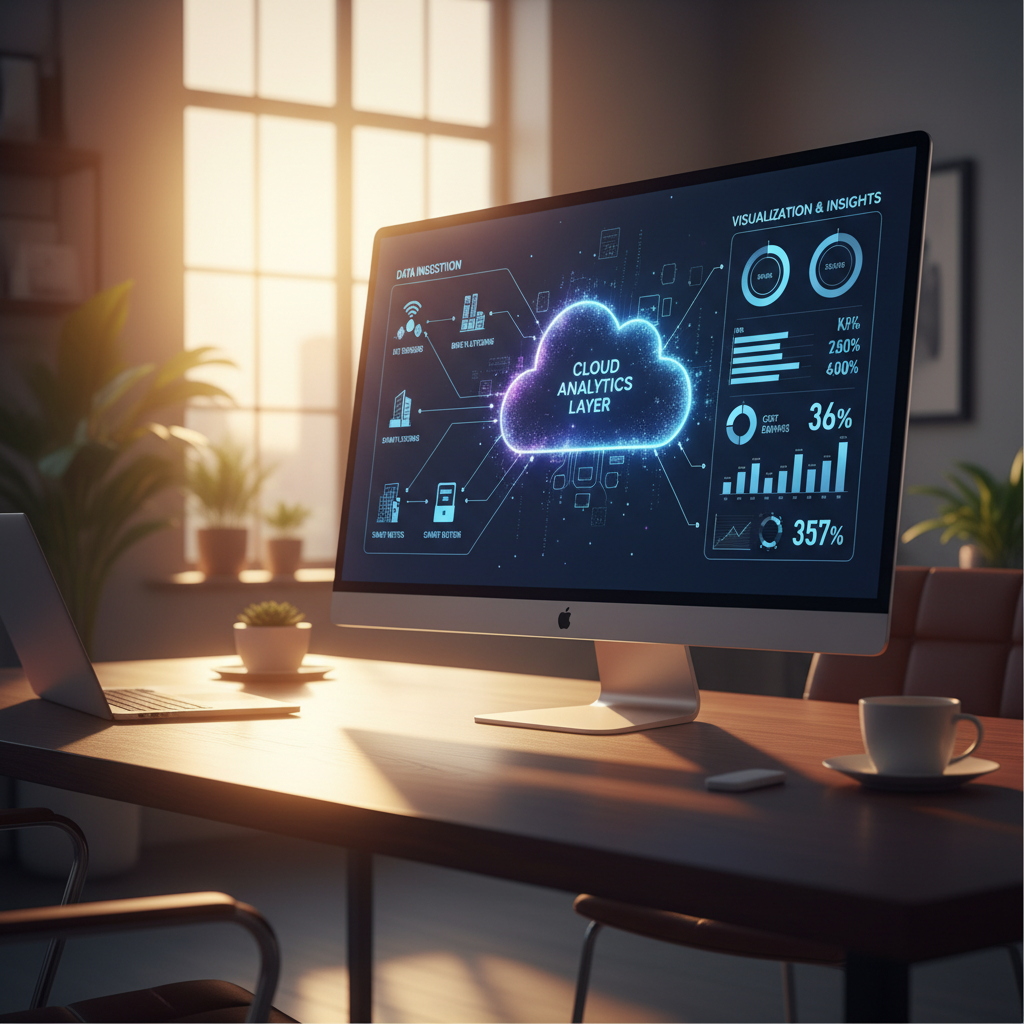
At its most practical, an application energy dashboard is a software interface — usually web-based or delivered as an embeddable app component — that does four things well: it collects raw energy data from distributed sources, normalizes that data into consistent formats and units, aggregates it across time intervals and organizational hierarchies, and then renders it through interactive visualizations that surface actionable insight. Think of it as the observability layer for energy, analogous to what tools like Datadog or Grafana do for infrastructure metrics, but purpose-built for kilowatt-hours, CO₂ equivalents, and energy use intensity (EUI).
For developers at a B2B SaaS company like JECO, the stakes are concrete. The applications you build run on infrastructure that consumes energy. The buildings your enterprise clients operate are instrumented with sensors that generate data. Every inefficiency in code or configuration has a real-world cost — both financial and environmental. Research suggests that inefficient software can inflate cloud infrastructure costs by 30% or more, a figure that an energy dashboard makes visible and therefore fixable. You can explore more about this dynamic in our breakdown of the impact of inefficient code on production costs.
Core Architecture: How an Application Energy Dashboard Actually Works
Understanding what is an application energy dashboard at a surface level is useful. Understanding its internal architecture is what separates developers who build mediocre dashboards from those who ship production-grade ones. Let us break the stack into its key layers.
Data Ingestion and Source Integration
The ingestion layer is where most of the engineering complexity lives. A well-designed application energy dashboard must be able to speak multiple protocols simultaneously. In building-centric deployments, that means BACnet/IP and Modbus for legacy BMS platforms, MQTT for modern IoT gateways, and REST or GraphQL APIs for cloud-native meter providers and utility companies.
Typical data sources include:
- BMS/BAS platforms such as Johnson Controls Metasys, Siemens Desigo, and Honeywell Forge, which expose meter points and equipment telemetry
- Smart electricity, gas, water, and steam meters connected via IoT gateways or utility API feeds
- Environmental sensors for temperature, occupancy, humidity, and air quality — used for context and normalization
- Weather APIs to support degree-day analysis and climate-normalized benchmarking
- Tariff and energy market price feeds for real-time cost modeling
- Emission factor datasets (grid intensity, Scope 1 and Scope 2 factors) for CO₂ equivalent calculations
Streaming patterns (MQTT brokers, Kafka topics, HTTPS webhooks) handle high-frequency telemetry, while scheduled ETL jobs pull from on-premises BMS databases on a minutes-to-hourly cadence. For sites with limited connectivity, edge collectors buffer and batch-forward data, mirroring the architecture used in platforms like Johnson Controls' OpenBlue Enterprise Manager.
Data Modeling and Time-Series Storage
Once data arrives, it needs a schema that balances query performance with analytical flexibility. The standard approach uses a time-series data model with tagged measurement points. Each point carries metadata: site ID, building ID, system type, equipment identifier, meter type, phase, and unit of measure. This tag set enables hierarchical roll-ups — from individual sub-meters all the way up to a portfolio-level summary — without re-writing queries.
Aggregation is a first-class design concern. Pre-computed roll-up tables for hourly, daily, monthly, and annual intervals are essential for dashboard query performance. Raw telemetry at one-minute resolution is valuable for anomaly detection, but no user should wait five seconds for a monthly chart to render. The OpenBlue Enterprise Manager approach of configuring point roles and roll-up flags at the data modeling stage — distinguishing binary/enum points from numeric ones and applying different aggregation rules accordingly — is a pattern worth adopting early.
Portfolio hierarchy typically follows a structure like: Portfolio → Region → Campus → Building → System → Equipment → Point. Getting this right at the schema design stage saves enormous refactoring effort later.
Not necessarily. Managed time-series databases (InfluxDB Cloud, TimescaleDB, Amazon Timestream, or ClickHouse) provide the storage primitives you need. The real engineering work is in the ingestion adapters, the point-tagging schema, and the aggregation pipeline — not in reinventing storage from scratch. Choose a managed service and invest your effort in the data modeling layer instead.
Key UI Features Every Application Energy Dashboard Must Have
The question of what is an application energy dashboard cannot be fully answered without examining what the user-facing layer delivers. The best platforms balance analytical depth with operational simplicity, serving both data-savvy engineers and non-technical facilities managers through the same interface.
Consumption and Production Widgets
The baseline widget set for any energy dashboard includes time-series charts of consumption by commodity (kWh, therms, gallons, lbs of steam), with selectable aggregation intervals — hourly for operational troubleshooting, daily and monthly for trend analysis, and annual for sustainability reporting. Side-by-side period comparisons (this month vs. last month, this year vs. last year) and baseline deviation indicators are table-stakes features that users expect on day one.
KPI Cards and Benchmarking
Energy Use Intensity (EUI) — typically expressed as kBtu per square foot per year in North America — is the normalized benchmark metric that allows buildings of different sizes to be compared fairly. A well-designed application energy dashboard surfaces EUI prominently, alongside peer benchmarks and historical trends. Portfolio-level views that rank buildings by performance help operations teams prioritize interventions.
GHG Emissions Tracking
Sustainability reporting requirements are driving strong demand for built-in carbon accounting. Enterprise clients increasingly need Scope 1 and Scope 2 emissions data in formats compatible with GRI, TCFD, and CDP frameworks. An application energy dashboard that can multiply metered consumption by location-based or market-based emission factors — and export the result to PDF or CSV — removes a manual step that currently costs enterprise sustainability teams hours each month.
Alerting and Anomaly Detection
Static threshold alerts (send an email when consumption exceeds X kWh) are the minimum. Leading platforms are moving toward statistical anomaly detection — flagging deviations from predicted consumption based on historical patterns and weather normalization. For developers, this means integrating a lightweight forecasting model (even a simple regression against degree-days is a significant improvement over static thresholds) into the alerting pipeline.
Reports and Data Export
Scheduled PDF reports, on-demand CSV exports, and RESTful API endpoints for programmatic data access are non-negotiable for enterprise buyers. Many B2B SaaS clients will want to pull energy data into their own BI tools (Power BI, Tableau, Looker), so a well-documented public API is as important as the dashboard UI itself.
How Application Energy Dashboards Differ from Generic Analytics Platforms
Developers familiar with observability tools like Grafana, Datadog, or Amplitude sometimes ask why they cannot simply repurpose those platforms when thinking about what is an application energy dashboard. The short answer is that general-purpose analytics platforms are optimized for software metrics — requests per second, error rates, p99 latencies — not for energy domain concepts.
The differences that matter in practice include:
- Domain-specific data types: Energy data includes interval meter reads with demand and consumption components, time-of-use tariff blocks, power factor, and reactive power — concepts that require custom handling beyond generic float time series.
- Regulatory and reporting context: Energy dashboards must produce outputs aligned with utility billing periods, local building energy benchmarking ordinances (like New York City's Local Law 97), and international sustainability frameworks.
- Equipment and site hierarchy: Energy analytics is inherently hierarchical and spatial. A generic analytics platform has no native concept of a building, a floor, or a sub-panel — but an application energy dashboard is organized around these physical structures.
- Normalization for external variables: Weather normalization, occupancy adjustment, and production-intensity normalization (energy per unit of output for industrial sites) are standard requirements with no analogue in software observability.
Both deployment patterns are valid and increasingly common. Embedded dashboards (rendered inside an iframe or composed with a component library from an SDK) allow you to deliver energy insights within the workflow your users already live in — a BMS control UI, a facilities management platform, or a tenant engagement app. Standalone dashboards make sense for dedicated energy management workflows. The key architectural requirement is that the data layer (ingestion, storage, aggregation API) is the same in both cases; only the rendering context changes.
The Developer Opportunity: Building on Top of Application Energy Dashboards
For developers at B2B SaaS companies, grasping what is an application energy dashboard is not just an academic exercise — it is a product strategy conversation. As enterprise sustainability commitments translate into procurement requirements, the ability to expose energy and carbon data through your platform becomes a competitive differentiator.
JECO's approach sits at the intersection of developer tooling and energy analytics. Rather than asking development teams to build the full data pipeline from scratch, a toolkit-first model provides the SDKs, ingestion adapters, and aggregation APIs that let teams focus engineering effort on the UI and business logic layers — the parts that differentiate their product in the market.
This aligns with a broader trend in sustainable software development. Studies have shown that teams with visibility into the energy and performance footprint of their code make meaningfully different architecture decisions than teams flying blind. If you want to go deeper on how that visibility translates into reduced infrastructure spend, our guide on how to optimize cloud application performance covers the connection between profiling, efficiency, and cost in practical detail.
The competitive landscape for application energy dashboards is fragmented across three segments: legacy building management vendors (Johnson Controls, Schneider Electric, Siemens, Honeywell) who own the hardware and BMS integration layer but move slowly on developer experience; cloud carbon tools (Cloud Carbon Footprint, Microsoft Emissions Impact Dashboard) that cover the infrastructure layer but not the application or building layer; and a growing set of developer-first green software tools that are establishing new norms for how energy metrics get embedded into the SDLC. JECO is positioned in that third segment.
Sustainable software development practices, including instrumenting applications for energy awareness, are becoming baseline expectations in enterprise development teams. Our resource on best practices for sustainable software development provides a practical starting point for teams beginning that journey.
How to Evaluate an Application Energy Dashboard: A Developer Checklist
Whether you are building an application energy dashboard, integrating one into an existing product, or evaluating a vendor solution, the following criteria help separate robust platforms from superficial ones.
- Protocol coverage: Does the ingestion layer natively support the protocols your data sources use — BACnet, Modbus, MQTT, REST? Or does it require custom middleware for every integration?
- Data modeling flexibility: Can you define custom equipment hierarchies and point metadata schemas, or are you locked into a vendor-specific taxonomy?
- Aggregation performance: How does query latency scale as the number of metered points and historical data volume grows? Are pre-computed roll-ups available?
- API completeness: Is there a fully documented REST or GraphQL API that exposes all data available in the UI? Can third-party BI tools consume it without custom ETL work?
- Multi-tenancy and RBAC: For B2B SaaS deployments, can you isolate data by client tenant? Does the permission model support role-based access at the building, system, and point level?
- Emissions accounting: Are emission factors (grid intensity by region, fuel combustion factors) built in, and are they kept current? Can you apply market-based factors for renewable energy procurement?
- Reporting outputs: Does the platform generate utility-grade reports, sustainability disclosure outputs, and building benchmarking submissions — or only generic charts?
- White-label and embedding support: If you need to deliver the dashboard under your own brand inside a partner platform, does the architecture support that without a complete rebuild?
Market Trends Shaping the Future of Application Energy Dashboards
The category of what is an application energy dashboard is not static. Several converging forces are reshaping what these platforms need to do over the next three to five years.
AI-Driven Anomaly Detection and Recommendations
Static threshold alerting is giving way to machine learning models that learn baseline consumption patterns from historical data and flag statistically significant deviations. The next generation of application energy dashboards will not just show what happened — they will generate prioritized recommendations for what to do next, ranked by estimated impact and implementation effort.
Real-Time Grid Integration and Demand Flexibility
As electricity grids incorporate more variable renewable generation, the time-of-use value of energy consumption shifts dramatically hour to hour. Application energy dashboards that integrate real-time grid carbon intensity signals (like those published by WattTime and Electricity Maps) can surface optimization opportunities — shifting flexible loads to low-carbon, low-cost grid windows — that were simply invisible with daily or monthly data.
Regulatory Pressure Accelerating Adoption
Building energy performance standards, carbon disclosure requirements (SEC climate disclosure rules, EU CSRD), and urban benchmarking ordinances are creating hard deadlines for organizations to instrument their energy use. This regulatory tailwind is converting energy dashboards from nice-to-have tools into compliance infrastructure — a powerful driver of B2B SaaS adoption.
Software Carbon as a First-Class Metric
The Green Software Foundation's Software Carbon Intensity (SCI) specification is establishing a standardized way to measure the carbon cost of running software workloads. As this spec matures and gains enterprise adoption, application energy dashboards will increasingly need to bridge the building/infrastructure energy layer and the software workload layer — tracking not just how much energy a building consumes, but how much of that is attributable to specific applications and services running within it.
What is an application energy dashboard in simple terms?
An application energy dashboard is software that collects energy data from meters, sensors, and building management systems, then presents that data as interactive charts, KPIs, and reports. It helps teams monitor energy consumption, track costs, measure carbon emissions, and identify optimization opportunities — all in one interface.
How does an application energy dashboard differ from a utility bill analysis tool?
A utility bill analysis tool works retrospectively with monthly billing data. An application energy dashboard works with continuous, granular time-series data — often at one-minute or fifteen-minute intervals — from meters and sensors. This granularity enables real-time anomaly detection, demand charge management, and operational optimization that monthly bill analysis cannot support.
What data sources does an application energy dashboard typically connect to?
Typical data sources include BMS/BAS platforms (e.g., Johnson Controls Metasys, Siemens Desigo), smart electricity and gas meters via IoT gateways, utility API feeds, environmental sensors, weather APIs for normalization, tariff databases for cost modeling, and emission factor datasets for carbon accounting.
Can an application energy dashboard be embedded into an existing SaaS product?
Yes. Many modern application energy dashboards are designed with embedding as a first-class deployment pattern. They expose component libraries or iframe-based widgets that can be composed into existing UIs, backed by the same data API layer. This allows B2B SaaS companies to add energy analytics to their existing product without rebuilding their entire frontend.
What skills do developers need to build an application energy dashboard?
Core skills include time-series data modeling, experience with streaming ingestion patterns (MQTT, Kafka, webhooks), REST API design, and frontend charting libraries (D3.js, ECharts, Recharts, or similar). Domain knowledge of energy units, billing structures, and emissions accounting frameworks accelerates delivery significantly and reduces costly rework during client integrations.
Conclusion: Building With Energy Visibility as a Competitive Advantage
Understanding what is an application energy dashboard is the entry point to a much larger opportunity. For developers and B2B SaaS teams, energy dashboards represent the convergence of two powerful trends: the operational need to manage energy costs at scale, and the strategic imperative to demonstrate sustainability credentials to enterprise buyers who now require them.
The technical architecture is well-established — time-series ingestion, hierarchical data modeling, pre-computed aggregations, a rich UI layer, and a complete public API. The domain knowledge required — energy units, normalization methods, emissions frameworks, tariff structures — is learnable and well-documented. The market gap that remains is a developer-first platform that makes building production-grade application energy dashboards as approachable as standing up a modern web application.
That is the problem JECO is built to solve. Whether you are instrumenting your own software workloads for energy awareness, building an embedded energy analytics module for enterprise clients, or evaluating the full stack of what a purpose-built application energy dashboard requires, JECO provides the toolkit, the APIs, and the domain expertise to accelerate that work.
Ready to see what an application energy dashboard built on JECO looks like in practice? Explore the platform and start your integration today at jeco.co.