How to Read Stock Charts for Beginners: 2025 Guide
June 13, 2026 · 13 min read
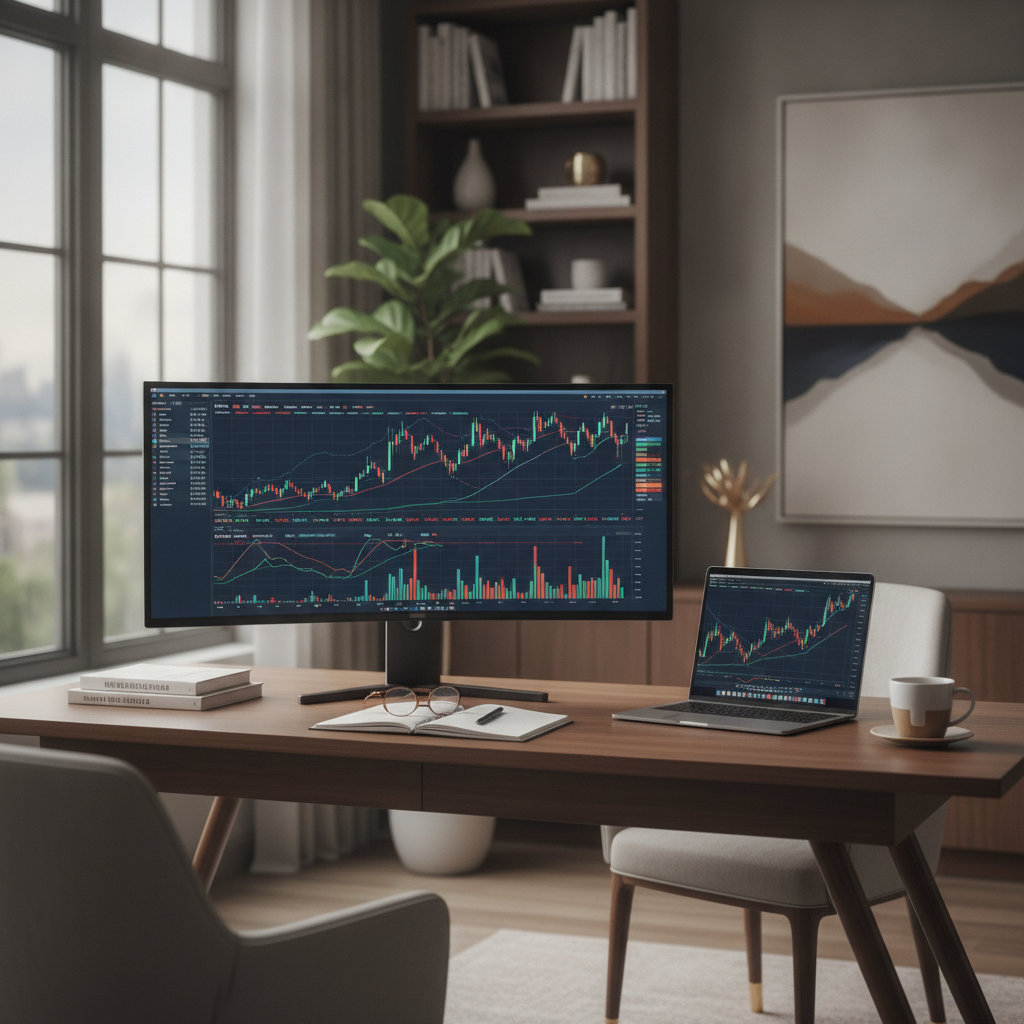
Learning how to read stock charts for beginners is the single most important visual skill an investor can develop. Charts compress years of buying, selling, fear, and greed into a few lines, candles, and bars — and once you can decode them, you can spot trends, time entries, and avoid emotional mistakes that derail most new traders. This guide walks you through every element of a stock chart, from the price and time axes to candlesticks, volume, trendlines, support and resistance, and the basic patterns that professional traders rely on every day.
TL;DR — The Bottom Line
To read a stock chart, focus on four things: price (vertical axis), time (horizontal axis), volume (bars below the chart), and trend (the direction of higher highs/lows or lower highs/lows). Start with a 1-year daily candlestick chart, identify support and resistance levels, draw trendlines, and confirm moves with volume. Platforms like Finviz combine charts, screeners, and heatmaps so beginners can practice these skills on real market data in seconds.
Quick Facts
- Three chart types: Line, Bar (OHLC), and Candlestick
- Beginner timeframe: 1-year daily chart
- Core data points: Open, High, Low, Close, Volume
- Trend rule: Uptrend = higher highs + higher lows
- Volume signal: Big moves on big volume = stronger conviction
- Free tools: Finviz offers screeners, charts, and heatmaps at no cost
Why Learning How to Read Stock Charts for Beginners Matters
Most new investors buy stocks based on headlines, tips, or a company's reputation — and most of them underperform the market. Charts solve this problem by giving you an objective, data-driven snapshot of supply and demand. When you understand how to read stock charts for beginners, you stop asking "Is this a good company?" and start asking the more useful question: "Is this a good price?"
According to research summarized by Charles Schwab and Investopedia, traders who combine fundamental analysis with basic technical chart reading tend to make more disciplined entry and exit decisions than those relying on intuition alone. Charts won't predict the future, but they reveal the psychology of every market participant who has bought or sold the stock — and that's a powerful edge.
For self-directed investors using platforms like Finviz's stock screener, chart literacy is the bridge between filtering a universe of 8,000+ tickers and actually pulling the trigger on a trade.
The Anatomy of a Stock Chart: Price, Time, and Volume
Every stock chart, no matter how sophisticated, is built on three pillars. Mastering these is step one in learning how to read stock charts for beginners.
The Axes: Price (Y) and Time (X)
- Horizontal axis (x-axis): shows time — minutes, hours, days, weeks, or months.
- Vertical axis (y-axis): shows price — usually in dollars per share.
Beginners should start with a 1-year daily chart. Each data point represents one trading day, and a year gives you enough context to see the recent trend, the 52-week high, and the 52-week low. Once comfortable, zoom out to a 5-year weekly chart to gauge long-term strength.
Volume: The Fuel Behind Price
Below the price chart, you'll see vertical bars representing volume — the number of shares traded during each period. Volume is the conviction behind a price move:
- High volume + big price move = strong, meaningful action
- Low volume + big price move = suspect, may reverse
- Volume spike at support/resistance = potential breakout or reversal
Start with a 1-year daily chart. It gives enough history to see the trend, the 52-week range, and recent volatility without the noise of intraday charts. Day traders use 1- and 5-minute charts; swing traders use daily; long-term investors use weekly or monthly.
Chart Types: Line, Bar, and Candlestick Explained
When you open a chart on Finviz's quote page, you can toggle between three main chart styles. Each tells the same story with different levels of detail.
Line Charts
The simplest format — a single line connecting closing prices. Great for spotting the overall trend without distraction. Beginners often start here because it eliminates the visual clutter of individual price bars.
Bar Charts (OHLC)
Each vertical bar represents one period and displays four data points: Open, High, Low, Close. A small tick on the left marks the open; a tick on the right marks the close. Bar charts give more information than line charts but are less visually intuitive than candlesticks.
Candlestick Charts
The professional standard. Each candle has a rectangular body (range between open and close) and thin wicks (highs and lows). Color signals direction:
- Green/white candle: close higher than open (bullish)
- Red/black candle: close lower than open (bearish)
Candlesticks let you see the daily "battle" between buyers and sellers. A long upper wick, for example, means buyers pushed the price up but sellers slammed it back down — a potential reversal signal. Once you grasp how to read stock charts for beginners using candlesticks, you'll never go back to line charts for serious analysis.
How to Read Stock Charts for Beginners: Identifying Trends
Once you can read individual candles, the next skill is identifying the broader trend — the general direction of price over time. This is the heart of how to read stock charts for beginners.
The Three Trend Types
- Uptrend (bullish): A series of higher highs and higher lows. Price is making progressively higher peaks and shallower pullbacks.
- Downtrend (bearish): A series of lower highs and lower lows. Each bounce fails at a lower level.
- Sideways (range-bound): Price oscillates between a ceiling and a floor with no clear slope.
According to Charles Schwab's technical analysis education, a true new trend isn't confirmed until you see at least one fresh higher high and higher low (for an uptrend) — or the inverse for a downtrend. This rule prevents you from chasing every bounce as if it were a major reversal.
Drawing Trendlines
Trendlines visualize the slope of a trend:
- Uptrend line: connect at least two major swing lows with a rising diagonal line and extend it forward.
- Downtrend line: connect at least two major swing highs with a declining line.
A well-respected trendline often acts as dynamic support (in uptrends) or dynamic resistance (in downtrends). When price breaks a trendline on heavy volume, it's an early warning that the trend may be changing.
Support, Resistance, and the 52-Week Range
If trends are the river, support and resistance are the dams. These are horizontal price levels where the market has historically reversed direction, and they're essential to how to read stock charts for beginners with any precision.
Support: The Floor
A price level where buying interest has historically been strong enough to halt declines. Think of it as a temporary floor. When price approaches support, traders watch to see if it holds (bullish) or breaks (bearish).
Resistance: The Ceiling
The mirror image: a level where selling pressure has repeatedly capped rallies. A break above resistance on strong volume often triggers fresh buying.
Pivot Highs and Pivot Lows
Interactive Brokers and most technical analysts identify support and resistance using pivot points:
- Pivot high: a bar with a lower high both before and after — potential resistance.
- Pivot low: a bar with a higher low both before and after — potential support.
The 52-Week Range
The 52-week high and low printed on every quote page are the most-watched support/resistance levels in the market. Stocks breaking out to new 52-week highs often attract momentum buyers, while stocks crashing to 52-week lows can signal trouble. Finviz's market heatmap includes a dedicated 52-week high/low view so you can spot these breakouts across the entire market at once.
The more times price has tested a level without breaking it, the stronger that level is. Three or more touches with rejections is considered significant. Volume confirmation matters too — heavy volume on bounces from support strengthens the level.
Basic Chart Patterns Every Beginner Should Know
Patterns are recurring price formations that often precede predictable moves. You don't need to memorize 50 of them — these five cover the vast majority of beginner-friendly setups.
1. Head and Shoulders (Reversal)
Three peaks where the middle one is highest. A break below the "neckline" connecting the two valleys signals a bearish reversal. The inverse pattern signals bullish reversals.
2. Double Top / Double Bottom (Reversal)
Price tests a level twice and fails. A double top after an uptrend often signals exhaustion; a double bottom after a downtrend often signals accumulation.
3. Cup and Handle (Continuation)
A rounded "U" shape followed by a small pullback (the handle), then a breakout. Popularized by William O'Neil, it's one of the most reliable bullish continuation patterns.
4. Triangles (Continuation or Reversal)
Ascending, descending, and symmetrical triangles form as price consolidates into a tighter range. The breakout direction — confirmed by volume — usually dictates the next major move.
5. Flags and Pennants (Continuation)
Short consolidations after a sharp move. Flags look like small rectangles sloping against the trend; pennants look like small symmetrical triangles. Both typically resolve in the direction of the prior trend.
Finviz's chart engine actually tags many of these patterns automatically — you can filter for them directly inside the screener under the Technical tab, which is a huge shortcut for beginners still training their eye.
Using Indicators Without Overloading Your Chart
Indicators are mathematical overlays that help confirm what price action is already showing. Beginners often make the mistake of stacking ten indicators and getting paralyzed by conflicting signals. Start with these three:
Moving Averages (MA)
The 50-day and 200-day simple moving averages are the most-watched lines in finance. When price is above both and the 50-day is above the 200-day, the stock is in a long-term uptrend. The opposite alignment — known as a "death cross" — signals weakness.
Relative Strength Index (RSI)
An oscillator scaled 0–100 that measures momentum. Readings above 70 are considered overbought; below 30, oversold. RSI is most useful when it diverges from price (e.g., price makes a new high but RSI doesn't).
MACD (Moving Average Convergence Divergence)
Two lines plus a histogram that show momentum shifts. A bullish crossover (MACD line crossing above signal line) often precedes upward moves; the opposite crossover signals weakness.
Quotable insight: "Indicators don't predict — they confirm. Price is the only true leading indicator; everything else is a second opinion."
How to Read Stock Charts for Beginners Using Finviz
Theory only sticks once you apply it. Here's a practical step-by-step workflow for using Finviz to practice how to read stock charts for beginners on real market data every day.
- Open the heatmap. Visit finviz.com/map.ashx and scan the day's biggest movers by sector. Green squares = gainers, red = losers.
- Click a ticker. You'll land on the quote page showing a candlestick chart, key stats (P/E, EPS, beta), news, and insider data on one screen.
- Identify the trend. Look at the daily chart. Higher highs + higher lows? Uptrend. The opposite? Downtrend.
- Mark support and resistance. Note the 52-week high and low, plus any obvious horizontal levels where price has reversed before.
- Check volume. Is today's move on above-average volume? If yes, the move has conviction.
- Scan for patterns. Use the screener's Technical filters to find stocks already exhibiting cup-and-handle, channel up, or breakout setups.
- Compare to peers. Use Finviz's industry heatmap to see if the whole sector is moving or if your stock is acting alone.
Doing this for 15 minutes a day on five tickers will accelerate your pattern recognition faster than any textbook.
Common Mistakes Beginners Make When Reading Charts
- Ignoring volume. A breakout without volume is usually a fakeout.
- Drawing too many trendlines. If you have to squint to see it, it's not a real level.
- Cherry-picking timeframes. A stock can be in a daily uptrend and a weekly downtrend. Always check multiple timeframes.
- Confusing correlation with causation. A pattern that worked last week won't work every time. Use stops.
- Overloading with indicators. Three is plenty. Ten is paralysis.
- Trading against the trend. Most profitable setups align with the larger trend, not against it.
Quotable insight: "The chart doesn't tell you what will happen — it tells you what's most likely to happen next, based on what every buyer and seller has already done."
Frequently Asked Questions
How long does it take to learn how to read stock charts for beginners?
Most beginners can grasp the basics — axes, candlesticks, trends, and support/resistance — in about 10–15 hours of focused study. Pattern recognition and indicator interpretation take 3–6 months of daily chart review to internalize. The fastest learners spend 15 minutes a day analyzing real charts on platforms like Finviz.
What's the best chart type for beginners?
Start with line charts to understand overall trend, then graduate to candlestick charts within a few weeks. Candlesticks show open, high, low, and close prices visually and are the standard used by professional traders. Avoid bar charts at first — they convey the same info as candlesticks but are harder to read at a glance.
Do stock charts actually work, or is it just guessing?
Charts don't predict the future, but they reveal the supply/demand psychology of every market participant who has traded the stock. Backtested studies show that trend-following and breakout strategies based on chart patterns deliver a measurable edge over random entries — especially when combined with volume confirmation and risk management.
Should I use free chart tools or pay for a subscription?
Beginners can do 90% of what they need with free tools. Finviz offers free screeners, charts, heatmaps, and basic technical filters that rival paid platforms. Upgrade to Finviz Elite or TradingView only when you need real-time data, advanced indicators, or backtesting — usually after 6–12 months of practice.
What's the single most important thing on a stock chart?
Price action — the actual movement of price over time — is the only leading indicator. Everything else (RSI, MACD, moving averages) is derived from price. If you can identify the trend, support, resistance, and volume on a chart, you already have 80% of what professional traders use daily.
Conclusion: Your Next Steps
Learning how to read stock charts for beginners is not about memorizing patterns or stacking indicators — it's about training your eye to see the story price is telling. Start with the basics: price and time axes, candlesticks, volume, and trend direction. Then layer in support, resistance, and a handful of reliable patterns. Within a few weeks of daily practice, you'll go from "I have no idea what I'm looking at" to "I see exactly where the buyers and sellers are fighting."
The fastest way to get there is repetition on live data. Head to Finviz, open the heatmap, pick five tickers, and run through the 7-step workflow above. Do it every trading day for a month, and you'll have read more charts than 99% of retail investors ever will. That's the foundation every successful trader and long-term investor builds on — and it starts with a single chart.