Stock Screener with Backtesting: Finviz Elite Guide
June 12, 2026 · 13 min read

TL;DR — The Bottom Line
A stock screener with backtesting lets you define rule-based filters (fundamental, technical, descriptive) and then simulate how those rules would have performed historically. Finviz Elite combines one of the web's fastest multi-factor screeners with a rule-based backtesting module, real-time data, and email alerts for about $39.99/month. It's ideal for prosumer traders who want speed and breadth, though deep quant users may pair it with a specialist platform.
For active investors and traders, the workflow has become unavoidable: find a list of candidate stocks, then prove the idea has historical merit. A stock screener with backtesting collapses those two steps into a single research loop. Instead of guessing whether "low P/E plus RSI under 30" is a real edge or just a hunch, you can test it against years of market data in minutes. This guide explains how a stock screener with backtesting works, what to look for, and how Finviz delivers this through its Elite tier.
Quick Facts
- Finviz Elite price: ~$39.99/month or $299.50/year
- Filter categories: Descriptive, Fundamental, Technical (70+ filters)
- Data latency (Free): 15-minute delayed
- Data latency (Elite): Real-time, including premarket/after-hours
- Backtesting access: Elite-only, rule-based module
- Primary use case: Prosumer screening, idea generation, and historical validation
What Is a Stock Screener with Backtesting?
A stock screener with backtesting is two tools fused into one workflow. The screener narrows the universe of thousands of listed equities down to a manageable shortlist using rule-based filters. The backtester then applies those same (or modified) rules to historical data to answer the next obvious question: would this strategy have worked?
Traditional screeners, by themselves, suffer from a credibility gap. You can find every stock trading above its 200-day moving average with a PEG ratio under 1, but you have no idea whether buying that basket has historically outperformed the S&P 500 or simply chased noise. A stock screener with backtesting closes that gap by simulating entries and exits over multi-year windows and reporting performance statistics.
Modern tools in this category typically provide:
- Rule-based filters across descriptive, fundamental, and technical data
- Historical simulation of those rules over multi-year windows
- Performance metrics like CAGR, max drawdown, win rate, and volatility
- Workflow integration with alerts, watchlists, and exports
Why Investors Need Backtesting Built Into Their Screener
The most expensive mistake in retail investing isn't a bad trade — it's deploying capital behind an untested idea. Behavioral research consistently shows that traders who don't validate their strategies before risking money tend to abandon them at the first drawdown, often locking in losses just before the strategy would have recovered.
Pairing screening with backtesting solves four practical problems:
- It removes hindsight bias. Eyeballing a chart and seeing that growth stocks "always come back" is not evidence. A backtest forces precise rule definition.
- It quantifies drawdowns. Knowing a strategy historically lost 28% in 2022 prepares you psychologically and helps with position sizing.
- It accelerates iteration. When a filter combination fails the test, you tweak and re-run — minutes, not months.
- It builds conviction. Strategies you've personally validated are easier to hold through volatility.
This is precisely why a stock screener with backtesting has become a baseline expectation for serious retail and prosumer investors, not just hedge funds.
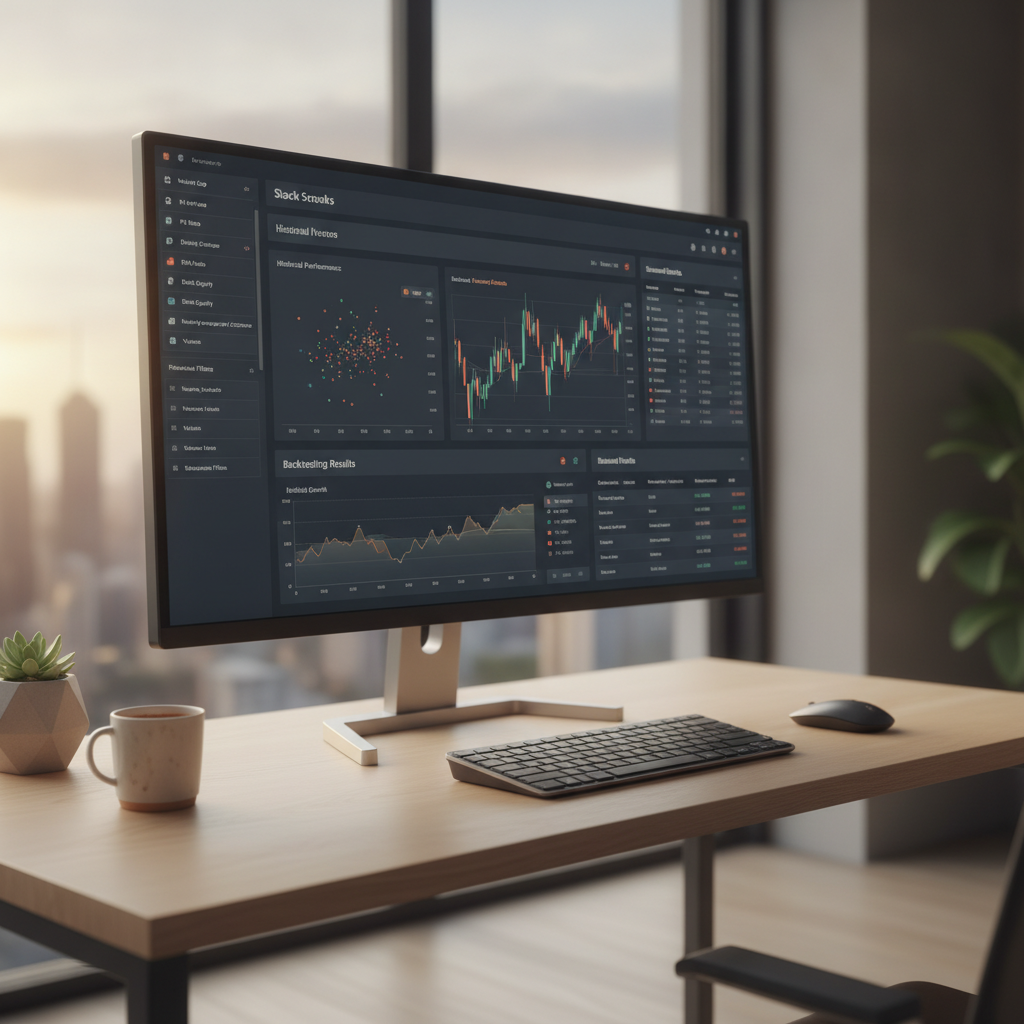
Yes. Platforms like Finviz Elite offer rule-based backtesting where you define criteria with dropdowns and sliders — no Python, no scripting. This is one of the biggest advantages of using an integrated stock screener with backtesting over dedicated quant platforms.
Inside Finviz: The Core Screener Engine
Finviz's reputation was built on one thing: speed. The Finviz screener scans the entire U.S. equity universe and returns matching tickers almost instantly as you toggle filters. There are three filter families to know.
Descriptive Filters
These define the universe: exchange (NYSE, NASDAQ, AMEX), sector, industry, country of operations, market capitalization, share price, average volume, IPO date, options/shortable availability, and analyst recommendation. Descriptive filters are how you eliminate microcaps, penny stocks, or foreign ADRs before any deeper analysis.
Fundamental Filters
Finviz exposes the metrics fundamental investors actually use: P/E, forward P/E, PEG, P/B, P/S, P/FCF, EPS growth (this year, next year, past 5 years, next 5 years), sales growth, ROA, ROE, ROI, gross/operating/profit margin, debt-to-equity, current ratio, quick ratio, dividend yield, payout ratio, insider ownership, insider transactions, institutional ownership, short float, and more.
Technical Filters
For traders, this is the engine room: price relative to 20/50/200-day moving averages, MA crossovers, RSI(14), gap up/down, candlestick patterns, chart patterns (channels, wedges, triangles), 52-week high/low position, performance (week, month, quarter, half, year, YTD), volatility, average true range, and relative volume.
Combining filters across these three families is what creates a true multi-factor stock screener with backtesting workflow. A representative screen might be: small-cap, profitable, ROE > 15%, debt-to-equity < 0.5, price above 50-day MA, RSI between 40 and 60 — the kind of "quality momentum" setup that institutional quants run daily.
Finviz Elite: How the Backtesting Module Works
The stock screener with backtesting functionality that most investors want is locked behind the Elite tier. At roughly $39.99/month (or $299.50/year), Elite unlocks real-time data, intraday charts, advanced alerts, correlation analysis, and the backtesting module.
Finviz's backtester is deliberately accessible. Instead of asking users to write event-driven code, it lets you:
- Define rules that mirror screener filters (fundamental and technical)
- Apply them across historical windows
- View aggregated historical performance for the matched basket
- Compare results against benchmarks for context
The philosophy is consistent with Finviz overall: fast, browser-based, no setup. You don't need to install software or learn a domain-specific language. For a retail investor evaluating ten strategy ideas a week, that frictionless loop is the entire value proposition.
That said, Finviz's backtesting is intentionally simpler than dedicated platforms like Portfolio123, QuantConnect, or Amibroker. If your needs include custom Python factors, options strategies, intraday tick-level simulation, or walk-forward optimization with parameter sweeps, you'll outgrow it. For everyone else — which is most investors — it's exactly enough.
How to Build Your First Backtested Screen: A Step-by-Step Workflow
The most common mistake new users make is treating a stock screener with backtesting like a slot machine — tweaking filters until something looks profitable, then trading it live. That's overfitting, and it destroys real capital. Here's a disciplined workflow.
- Start with a hypothesis, not a filter. Write down in plain English what edge you believe exists. Example: "Profitable small-caps breaking out from consolidation outperform over the next quarter."
- Translate the hypothesis into rules. Profitable = positive EPS. Small-cap = market cap $300M–$2B. Breakout = price above 50-day MA with relative volume > 1.5.
- Define entry, exit, and holding period. Are you holding 1 month? 3 months? Rebalancing weekly? A backtest is meaningless without these.
- Run the screen on current data first. Make sure the rules return a sensible number of names (typically 20–100). If you get 3 or 800, your filters are off.
- Backtest across multiple market regimes. A strategy that only worked in 2020–2021 isn't a strategy. Test through 2008, 2015, 2018, 2020, and 2022.
- Examine drawdowns, not just returns. A 22% CAGR with a 60% max drawdown is unusable for most investors.
- Reserve out-of-sample data. If you built rules using 2015–2020 data, validate them on 2021–2024 separately.
- Paper trade before going live. Even a clean backtest can fail in real conditions due to slippage, liquidity, and behavioral lapses.
Typically three to six. Too few and your basket is too noisy; too many and you're overfitting historical data. A good rule of thumb: each filter should map to a distinct edge — value, quality, momentum, or risk — rather than five variations of the same idea.
Finviz vs. Competing Stock Screeners with Backtesting
The market for a stock screener with backtesting is crowded, and choice depends heavily on your style. Here's how Finviz stacks up against the main alternatives.
| Platform | Best For | Backtesting Depth | Approx. Price |
|---|---|---|---|
| Finviz Elite | Prosumer screening, speed, breadth of filters | Rule-based, accessible | $39.99/mo |
| TradingView | Technical charting, multi-asset | Pine Script strategies | $14.95–$59.95/mo |
| Stock Rover | Long-term fundamental research | Portfolio-level historical analysis | $7.99–$27.99/mo |
| Portfolio123 | Serious quants, factor investors | Institutional-grade, walk-forward | $75+/mo |
| TrendSpider | Pattern recognition, automation | Advanced multi-timeframe | $33–$108/mo |
Where Finviz Elite wins is the combination of speed, breadth of filters, visual market overviews (the famous heat map), and a low learning curve. Where it loses is in highly customizable simulation logic — if you need to model multi-leg options strategies or run Monte Carlo on portfolio paths, you'll want a specialist.
For the vast majority of investors and traders, however, the question "do my screening rules have historical merit?" is exactly what Finviz Elite is built to answer.
Common Pitfalls When Using a Stock Screener with Backtesting
Even with the best tool, users routinely make mistakes that invalidate their results. Watch for these.
Overfitting
The classic trap: adding filters until the backtest looks beautiful. If your strategy only worked because you required "P/E between 12.4 and 14.7," you've curve-fit to noise. Keep rules round, intuitive, and economically justifiable.
Survivorship Bias
Some historical datasets exclude delisted stocks, which inflates returns because failures disappear. Always check whether your backtesting tool accounts for delisted tickers.
Look-Ahead Bias
If your screen uses data that wasn't actually available at the simulated trade date (such as restated earnings), your results are fiction. Reputable platforms guard against this, but you should still verify.
Ignoring Costs
Commissions are mostly zero now, but slippage and bid-ask spreads still matter, especially for small-caps and microcaps. A strategy with a 4% edge can disappear after realistic transaction costs.
Confusing Backtest with Forecast
A backtest tells you what would have happened. It does not tell you what will happen. Markets change regimes, factor premiums decay, and crowded strategies stop working. Treat backtests as evidence, not prophecy.
"A backtest is a hypothesis test, not a crystal ball. The goal isn't to find the best-looking equity curve — it's to eliminate strategies that clearly don't work."
Getting the Most From Finviz Elite's Workflow
Beyond the backtester itself, Finviz Elite includes several features that compound the value of a stock screener with backtesting:
- Email alerts tied to screener criteria — when a new ticker enters your validated screen, you know immediately.
- Real-time data for accurate intraday entries, including premarket and after-hours.
- Advanced charts with intraday timeframes and interactive overlays.
- Correlation analysis to ensure your basket isn't accidentally concentrated in one factor.
- Custom screener presets and saved layouts to streamline daily review.
- Ad-free interface and exports for offline analysis in spreadsheets.
A practical setup: build three to five backtested screens covering different market regimes (value, quality momentum, oversold mean-reversion, breakout, dividend growth). Set email alerts on each. Review matches weekly. Let the system surface ideas; spend your time on the trade-versus-pass decision, not on hunting tickers.
Frequently Asked Questions
Is Finviz's backtesting feature available on the free plan?
No. Backtesting is an Elite-only feature. The free tier of Finviz includes the screener with most filters and delayed (15-minute) data, but the backtesting module, real-time quotes, advanced charts, and email alerts require a paid Elite subscription at approximately $39.99/month or $299.50/year.
What is the best stock screener with backtesting for beginners?
For most retail investors, Finviz Elite offers the gentlest learning curve because both the screener and backtester are rule-based — no coding, no scripting, just dropdowns and sliders. Stock Rover is a strong alternative for long-term fundamental investors, while TradingView appeals to chart-driven traders.
How accurate are rule-based backtests on platforms like Finviz?
Rule-based backtests on platforms like Finviz are reliable for evaluating directional edges in equity strategies, but they simplify real-world execution. They typically assume clean fills at closing or open prices and may not fully model slippage, partial fills, or liquidity constraints. Treat them as evidence of a strategy's historical character, not as a precise P&L forecast.
Can I backtest options strategies with Finviz?
No. Finviz focuses on equities. For options backtesting with full Greeks, volatility surfaces, and multi-leg structures, you'll want a specialist tool like OptionStrat, OptionsAlpha, or OptionVisualizer. Finviz can still help identify the underlying stocks you want to trade options on.
How often should I re-run my backtested screens?
Markets evolve, so re-validate your strategies at least once a year, and any time the macro regime clearly shifts (recession, rate-cycle changes, sector rotations). Daily or weekly re-screening for new candidates is normal, but full backtests should be periodic, not constant — frequent re-optimization is a path to overfitting.
Conclusion: Turn Ideas Into Tested Strategies
A stock screener with backtesting is no longer a luxury reserved for hedge funds — it is the standard research workflow for any serious self-directed investor. The ability to filter the market by precise rules and then prove those rules out across decades of history transforms investing from guesswork into disciplined hypothesis testing.
Finviz Elite delivers that workflow in one of the fastest, most accessible packages on the market. With 70+ filters across descriptive, fundamental, and technical dimensions, real-time data, email alerts, and a rule-based backtesting module, it covers the full loop of idea generation, validation, and execution monitoring — without requiring you to write a single line of code.
Ready to stop guessing and start testing? Explore the Finviz screener, upgrade to Elite to unlock backtesting and real-time data, and start turning your market hunches into validated strategies today.