Stock Screener With AI Features: 2026 Investor Guide
July 8, 2026 · 13 min read
TL;DR — The Bottom Line
In 2026, a stock screener with AI features blends traditional rule-based filters (P/E, RSI, market cap) with machine-learning signals, natural-language queries, and sentiment analysis. Finviz remains the most-visited screener on the web with 10M+ monthly visitors, offering deep filter-driven screening, heatmaps, and AI-industry classifications — while power users increasingly pair it with third-party AI workflows for sentiment scoring and predictive alpha.
Choosing a stock screener with AI features in 2026 is no longer a niche decision — it's central to how modern investors and traders separate signal from noise across 10,000+ tickers. Whether you're a fundamentals-driven long-term investor, a momentum day trader, or a systematic quant, the right screener determines how quickly you can move from raw market data to actionable ideas. This guide breaks down what "AI features" actually mean in a screener context, where Finviz fits in today's landscape, how it compares to AI-first competitors, and how to build a workflow that combines the best of both worlds.
Quick Facts
- Finviz monthly visitors: 10M+ (SimilarWeb)
- Finviz Elite pricing: ~$39.50/month
- Filter categories: Descriptive, Fundamental, Technical
- AI-industry tags in Finviz: AGI, Compute, Cloud, Domain-Specific AI, and more
- Top AI-first competitors: Trade Ideas (Holly AI), Deepvue, TrendSpider
- Common AI workflow: Finviz for screening + external NLP for sentiment
What Makes a Stock Screener With AI Features Different in 2026?
A traditional screener asks you to know exactly what you're looking for: "Show me stocks with P/E under 15, RSI below 30, and a market cap above $2B." A stock screener with AI features flips that model. Instead of forcing you to translate an investment thesis into dozens of numeric filters, it lets machine learning, large language models, and quantitative signals surface ideas you might not have thought to query.
The four AI capabilities that matter most in modern screeners are:
- Natural-language querying: Type "undervalued semiconductor stocks with rising insider buying" and get a live result set — no dropdowns required.
- ML-generated trade ideas: Systems like Trade Ideas' Holly backtest thousands of strategies overnight and push the highest-conviction setups to you at market open.
- News and filings sentiment analysis: NLP models parse 10-Ks, earnings calls, and headlines to score bullish vs. bearish tone.
- Predictive scoring: Proprietary composite scores (e.g., VectorVest's buy/hold/sell rating) that combine dozens of signals into a single actionable number.
Not every investor needs all four. But understanding which of these your workflow benefits from is the key to picking the right tool.
Where Finviz Fits in the AI Screener Landscape
Finviz is, by traffic, the most widely used stock screener with AI features adjacent capabilities on the internet — with over 10 million monthly visitors according to SimilarWeb data. But its AI story is nuanced. Finviz's native strength remains fast, visual, rule-based screening, not generative AI. Yet the platform has evolved in ways that make it deeply useful in AI-enhanced workflows.
What Finviz does natively
- Rule-based multi-criteria screening across descriptive (sector, market cap, country), fundamental (P/E, PEG, margins, dividend yield), and technical (SMA, RSI, candlestick patterns, gaps) filters.
- Heatmaps and sector/industry maps that let you visually scan the market in seconds.
- AI-industry classifications such as "AI — AGI, general intelligence," "AI — Cloud & Infrastructure," "AI — Compute & Acceleration," and "AI — Apps, Domain-Specific AI" — letting you target the AI value chain precisely.
- Elite tier ($39.50/month) with real-time quotes, advanced charting, pre/after-market data, exports, and API access.
What Finviz doesn't (yet) do natively
Finviz does not currently offer generative-AI chat for screening, natural-language query parsing, or proprietary ML-based predictive scores inside its default UI. Its Elite tier focuses on speed, coverage, and data delivery — not algorithmic signals.
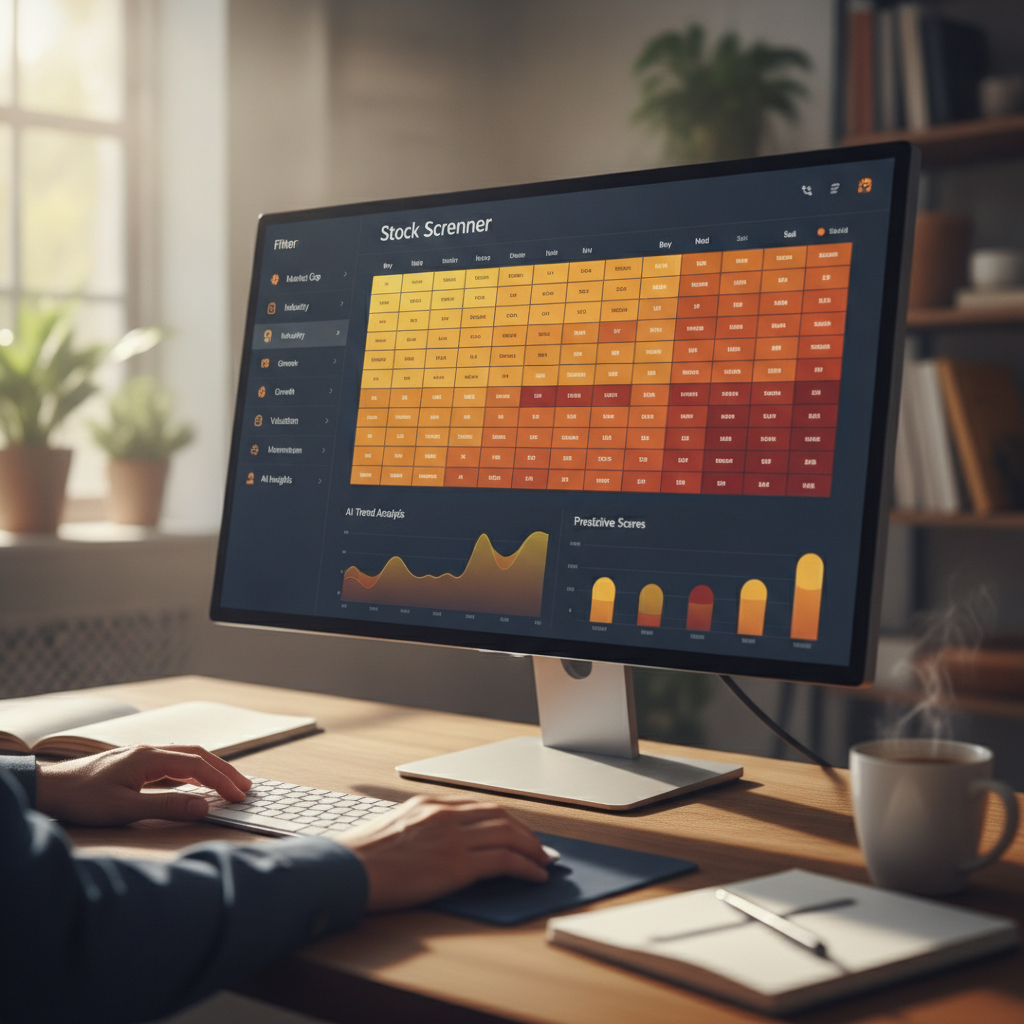
No. As of 2026, Finviz's screener remains filter-driven with dropdowns and numeric ranges rather than a natural-language chat interface. However, it includes dedicated AI-industry categories so you can screen for AI-sector companies with precision, and its API (Elite) is widely used to feed external AI models.
How Investors Use Finviz Inside AI-Powered Workflows
Here's where the story gets interesting. Even without generative AI baked into the UI, Finviz has become a foundational data layer for AI-driven trading pipelines. Developers, quants, and even sophisticated retail investors use Finviz as their screening and news source, then apply machine learning on top.
A widely referenced GitHub project uses the finvizfinance API alongside NLTK's VADER sentiment engine to pull screened tickers and their associated news headlines, then compute sentiment scores that inform buy/sell decisions. This pattern — Finviz for screening and raw data, external ML for sentiment and alpha — is now standard in systematic retail quant setups.
A typical hybrid AI workflow
- Screen in Finviz: Use fundamental and technical filters to narrow 10,000+ tickers down to 30-100 candidates.
- Export via Elite API: Pipe the filtered list into a Python or spreadsheet workflow.
- Layer sentiment analysis: Run NLP on associated headlines, earnings calls, or SEC filings.
- Rank with a composite score: Combine Finviz's technical/fundamental data with sentiment and volatility signals.
- Execute or watchlist: Feed the top-ranked names back into your broker or Finviz portfolio.
This hybrid approach is often more flexible than an all-in-one AI screener because it lets you customize the ML layer to your own edge.
Finviz vs. AI-First Screeners: A 2026 Comparison
To pick the right stock screener with AI features, compare Finviz side-by-side with the leading AI-first alternatives on the metrics that actually affect your day-to-day process.
| Platform | Core AI Feature | Best For | Starting Price |
|---|---|---|---|
| Finviz | AI-industry classifications + API for external ML | Fast visual screening, US equities, hybrid workflows | Free / $39.50 Elite |
| Trade Ideas | Holly AI — ML-generated real-time trade ideas | Active day traders wanting automated setups | ~$118/month |
| Deepvue | Conversational AI, auto-generated reports | Growth/momentum & CANSLIM traders | Freemium tiers |
| TrendSpider | Auto-detected patterns, no-code backtesting | Technical traders needing automation | ~$39/month |
| VectorVest | Proprietary buy/hold/sell rating system | Less-experienced investors wanting guidance | ~$69/month |
| Koyfin | Macro dashboards, document search | Fundamentals-driven professional investors | Free / paid tiers |
How to Choose the Right Stock Screener With AI Features
The "best" tool depends on three variables: your investment style, your technical comfort level, and your budget. Here's a practical decision framework.
Step 1: Define your investing style
- Long-term fundamentals investor: Prioritize deep financial data, global coverage, and document search. Finviz (fundamental filters) plus a platform like TIKR or Koyfin.
- Swing/momentum trader: Prioritize technical filters, chart pattern detection, and real-time data. Finviz Elite plus TrendSpider or Deepvue.
- Day trader: Prioritize ML-generated setups and intraday scanning. Trade Ideas (Holly AI) with Finviz for confirmation.
- Systematic/quant retail: Prioritize API access and custom ML. Finviz Elite API plus your own Python pipeline.
Step 2: Match AI features to real pain points
Don't buy AI for AI's sake. If your bottleneck is idea generation, an ML idea engine helps. If it's information overload, sentiment tools help. If it's speed of screening, a fast filter-based screener with an API — like Finviz — often outperforms flashier alternatives.
Step 3: Test the free tier first
Every major stock screener with AI features offers either a free tier or trial. Run the same investment thesis through two or three platforms and compare the shortlist quality before committing to an annual subscription.
Finviz's free tier is the most cost-effective entry point, offering multi-criteria screening, heatmaps, AI-industry classifications, and portfolio tools at no cost. For AI-generated trade ideas, TrendSpider (~$39/month) is among the cheapest ML-enabled options, while Trade Ideas' Holly AI sits at the premium end (~$118/month).
Building an AI-Augmented Screening Workflow With Finviz
Let's get concrete. Here's a five-step workflow that turns Finviz — a mostly rule-based tool — into a fully AI-augmented research engine.
- Define your thesis. Example: "Find mid-cap AI infrastructure companies with strong revenue growth and improving margins."
- Build the base screen in Finviz. Filter by Industry = "AI — Cloud & Infrastructure," Market Cap = mid, EPS growth > 20%, gross margin > 40%. Save the screen.
- Export the ticker list. Use Finviz Elite's export or API to pull the shortlist into your workflow (Excel, Google Sheets, or Python).
- Layer AI sentiment. Feed each ticker's recent headlines through an NLP tool (VADER, GPT-based summarizer, or a commercial sentiment API) and score each.
- Rank and act. Sort by a composite of fundamentals + sentiment + technical momentum. Move the top 5-10 into a Finviz portfolio for daily monitoring.
This workflow gives you the flexibility of AI without abandoning the visual speed and reliability of Finviz. It's also portable — you can swap the AI layer as tools evolve without re-learning a new screener.
The Future of AI in Stock Screening: What to Expect Beyond 2026
The direction of travel is clear. Expect the following shifts over the next 24-36 months:
- Native natural-language screening everywhere. Even traditionally filter-driven platforms will add "ask a question" interfaces powered by LLMs trained on financial data.
- Real-time alternative-data integration. Satellite imagery, credit card panel data, and web-scraped signals will be surfaced in mainstream screeners.
- Personalized ranking models. Instead of one-size-fits-all screens, platforms will learn each user's picking behavior and tune results accordingly.
- Multi-asset AI screening. Options flow, crypto, and futures will merge into unified AI-driven scanners.
- Explainable AI signals. Regulators and users alike will demand that ML-generated ideas come with clear rationale — not just black-box confidence scores.
Finviz's positioning — deep data, fast UI, open API — makes it well-suited to remain the workhorse layer under many of these AI-augmented workflows, whether or not it adds a native chatbot.
Frequently Asked Questions
What is the best stock screener with AI features in 2026?
There is no single "best" — it depends on your style. Finviz is the most-used and most flexible for hybrid workflows thanks to its free tier, deep filters, and Elite API. Trade Ideas leads for ML-generated day-trading setups, TrendSpider for automated technical analysis, and Deepvue for growth-oriented conversational AI research.
Does Finviz use artificial intelligence in its screener?
Finviz's screener remains primarily rule-based rather than AI-driven. However, it includes dedicated AI-industry classifications (AGI, cloud infrastructure, compute, domain-specific AI, and more) and its Elite API is widely used to feed external AI and sentiment models — making it a common backbone for AI-augmented workflows.
Can I use a free stock screener with AI features?
Yes. Finviz's free tier offers robust multi-criteria screening, heatmaps, AI-industry categories, insider data, and portfolio tools with no cost. For AI-generated ideas specifically, some platforms like Deepvue offer freemium tiers, though the most powerful AI features typically sit behind paid subscriptions.
How do I add AI sentiment analysis to my Finviz workflow?
Export your Finviz screen (via CSV or the Elite API), then run each ticker's recent headlines through an NLP tool such as NLTK's VADER, an LLM-based summarizer, or a commercial sentiment API. Score each stock, combine the sentiment score with Finviz's technical and fundamental data, and rank your shortlist accordingly.
Is a stock screener with AI features worth paying for?
For active traders whose income depends on finding setups quickly, yes — the time saved often exceeds the subscription cost within the first few trades. For long-term investors, a free screener like Finviz plus occasional external AI analysis is usually sufficient. Always test a free tier or trial before committing.
Conclusion: Choose the Workflow, Not Just the Tool
The market for a stock screener with AI features in 2026 is richer and more fragmented than ever. AI-first platforms like Trade Ideas, Deepvue, and TrendSpider offer genuine machine-learning capabilities that can accelerate specific trading styles. But the most durable choice for most investors is a flexible, fast, data-rich screener that plays well with the broader AI ecosystem — and that's exactly where Finviz continues to excel.
Whether you're screening for AI-industry leaders, building a systematic quant pipeline, or simply looking for a faster way to spot momentum, Finviz's free and Elite tiers give you the foundation to build an AI-augmented workflow that fits your style — not the other way around.
Ready to build your own AI-augmented screening workflow? Start exploring the full range of filters, heatmaps, and AI-industry categories at Finviz.com and see how quickly you can go from thesis to shortlist.