Email Newsletter Advertising Cost: Full 2025 Guide
May 17, 2026 · 13 min read

TL;DR — The Bottom Line
Email newsletter advertising cost varies widely — from $25 per placement in small indie newsletters to $10,000+ for a single hero slot in a major publisher's list. Pricing is driven by audience size, engagement rates, niche specificity, and ad format. For brands targeting engaged, high-intent readers, newsletter advertising consistently delivers stronger ROI than most digital alternatives. This guide breaks down every pricing model, benchmark, and decision factor you need to plan a smart campaign.
Quick Facts
- Typical CPM range (B2C newsletters): $20–$40 per 1,000 subscribers
- Typical CPM range (niche B2B newsletters): $40–$100+ per 1,000 subscribers
- Small newsletter flat fees (1k–10k subs): $25–$150 per placement
- Mid-sized publisher hero slot (100k subs, $30 CPM): ~$3,000 per send
- Average email open rate (engaged newsletters): 30–50%
- Most common pricing model: Flat fee per placement
If you've been researching email newsletter advertising cost, you already know one thing: the numbers vary enormously. A sponsored slot in a 2,000-subscriber cooking newsletter might cost $50. A premium placement in a 500,000-subscriber business intelligence newsletter can command $15,000 or more. Understanding what drives that gap — and knowing where your brand fits — is the difference between an efficient campaign and wasted budget.
This guide is designed for marketing teams, brand managers, and business owners who want a clear, data-backed picture of newsletter ad pricing. Whether you're a B2C brand looking to reach passionate consumers or a B2B company targeting decision-makers, you'll find the benchmarks, pricing models, and strategic advice you need to move forward with confidence.
Why Newsletter Advertising Is Experiencing a Renaissance
Before diving into the numbers, it's worth understanding why so many brands are actively increasing their email newsletter advertising cost budgets right now. Several macro trends have converged to make newsletter advertising more attractive than at any point in the past decade.
Social media platforms continue to reduce organic reach, making paid adjacency in editorial content more valuable. Third-party cookies are being phased out across browsers, pushing marketers toward first-party audience channels. And as consumers grow increasingly fatigued by display advertising, the native, editorial feel of a newsletter sponsorship cuts through in ways that banner ads simply cannot.
Research suggests that newsletter subscribers — by definition — are people who have actively opted in to receive content from a publisher they trust. That voluntary relationship creates an environment where advertising feels contextually relevant rather than intrusive. For brands, this means higher engagement rates, stronger brand recall, and better conversion performance compared to most other digital formats.
Newsletters also offer something that social media and programmatic display cannot: demographic precision. When you advertise in a specific newsletter, you know exactly who is reading it. That level of audience certainty has real monetary value — and it's one reason why email newsletter advertising cost in premium, niche publications commands a significant premium over commodity digital inventory.
Email Newsletter Advertising Cost: The Main Pricing Models
Understanding email newsletter advertising cost starts with understanding the pricing models publishers use. There is no single universal standard — different publishers use different structures, and knowing which model a given newsletter uses will dramatically affect how you budget and evaluate performance.
Flat Fee Per Placement
This is the most common pricing model for niche editorial newsletters, including mid-sized media publishers. Advertisers pay a fixed amount per newsletter issue for a specific ad slot — typically categorized as hero/top, mid-newsletter, or footer placement.
Flat fees are straightforward to budget and easy to compare across publishers. They are particularly prevalent among newsletters that have stable, predictable subscriber counts and well-established open rates. For advertisers, flat fees eliminate uncertainty; you know your cost before the campaign runs.
CPM — Cost Per Thousand
CPM pricing is standard among larger publishers and ad networks. There are two variants that are important to distinguish:
- Subscriber-based CPM: Price is calculated against total subscriber count, regardless of how many people actually open the email. This is simpler but less reflective of true reach.
- Open-based CPM: Price is calculated against the number of verified opens, giving advertisers a better sense of actual impressions delivered. This model has grown in popularity as publishers seek to demonstrate value beyond raw list size.
It's worth noting that Apple's Mail Privacy Protection (MPP), introduced in 2021, has complicated open-rate tracking by pre-loading email content and inflating open metrics. As a result, some publishers have shifted to click-based or hybrid measurement approaches when setting email newsletter advertising cost expectations with buyers.
CPC and CPA — Performance-Based Pricing
Cost-per-click and cost-per-acquisition models are less common in premium editorial newsletters but are increasingly available through aggregator platforms and newsletter ad networks. These models transfer more risk to the publisher and more accountability to the advertiser. They tend to work well for direct response campaigns — SaaS free trials, DTC offers, lead generation — where a clear conversion event can be tracked.
Hybrid and Custom Deals
Many premium publishers offer hybrid arrangements: a flat fee base with a performance bonus if a click threshold is met, or a discounted pilot rate for a first-time advertiser willing to commit to a multi-issue test. These structures are common when building new advertiser relationships and can represent excellent value if the audience is the right fit for your brand.
For brands new to newsletter advertising, flat fee placements in mid-sized, niche newsletters offer the most predictable cost structure and the easiest performance benchmarking. Start with a single-issue test, measure clicks and any downstream conversions, then scale based on real data before committing to CPM-based network buys.
Benchmark Costs by Newsletter Size and Niche
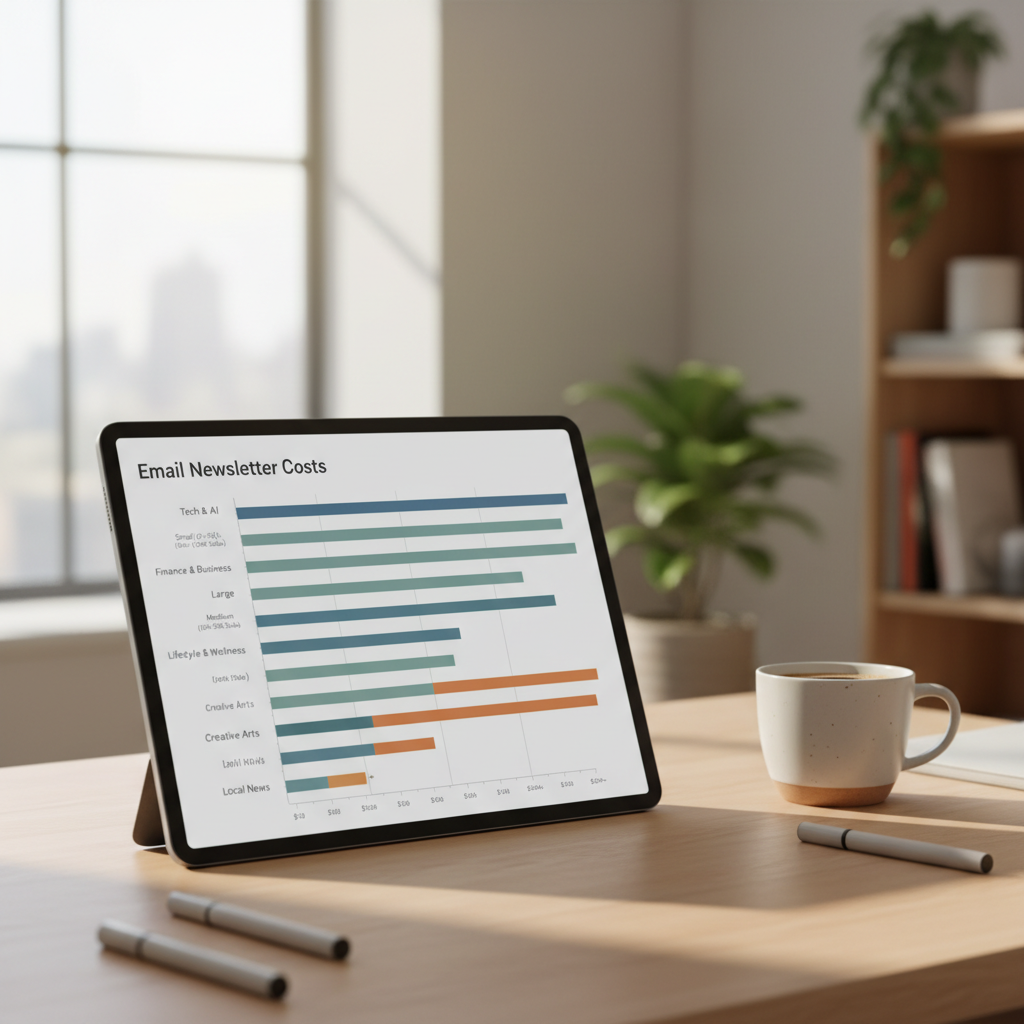
One of the most practical ways to understand email newsletter advertising cost is to look at real market benchmarks across different publisher tiers. These ranges are directional — actual pricing depends heavily on audience quality, niche specificity, and the publisher's track record — but they give you a solid anchor for evaluating any specific opportunity.
Small Newsletters: 1,000–10,000 Subscribers
Small newsletters often represent exceptional value for niche brands and local or regional advertisers. Typical pricing in this tier:
- Top/hero placement: $50–$150 per issue
- Mid-newsletter placement: $25–$90 per issue
- Footer placement: $15–$50 per issue
- Implied CPM (subscriber-based): $20–$50+
Research suggests that small newsletters with highly targeted audiences — say, a newsletter for independent auto shop owners, or one focused on classic car investing — can command CPMs at the high end of or above these ranges, because the audience is so precisely defined and purchase-ready.
Mid-Sized Editorial Newsletters: 10,000–250,000 Subscribers
This is the tier where most serious publisher brands operate, including the kinds of engaged-audience newsletters that brands like Donut Media produce. Pricing becomes more standardized at this level, and publishers often have formal rate cards.
- B2C / prosumer CPM (subscriber-based): $20–$40
- High-intent B2B or niche professional CPM: $40–$100+
- Example: A newsletter with 100,000 subscribers at a $30 CPM yields a hero placement cost of approximately $3,000 per send
- Open-based CPM example: 100,000 subscribers × 40% open rate = 40,000 opens × $70 CPM = $2,800 per placement
For automotive, enthusiast, and lifestyle newsletters targeting a passionate, brand-loyal audience — the kind Donut Media reaches — email newsletter advertising cost at the $40–$80 CPM range for hero placements is realistic and well-supported by market data. Brands in the auto industry, aftermarket accessories, tools, insurance, and adjacent categories can expect strong engagement from this demographic.
If you're evaluating specific newsletter sponsorship opportunities, our guide on newsletter sponsorship opportunities with Donut Media walks through the formats, audience data, and packages available in detail.
Large Publishers and Networks: 250,000+ Subscribers
At the top tier — Morning Brew, The Hustle, large B2B publisher networks — pricing reflects both scale and brand equity:
- CPM (subscriber-based): $40–$120+ depending on vertical
- Finance, SaaS, C-suite leadership niches: Often $80–$120+ CPM
- Single hero placements: Can exceed $10,000–$20,000 per send at major publishers
At this scale, most publishers also offer multi-send packages, co-branded content, and cross-channel bundles that can reduce the effective email newsletter advertising cost per impression significantly.
The Factors That Drive Email Newsletter Advertising Cost Up or Down
Two newsletters with identical subscriber counts can have dramatically different price tags. Understanding the variables that drive email newsletter advertising cost helps you evaluate whether a given rate is fair — and helps publishers understand how to position their inventory.
Audience Quality and Specificity
A list of 50,000 car enthusiasts who actively modify their vehicles is worth far more per subscriber to an aftermarket parts brand than a general-interest list of 50,000 people who once clicked on a car article. Purchase intent, hobbyist depth, and audience income level all feed directly into premium pricing.
Engagement Metrics
Open rates and click-through rates are the clearest signal of audience health. A newsletter with 100,000 subscribers but a 15% open rate is delivering fewer real impressions than one with 60,000 subscribers at a 45% open rate. Publishers with strong engagement data — consistently above 30% opens, with click rates above 2–3% — can and should charge a premium. Advertisers evaluating email newsletter advertising cost should always ask for engagement data, not just subscriber counts.
Ad Placement Position
Position matters enormously. Hero placements at the top of the newsletter — often featuring the brand logo, a headline, and a primary CTA — command 2x to 5x the price of footer placements. Mid-newsletter placements fall in between. If budget is tight, a mid-placement in a highly engaged newsletter often outperforms a hero slot in a less engaged one.
Exclusivity and Category Protection
Some publishers offer category exclusivity — guaranteeing that no competing brands advertise in the same issue. This premium is worth paying for brands in competitive categories like auto insurance, finance apps, or performance automotive products, where appearing alongside a rival would dilute impact.
Production and Creative Requirements
Simple text-based ad units cost less to produce and are often preferred by readers for their native feel. Rich media, custom HTML, or fully designed sponsor sections require more production effort and may carry production fees on top of the placement cost.
How to Evaluate Whether the Price Is Worth It
Knowing the benchmarks for email newsletter advertising cost is useful, but the real question is always: will this placement pay for itself? Here's a practical framework for evaluating any newsletter advertising opportunity before you commit budget.
Step 1: Request Full Audience and Engagement Data
Ask the publisher for: total verified subscribers, average open rate (last 90 days), average click-through rate, and any demographic data they can share. Be cautious of publishers who can only provide top-line subscriber numbers without engagement metrics.
Step 2: Calculate Your Effective CPM
If the publisher quotes a flat fee, convert it yourself. Divide the flat fee by the number of subscribers (or opens) and multiply by 1,000. Compare this to the market benchmarks above. If a publisher is quoting $5,000 for a list of 10,000 subscribers, that's a $500 CPM — astronomical for any category. If they're quoting $2,500 for 100,000 subscribers, that's $25 CPM — very competitive.
Step 3: Model Your Conversion Economics
Even if the email newsletter advertising cost looks high on a CPM basis, it may be justified if the audience converts at an above-average rate. Take your expected open rate, multiply by your expected click-through rate, and then apply your typical landing page conversion rate. If the math produces an acceptable cost-per-acquisition, the placement is worth testing.
Step 4: Start with a Single-Issue Test
Never commit to a long-term multi-send package before testing a single issue. Most reputable publishers will accommodate a one-off test at the standard rate card. Use that test to gather your own click and conversion data before scaling.
Step 5: Negotiate Multi-Send Packages
Once you have positive test data, negotiate. Publishers almost universally offer discounts for multi-send commitments — often 10–25% off for 4-issue or 8-issue packages. This is where you lock in value and build the audience familiarity that compounds newsletter advertising performance over time.
Research suggests that well-crafted newsletter ad placements in engaged, niche publications typically generate click-through rates of 1–4% of openers. Hero placements with strong creative and a compelling offer can push above 4%. Footer placements or generic offers may fall below 1%. Always ask a publisher for historical advertiser CTR data before committing budget to understand what email newsletter advertising cost translates to in actual traffic.
Comparing Newsletter Advertising to Other Digital Channels
When budgeting for email newsletter advertising cost, it helps to benchmark newsletter advertising against the digital channels competing for the same dollars.
| Channel | Typical CPM | Engagement Quality | Audience Targeting | Brand Safety |
|---|---|---|---|---|
| Programmatic Display | $2–$10 | Low (banner blindness) | Broad, cookie-based | Variable |
| Social Media Ads | $6–$30 | Medium | Algorithm-based | Medium |
| Search (PPC) | Varies (CPC $1–$50+) | High (intent-driven) | Keyword-based | High |
| Podcast Ads | $20–$50 | High (host-read) | Show-level | High |
| Newsletter (B2C niche) | $20–$40 | Very High | Editorial / demographic | Very High |
| Newsletter (B2B niche) | $40–$100+ | Very High | Professional / role-based | Very High |
The table above illustrates a consistent truth: newsletter advertising cost is not cheap on a CPM basis compared to programmatic display, but it is competitive with — and often superior to — podcast and social formats when you factor in engagement quality and audience certainty. For brands where the audience match is strong, newsletter advertising frequently delivers the best cost-per-qualified-click of any channel.
For a deeper look at the mechanics of newsletter placements and creative strategy, our comprehensive resource on how to advertise in newsletters covers everything from ad copy best practices to negotiating your first deal.
Advertising in Engaged Enthusiast Newsletters: The Donut Media Advantage
Not all newsletter audiences are created equal, and for brands targeting passionate consumers or automotive enthusiasts, the quality of the reader relationship matters as much as scale. Newsletters built around high-trust editorial brands — where readers show up consistently, share content, and act on recommendations — command premium email newsletter advertising cost for good reason.
Donut Media's newsletter properties reach an audience of deeply engaged car enthusiasts, many of whom are active buyers of automotive products, accessories, insurance, and lifestyle gear. Research suggests that automotive enthusiast audiences skew toward higher disposable income and stronger category involvement than general consumer audiences — characteristics that directly justify premium CPMs for relevant advertisers.
When evaluating the email newsletter advertising cost for any enthusiast or lifestyle newsletter, consider the lifetime value of the customer you're reaching, not just the cost-per-click. A reader who is actively passionate about their vehicle and regularly spends on modifications, maintenance, and accessories is worth far more per impression than a casual browser who clicked a display ad.
This is the calculus that makes niche, engaged newsletter audiences — like those Donut Media has built — a high-value advertising channel for automotive brands, aftermarket parts companies, insurance providers, tools and equipment brands, and any product that resonates with an audience that takes their hobby seriously.
What is the average cost of advertising in an email newsletter?
The average email newsletter advertising cost depends heavily on list size and niche. Small newsletters (1,000–10,000 subscribers) typically charge $25–$150 per flat-fee placement. Mid-sized publishers (10,000–250,000 subscribers) generally price between $20–$100 CPM, translating to $500–$5,000+ per hero placement depending on scale. Large publisher networks can charge $10,000–$20,000 or more for a single send to a premium list.
What is a CPM in newsletter advertising, and how is it calculated?
CPM stands for cost per thousand — the price an advertiser pays for every 1,000 subscribers (or opens) who receive the ad. To calculate it: divide the total placement cost by the number of subscribers (or opens), then multiply by 1,000. For example, a $3,000 placement in a newsletter with 100,000 subscribers equals a $30 CPM. Open-based CPM uses actual open counts rather than total subscribers for a more precise measure of real impressions.
Is newsletter advertising worth the cost compared to social media ads?
For most brands targeting specific, defined audiences, newsletter advertising delivers superior engagement quality and brand safety compared to social media advertising at comparable CPMs. Social media ads ($6–$30 CPM) reach a broader audience but with lower intent and higher ad-fatigue. Newsletter advertising ($20–$100+ CPM) reaches opted-in readers in a trusted editorial context, typically producing stronger click-through rates and better brand recall. The ROI case is especially strong when the newsletter's audience aligns closely with your product category.
How should I negotiate email newsletter advertising rates?
Start by requesting a media kit and full engagement metrics — open rates, click-through rates, and subscriber demographics. Calculate the effective CPM yourself and compare it to market benchmarks. For a first campaign, negotiate a single-issue test at the standard rate before committing to a package. Once you have positive performance data, negotiate a multi-send package — most publishers offer 10–25% discounts for 4-issue or longer commitments. Always ask about category exclusivity if you're in a competitive vertical.
Conclusion: Making Email Newsletter Advertising Cost Work for Your Brand
Email newsletter advertising cost is not a single number — it's a spectrum shaped by audience size, engagement quality, niche specificity, ad format, and the competitive dynamics of your category. The range runs from $25 flat fees in small indie publications to $20,000+ hero placements in major media newsletters, with the most compelling value for most brands sitting in the mid-market: niche editorial newsletters with 50,000–250,000 highly engaged subscribers at CPMs of $30–$80.
The most important principle to take away: email newsletter advertising cost per impression is only meaningful when divided by audience quality. A $5,000 placement that reaches 50,000 deeply engaged car enthusiasts who actively buy products in your category will outperform a $500 placement in a disengaged general-interest list almost every time. Invest in fit, not just reach.
Whether you're a B2C brand looking to drive product awareness and sales among passionate consumer communities, or a B2B company seeking to put your message in front of decision-makers who trust the publications they read, newsletter advertising in 2025 offers one of the strongest value propositions in digital media.
Ready to explore what newsletter advertising can do for your brand? Donut Media works with advertisers across automotive, lifestyle, tools, insurance, and adjacent categories to build campaigns that connect with genuinely engaged audiences. Reach out to our partnership team to discuss placement options, audience data, and custom campaign structures designed around your goals.