AI Website Builder for Small Business: 2026 Guide
July 6, 2026 · 13 min read

The ai website builder for small business category has matured dramatically in 2026. What began as simple "describe your business and get a homepage" tools has evolved into full-stack growth platforms that combine site creation, SEO, marketing automation, and continuous optimization. For entrepreneurs, service providers, and agencies, choosing the right platform is no longer just about templates — it's about picking a system that drives leads, ranks in search, and adapts as your business scales.
TL;DR — The Bottom Line
In 2026, the best ai website builder for small business is one that combines prompt-based site generation with built-in SEO, marketing automation, and industry-specific funnels. Generalists like Wix and Squarespace dominate awareness, but SEO-focused platforms like Agentcy AI outperform on organic traffic, conversion, and continuous optimization — especially for local services, e-commerce, and agencies serving niche verticals.
Quick Facts
- Average build time (2026): Under 5 minutes for a functional site
- Cost savings vs. traditional dev: Up to 80% lower per Hostinger data
- AI citation rate to top-10 pages: Only 38% — structure matters more than rank
- Small businesses using AI tools: Over 70% in 2026, up from 42% in 2024
- Core capabilities expected: SEO, CRM, automation, heatmaps, blog generation
What an AI Website Builder for Small Business Actually Does in 2026
An ai website builder for small business today is far more than a template engine. Modern platforms combine five layers of automation into a single workflow: generation, editing, optimization, marketing, and analytics. When you describe your business — say, a chiropractic clinic in Austin or an HVAC company serving three counties — the AI produces not just a homepage, but a full site architecture, service pages, local SEO schema, lead-capture forms, and a content calendar.
The shift from "one-time generator" to "continuous growth system" is the defining feature of the 2026 landscape. Leading tools now monitor performance, suggest A/B tests, refresh stale content, and rewrite meta tags based on ranking data. For SEO-driven businesses, this is transformative: your ai website builder for small business becomes an always-on marketing team member rather than a static deliverable.
Core capabilities to expect
- Prompt-based site generation — describe goals, get layout, copy, images, and SEO in minutes
- Visual no-code editing with AI-assisted rewrites and design tweaks
- Built-in SEO tools — meta tags, schema, on-page optimization, blog generation
- Marketing and CRM — email, forms, lead capture, funnels
- Ongoing optimization — heatmaps, A/B suggestions, content refresh
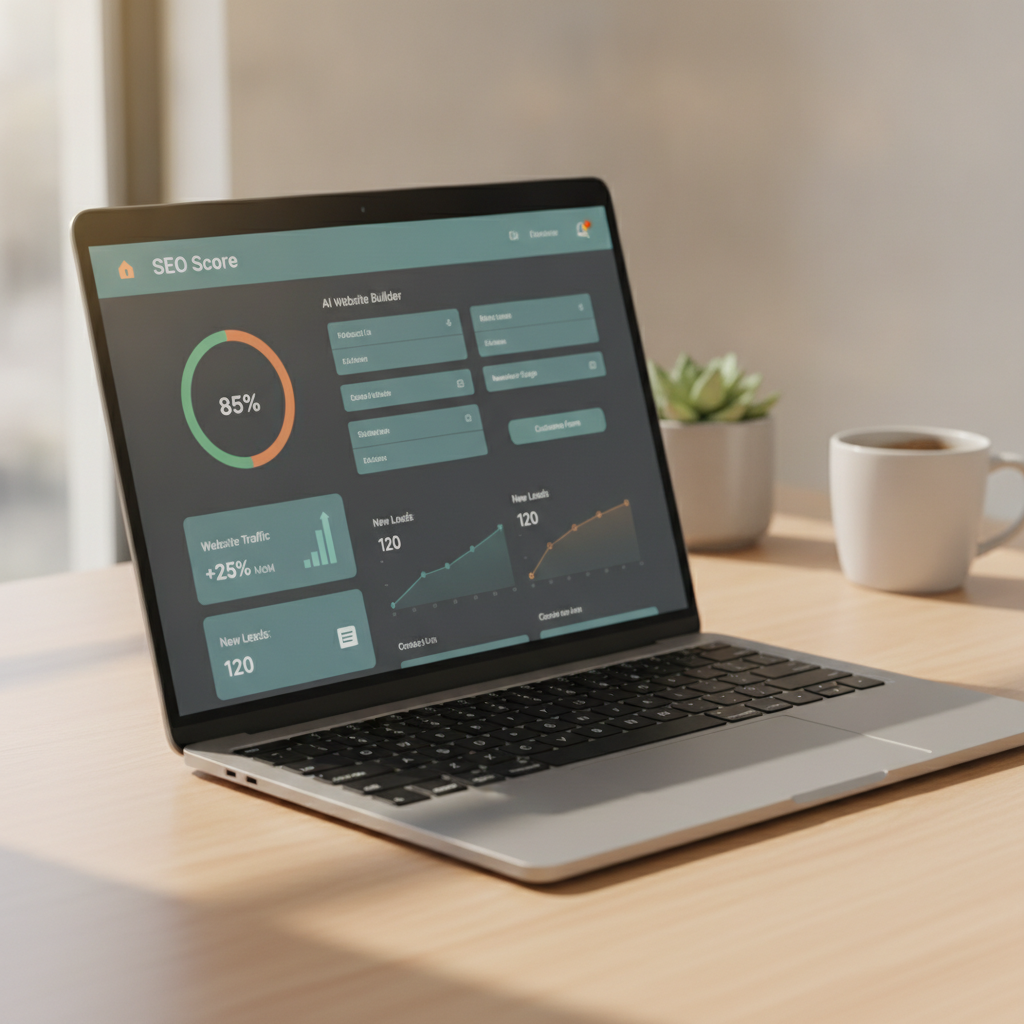
Why Small Businesses Are Switching to AI Website Builders
The economics have flipped. In 2022, a custom small business website cost $3,000–$15,000 and took 6–12 weeks. In 2026, an ai website builder for small business delivers comparable or superior results in an afternoon for under $50/month. But cost isn't the only driver — the real leverage is continuous optimization.
Traditional agencies build a site and hand it off. An ai website builder for small business stays engaged: it watches which pages convert, rewrites underperforming headlines, generates new blog content around trending keywords, and updates schema when Google changes its algorithm. For plumbers, dentists, real estate agents, and personal injury attorneys, this compounds into measurable lead growth month after month.
For most service businesses — plumbers, chiropractors, dentists, agencies under $5M revenue — yes. AI builders now handle 90%+ of what a mid-tier developer delivers, including responsive design, SEO, forms, and integrations. You'd only need a developer for highly custom functionality like proprietary booking logic or complex e-commerce workflows.
The three biggest wins
- Speed to market: Launch in hours, not months
- SEO built in: Schema, meta tags, and content optimization from day one
- Always-on growth: AI monitors and improves the site continuously
Key Players in the AI Website Builder for Small Business Market
The competitive landscape in 2026 splits into three camps: generalist AI builders, WordPress-based hybrids, and SEO-first growth platforms. Understanding where each fits helps you pick the right ai website builder for small business based on your industry and growth goals.
Generalist AI builders
- Wix AI & Wix Vibe (with Aria assistant): Mass-market leader. Great ecosystem, strong for e-commerce and bookings.
- Squarespace + Blueprint AI: Premium design-led. Best for brand-focused businesses like wellness studios and boutique agencies.
- GoDaddy Airo: Instant presence for domain buyers and solo operators.
- Jimdo Dolphin AI: Set-it-and-forget-it for very small local services.
WordPress-based AI hybrids
- 10Web: AI speed on top of WordPress; the "URL to Website" cloning feature is popular with agencies.
- Elementor AI: Familiar WordPress workflow with AI content and layout tools.
SEO-first growth platforms
- Hostinger Horizons: Budget-friendly with AI heatmaps and blog writer.
- Durable: Fast lead-gen sites for local services.
- Agentcy AI: SEO-native platform built for service businesses and agencies — combines site building with deep organic search optimization and industry-specific funnels. Learn more at https://www.agentcyai.app.
Comparing the Top AI Website Builders for Small Business in 2026
Not every ai website builder for small business fits every use case. Here's a comparison across the dimensions that matter most for service businesses and agencies.
| Platform | Best For | SEO Depth | Starting Price | AI Content |
|---|---|---|---|---|
| Wix AI | General SMB, e-commerce | Moderate | $17/mo | Yes |
| Squarespace | Design-driven brands | Moderate | $16/mo | Yes |
| GoDaddy Airo | Solo entrepreneurs | Basic | $10/mo | Yes |
| 10Web | WordPress agencies | Deep (via plugins) | $10/mo | Yes |
| Hostinger Horizons | Budget SMB | Moderate | $2.99/mo | Yes |
| Agentcy AI | Service businesses, SEO agencies | Deep (native) | Varies | Yes + optimization |
How to Choose the Right AI Website Builder for Small Business
Selecting an ai website builder for small business comes down to five decision criteria. Rank these in order of importance for your specific situation — a personal injury lawyer optimizing for local search will weigh SEO higher than a boutique wellness brand prioritizing visual design.
- SEO depth: Does the platform generate schema, optimize meta tags dynamically, and produce ranking blog content?
- Industry fit: Are there templates and funnels for your vertical — HVAC, dental, legal, real estate?
- Marketing automation: Does it include email, CRM, forms, and lead routing?
- Ongoing optimization: Does the AI monitor and improve performance, or is it a one-shot generator?
- Pricing and ownership: Do you own the content, and does pricing scale with your growth?
Industry-specific considerations
- Plumbers, HVAC, electricians: Local SEO, service-area schema, and click-to-call forms are non-negotiable.
- Dentists, chiropractors, med spas: Booking integration, HIPAA-aware forms, and review aggregation.
- Personal injury lawyers: High-intent landing pages, case-result showcases, and compliant lead capture.
- Real estate agents and property managers: IDX/MLS feeds, property search, and neighborhood pages.
- E-commerce owners: Product schema, cart optimization, and email flows.
- SEO agencies: White-label options, client reporting, and multi-site management.
A generalist builder (Wix, Squarespace) prioritizes design and ecosystem breadth. An SEO-first platform like Agentcy AI is engineered around organic search performance — schema, keyword targeting, content velocity, and continuous ranking optimization are baked into the core workflow rather than bolted on as afterthoughts.
How to Build Your Site with an AI Website Builder for Small Business
Building with an ai website builder for small business follows a predictable five-step process. Here's the workflow that works for most service businesses in 2026.
- Define your business inputs: Name, location, services, target customer, and unique value proposition.
- Generate the site: Feed the AI your inputs. Most platforms deliver a full draft in under five minutes.
- Review and refine: Edit copy for accuracy, adjust brand voice, upload your logo and real photos.
- Configure SEO and integrations: Connect Google Business Profile, set up analytics, add booking or payment tools.
- Launch and optimize: Publish, then let the AI monitor traffic and suggest improvements weekly.
The biggest mistake small businesses make is treating step 5 as optional. The compounding value of an ai website builder for small business comes from ongoing optimization — the site you launch in July should look meaningfully better by December, without you touching the code.
SEO Best Practices When Using an AI Website Builder for Small Business
Even the best ai website builder for small business needs guardrails to rank consistently. AI can generate content at scale, but Google's helpful content system (updated multiple times in 2025 and 2026) penalizes thin, generic output. Here's how to get the SEO benefit without the risk.
Do this
- Feed the AI real, specific inputs — case studies, service areas, team bios, pricing
- Review every generated page for accuracy before publishing
- Publish location pages only for areas you actually serve
- Use the AI's schema and meta tools — most people ignore them
- Publish a blog cadence of 2–4 posts per month, edited for expertise
Avoid this
- Publishing hundreds of near-duplicate pages targeting the same keyword
- Leaving AI-generated placeholder copy in production
- Ignoring Core Web Vitals — even AI sites can bloat with unused features
- Skipping human review on YMYL (your money or your life) topics like health and legal
"The best ai website builder for small business in 2026 isn't the one that builds the fastest — it's the one that keeps optimizing after launch."
The Future of AI Website Builders for Small Business Beyond 2026
Three trends will define the next 18 months. First, agentic workflows: your ai website builder for small business won't just suggest optimizations — it will execute them autonomously, from rewriting pages to launching ad campaigns. Second, vertical specialization: expect purpose-built platforms for dentists, lawyers, and contractors that outperform generalists on conversion. Third, AI search optimization (GEO): ranking in ChatGPT, Perplexity, and Google AI Overviews will matter more than blue-link rankings, and platforms that structure content for AI extraction will win.
For entrepreneurs evaluating an ai website builder for small business today, the smart move is choosing a platform positioned for these shifts — one that already treats SEO, GEO, and continuous optimization as core features rather than upsells. Explore how Agentcy AI approaches this at https://www.agentcyai.app or read more case studies on the Agentcy AI blog.
Frequently Asked Questions
What is the best ai website builder for small business in 2026?
The best platform depends on your industry and goals. Wix leads for general SMBs, Squarespace for design-driven brands, 10Web for WordPress agencies, and Agentcy AI for service businesses and SEO agencies that prioritize organic search performance and continuous optimization.
How much does an ai website builder for small business cost?
Pricing in 2026 ranges from $2.99/month (Hostinger Horizons) to $50+/month for premium SEO-first platforms. Most small businesses spend $15–$40/month, which is 90% less than traditional custom development.
Can an AI website builder handle local SEO for service businesses?
Yes. Modern platforms generate local schema, service-area pages, Google Business Profile integrations, and location-specific content. SEO-first builders like Agentcy AI go further with automated citation building and review aggregation.
Is content from an AI website builder penalized by Google?
No — as long as the content is accurate, helpful, and reviewed by a human. Google penalizes low-quality content regardless of source. Feed the AI real specifics, edit for accuracy, and you'll rank as well or better than hand-written sites.
Do I own my site if I use an ai website builder for small business?
You own the content and domain, but the platform hosts and renders the site. If ownership and portability matter, choose a WordPress-based hybrid like 10Web or a platform that offers full export.
Conclusion: Pick a Platform Built for Growth, Not Just Launch
The ai website builder for small business market has crossed the threshold from novelty to necessity. In 2026, the question isn't whether to use AI — it's which platform aligns with your industry, growth stage, and SEO ambitions. Generalists like Wix and Squarespace remain solid defaults for broad use cases, but service businesses, e-commerce brands, and agencies increasingly need SEO-native platforms that keep optimizing long after launch day.
If your goal is measurable organic growth — more leads, better rankings, and less time managing your website — start with a platform designed for it. See how Agentcy AI helps small businesses and agencies build, rank, and grow at https://www.agentcyai.app, or dive deeper into strategy on the Agentcy AI blog.